

A HOA loan west palm beach search often starts with a practical problem: an association has a major repair, reserve obligation or capital project that needs funding before enough cash is available.
For HOA and condominium boards in West Palm Beach and across Palm Beach County, financing can be one way to spread a large community expense over time rather than collecting the entire amount from owners at once. This guide explains when association financing may make sense, what local boards should prepare, how Florida condominium requirements can affect the decision and what to compare before borrowing.
This article provides general educational information, not legal, tax or financial advice. Borrowing authority, voting requirements and owner obligations can depend on Florida law and an association’s governing documents. Boards should have association counsel and qualified financial professionals review a proposed financing arrangement before approval.
Why West Palm Beach associations may need financing
Communities rarely start looking for an association loan because borrowing was part of the original plan. More often, the need appears when the timing of a major expense no longer matches the cash available in reserves.
That can happen to an older condominium building that needs concrete restoration, a coastal property facing waterproofing work or an HOA that discovers several common-area systems need replacement within the same budget cycle.
For a board, the problem isn’t simply whether the association can pay for a project eventually. The harder question is whether it has enough money available when contractors, engineers or building requirements make the work necessary.
Common uses of association financing can include:
- Roof replacement or significant roof repairs.
- Concrete restoration and structural work.
- Waterproofing and exterior building repairs.
- Plumbing or electrical system improvements.
- Elevator modernization.
- Impact windows and exterior doors.
- Seawall or other marine-related work.
- Parking area improvements.
- Required reserve funding where applicable.
TuCielo identifies these types of common-area repairs and capital improvements among the projects that may be considered through its Florida association financing program.
An association loan doesn’t remove the cost of the project. The association still has to repay what it borrows. Financing changes when the money becomes available and how the repayment burden is distributed over time.
That distinction matters when a repair can’t reasonably wait for the association to accumulate several more years of reserves.
A hypothetical West Palm Beach condo scenario
Consider a hypothetical condominium near West Palm Beach with an upcoming exterior restoration project. The association has money in reserves, but using all of it would leave little available for other anticipated building work.
The board might compare three approaches. It could levy a large special assessment, increase assessments and delay part of the project or finance some of the required cost while using reserves for the remainder.
The right choice would depend on more than the project price. The board would also need to look at how quickly the work must start, how much owners would need to pay under each structure, what reserves must remain available and what the association’s governing documents allow.
A palm beach condo association loan may therefore be part of a broader funding plan rather than the sole source of project money.
How an HOA loan in West Palm Beach works
An association loan is taken out by the association for an association responsibility. It differs from a personal loan taken out separately by each homeowner or unit owner.
The association receives funding for an approved purpose and becomes responsible for making the loan payments. It generally needs an assessment or other association revenue sufficient to meet that obligation.
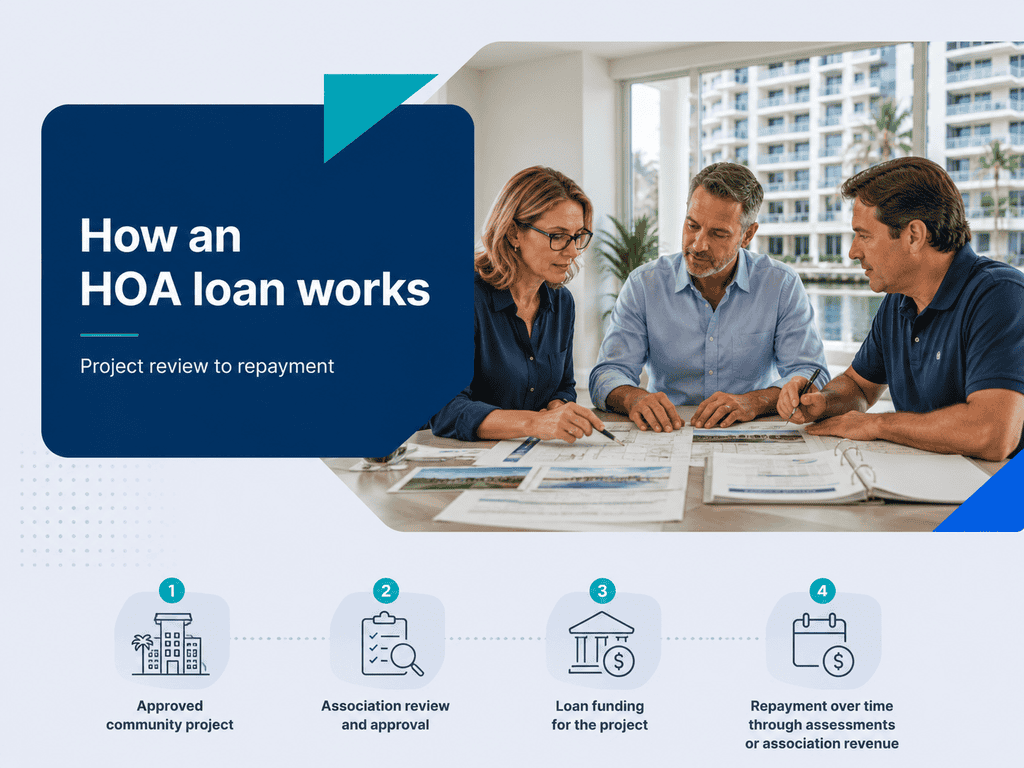
For boards that want a more detailed explanation of the mechanics, TuCielo’s guide to how HOA loans work covers the process from planning through repayment.
A typical evaluation can be broken into several stages.
1. Define the project before discussing financing
Boards should start with the underlying expense rather than with the loan amount.
Collect current information about the project, such as engineering reports, reserve studies, contractor proposals, scopes of work and anticipated project phases. If the cost is still uncertain, the association may not yet know how much financing it actually needs.
This is especially important for restoration projects where an initial inspection can uncover work that wasn’t obvious when the budget was first prepared.
2. Determine how much the association actually needs
Borrowing the full project cost isn’t always necessary.
Suppose an association has usable reserve funds allocated for the project. The board may decide that a combination of reserves and borrowing produces a better result than financing everything.
The calculation should account for more than the contractor’s headline price. Boards may need to consider engineering expenses, permitting, project administration, contingency amounts and any other legitimate project costs identified by the association’s professionals.
The board should also determine whether using existing cash could create a shortage for another scheduled obligation.
3. Confirm the association’s authority
A board shouldn’t assume that the ability to levy assessments automatically gives it unrestricted authority to borrow.
For Florida condominium associations, statutory requirements, the declaration, bylaws and other governing documents may affect the process. The 2026 Florida Condominium Act provisions governing association powers provide part of the statutory framework, but boards should also review their own governing documents.
HOAs organized under Chapter 720 have a different statutory framework. Boards can review the 2026 Florida Homeowners’ Association Act for the rules that apply to homeowners associations.
Association counsel can determine which statutory requirements and governing-document provisions apply to a particular community.
4. Prepare the association for underwriting
The lender is evaluating the association as a borrower. That makes the association’s finances, governance and ability to collect assessments central to the review.
Documents commonly requested can include budgets, financial statements, reserve information, delinquency data, governing documents and project documentation.
Boards preparing for WPB HOA financing can use TuCielo’s HOA loan requirements guide as a practical starting point for organizing the records lenders may review.
A cleaner application doesn’t guarantee approval, but it helps the lender understand the project and the association’s financial position without having to resolve preventable documentation gaps.
5. Establish the repayment plan
A board should know how repayment translates into owner costs before presenting a financing proposal.
If the association borrows money and uses assessments to service the debt, owners ultimately fund those payments through the association. Boards should model how different loan amounts, terms and payment structures affect both the association budget and individual owners.
That analysis should be clear enough to explain at a board meeting without relying on lender terminology.
Palm Beach County condo boards also need to consider inspections and reserves
Financing decisions can be more complicated for condominium associations because Florida’s structural inspection and reserve laws may affect both the timing and amount of required funding.
This has particular relevance in Palm Beach County, where many condominium buildings may be old enough to fall within milestone inspection requirements.
Palm Beach County milestone inspections can create a funding deadline
Palm Beach County states that condominium and cooperative buildings three stories or taller in unincorporated Palm Beach County are subject to mandatory milestone structural inspections, subject to statutory exceptions.
According to Palm Beach County’s mandatory milestone inspection guidance, buildings within three miles of a coastline generally receive their first inspection at 25 years of age. Buildings farther inland follow the schedule established by Florida law and the applicable local jurisdiction.
For an association, the financial issue may arise after the inspection. If the report identifies repairs that need to be completed, delaying the project simply because reserves are insufficient may not be practical.
That is when boards may need to compare existing reserves, a special assessment and outside financing within a relatively short decision window.
SIRS can affect the funding plan
Florida’s Structural Integrity Reserve Study (SIRS) requirements are separate from milestone inspections, although the two can affect the same building.
Under section 718.112 of the 2026 Florida Statutes, qualifying residential condominium associations must have a SIRS completed at least every 10 years for covered buildings that are three habitable stories or higher. The study covers specified components such as the roof, structural elements, fire protection systems, plumbing, electrical systems, waterproofing, exterior painting, windows and exterior doors.
A SIRS also addresses estimated remaining useful life, replacement or deferred maintenance costs and a reserve funding schedule.
For boards considering borrowing, one provision is especially relevant. Florida law allows required reserves for covered components to be funded through regular assessments, special assessments, lines of credit or loans. The statute also says the SIRS must take the association’s selected funding method into account.
If the study was completed before the association approved a special assessment or secured financing, it may need to be updated to reflect the chosen funding method and its effect on the reserve schedule.
Boards working through that issue may also want to review TuCielo’s guide to SIRS funding options in Florida, which explains how different funding methods can fit into a condominium association’s reserve plan.
This is one reason a Palm Beach County condominium board should involve its reserve professional and association attorney before treating a loan as a stand-alone financial decision.
How to compare an association loan with other funding options
The best funding structure depends on what problem the board is trying to solve.
If the association has enough cash and spending it won’t compromise other obligations, borrowing may add unnecessary financing cost. If the project is urgent and reserves are inadequate, waiting several years to accumulate funds may be unrealistic.
A board can begin with this comparison:
| Funding method | When it may fit | Main issue to evaluate |
| Existing reserves | Funds are already available for the permitted purpose | What other scheduled obligations will remain after the withdrawal? |
| Regular assessments | The association has enough time to accumulate funds gradually | How large must the annual budget increase be? |
| Special assessment | The association needs a defined amount and owners can reasonably fund it | How much must each owner pay and when? |
| Association loan | Capital is needed sooner than the association can reasonably collect it | What is the total borrowing cost and repayment obligation? |
| Combination approach | The association wants to limit both borrowing and immediate owner contributions | How do the funding sources interact over the full project timeline? |
A loan shouldn’t automatically be compared only with “doing nothing.” The useful comparison is between complete funding scenarios.
For example, compare a $3 million project funded entirely by a special assessment with a structure that uses part of the association’s available reserves plus a smaller loan. Then compare both with delaying any nonurgent phase while collecting higher regular assessments.
The board should see the cash requirement, owner impact and timing under each scenario.
Look beyond the interest rate
Two financing proposals with different rates can still have very different overall economics.
Boards should review:
- The total principal being borrowed.
- Whether the rate is fixed or variable.
- The repayment period and payment schedule.
- All lender or closing costs disclosed in the proposal.
- Prepayment provisions.
- Collateral or security requirements.
- Financial covenants and reporting requirements.
- What happens if project costs change.
- Whether the repayment schedule fits the association budget.
A lower quoted rate doesn’t automatically make one proposal the better option if other terms create additional cost or inflexibility.
Compare owner impact, not just association-level numbers
A multimillion-dollar project can feel abstract when discussed only at the association level.
Convert each funding structure into an estimated owner-level obligation based on the allocation method required by the association’s documents. Boards can then show owners how an immediate special assessment differs from payments spread over time.
These estimates should be clearly labeled as projections until final project costs, loan terms and assessment allocations are known.
Consider what happens after the immediate project
Boards sometimes focus so closely on today’s repair that they create tomorrow’s budget problem.
Before using most of the association’s available cash, check the reserve study and capital plan for major expenses expected over the next several years. A roof project followed by elevator work or seawall repairs can change the wisdom of using every available reserve dollar today.
Borrowing also has a future effect. Debt service becomes another recurring obligation that needs to fit alongside operating expenses and reserve contributions.
A practical checklist before seeking WPB HOA financing
A board can save time by resolving basic financial and governance questions before requesting proposals.
Use this workflow:
- Confirm the project scope. Obtain current engineering reports, specifications or contractor estimates that explain what work is actually required.
- Separate urgent work from optional improvements. A structural repair may have a different timeline from an amenity upgrade, even if both appear in the same capital plan.
- Review available funds. Identify reserves that are legally and properly available for the project and determine what must remain for other obligations.
- Check governing documents and required approvals. Have association counsel confirm borrowing authority, assessment authority and any membership voting requirements.
- Model the funding gap. Subtract appropriate available funds from the expected project requirement and include reasonable project costs identified by the association’s professionals.
- Compare complete financing scenarios. Evaluate special assessments, regular assessments, loans, lines of credit where applicable and combination approaches rather than looking at one option in isolation.
- Prepare financial records before applying. Organize budgets, financial statements, reserve information, delinquency reports, association documents and supporting project records.
After receiving a financing proposal, the same process should continue. Boards should review the actual agreement rather than assuming the initial illustration represents the final obligation.
For condominium associations subject to SIRS requirements, the board should also verify that the selected funding method remains consistent with the current reserve study and Florida law.
Questions West Palm Beach boards should ask a financing provider
A useful financing conversation should produce specific answers that the board can take back to its attorney, financial adviser or management team.
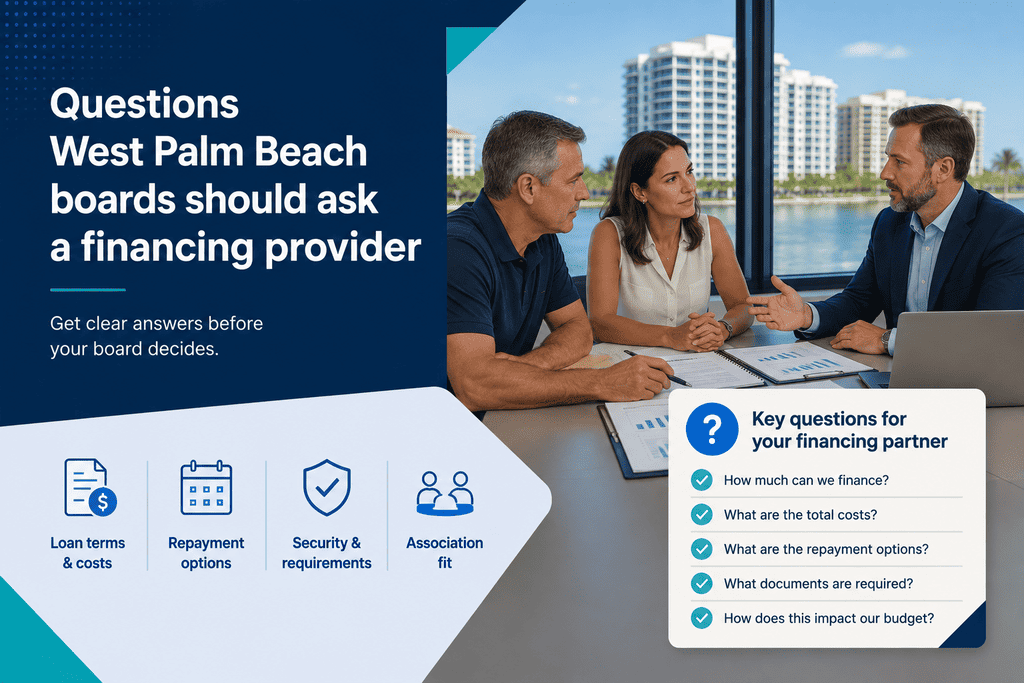
Start with questions such as:
- What information do you need to determine whether our association qualifies?
- How much of the project can potentially be financed?
- Is the interest rate fixed or variable?
- What fees or closing costs apply?
- What term options are available?
- How will repayment be structured?
- What association revenue is expected to support repayment?
- What security or collateral does the financing require?
- Are there prepayment restrictions or charges?
- What financial reporting will the association need to provide after closing?
- Can financing cover only current construction costs or can qualifying reserve obligations also be considered?
- What happens if the final project cost differs from the original estimate?
Boards should request written documentation for material loan terms. Verbal explanations are useful for understanding a proposal, but the signed financing documents determine the association’s actual obligations.
When an association loan may be worth considering
Association financing may deserve closer evaluation when the project needs to begin before the association can reasonably accumulate enough cash.
It can also be useful when collecting the entire project amount through one immediate special assessment would create a difficult timing problem for owners.
That doesn’t make borrowing automatically preferable. Financing introduces interest and other potential costs. A financially strong association with adequate available reserves may determine that paying cash is more economical.
The decision becomes more defensible when the board can explain exactly why the funding method matches the project timeline, reserve position and expected owner impact.
Evaluate financing around the association’s actual project
A West Palm Beach association usually gets a clearer answer when it starts with the project, available reserves and required timeline rather than asking simply how much it can borrow.
Model the funding gap, compare the effect on owners, confirm the association’s legal authority and review the full financing terms before committing. Condominium boards should also make sure the proposed structure aligns with current SIRS and inspection-related obligations when those requirements apply.
Boards in West Palm Beach and elsewhere in Palm Beach County that want to explore association financing can speak with TuCielo about their project, funding need and the information required to evaluate available financing options.
FAQs
Can a West Palm Beach HOA borrow money for repairs?
An HOA may be able to borrow for association expenses, but the board’s authority and approval process depend on its governing documents and applicable Florida law. Boards should have association counsel confirm the required procedure before executing loan documents.
Can a Palm Beach condominium association use a loan for SIRS funding?
Yes, qualifying condominium associations may use loans as one of the funding methods permitted under Florida’s SIRS reserve provisions. The association’s reserve study may also need to be updated to reflect the selected financing and its effect on the funding schedule.
Is an HOA loan taken out by individual homeowners?
No. With association financing, the association is the borrower rather than each homeowner taking out a separate personal loan. TuCielo’s association financing FAQ explains how the association can use financing for major common-area projects and repay the loan over time.
Does borrowing eliminate the need for a special assessment?
Not necessarily. An association may still use an assessment to generate the revenue needed for loan payments, but financing can change the timing of how the project cost is collected. The exact structure depends on the financing agreement and the association’s governing requirements.
What documents are usually needed for a Palm Beach condo association loan?
Lenders commonly review financial statements, budgets, reserve information, governing documents, delinquency information and records describing the project. Requirements vary by lender and association, so boards should ask for a current application checklist before assembling a package.
Should an association use reserves or borrow?
That depends on whether the reserves are available for the project, what other obligations are approaching and what borrowing would cost. Boards should compare the full financial effect of using cash, assessing owners, borrowing or combining those methods rather than choosing solely on the size of the immediate payment.
Does every Palm Beach County condominium follow the same inspection schedule?
No. The applicable schedule can depend on building age, height, location and jurisdiction. Palm Beach County’s milestone inspection information specifically addresses qualifying buildings in unincorporated Palm Beach County, while properties inside municipalities should verify requirements with the appropriate local building authority.