

HOA loan requirements usually cover three areas: the association’s authority to borrow, its ability to repay the debt and the condition and cost of the proposed project. Lenders also need enough documentation to confirm that the board has presented accurate financial, operational and governance information.
This guide is for Florida homeowners’ association boards, condominium association directors and property managers preparing for association financing. By the end, you’ll understand what lenders commonly review, which documents to organize and which issues may delay an application.
What lenders review when an association applies
An HOA loan differs from a personal loan or mortgage. The association applies as the borrower, and the lender evaluates the organization rather than checking every owner as an individual applicant.
The exact underwriting process varies by lender. However, most association loan eligibility reviews examine the same broad questions:
- Does the association have legal authority to borrow?
- Has the board followed the required approval process?
- Can the association collect enough revenue to make the payments?
- Are delinquencies and collection practices manageable?
- Is the proposed project clearly defined and reasonably budgeted?
- Does the association carry appropriate insurance?
- Are its records complete, current and internally consistent?
A lender doesn’t usually make a decision from one financial ratio. It reviews the association as a whole. A reserve shortage, for example, may not automatically prevent financing, but it will affect how the lender evaluates liquidity, project urgency and repayment planning.

The association’s legal authority
The first question is whether the association has the power to borrow and enter into the proposed loan documents.
For a Florida HOA, that authority may come from Chapter 720 of the Florida Statutes, the association’s declaration, articles of incorporation and bylaws. Florida law states that an HOA’s powers and duties include those established by statute and, unless restricted by statute, those provided in its governing documents. Board members also have a fiduciary relationship to the members they serve. Boards can review the statutory framework in Florida Statute 720.303.
Condominium associations operate under a different statutory chapter. Florida Statute 718.111 addresses the condominium association as a corporate entity and describes its authority to manage condominium property and enter into contracts.
The statutes don’t replace the governing documents. A declaration or bylaw may place conditions on borrowing, pledging assessment revenue, approving a special assessment or executing a long-term obligation. The board should have association counsel review the current recorded documents before relying on a general rule.
Repayment capacity
A lender needs evidence that the association can make the proposed debt payments while continuing to pay its normal operating expenses.
This review may include:
- Annual assessment income
- Current operating expenses
- Reserve contributions
- Cash balances
- Accounts receivable
- Delinquent owner balances
- Existing loan payments
- Pending insurance claims or litigation
- Anticipated increases in expenses
- The proposed assessment or budget adjustment used for repayment
A strong application explains where the repayment money will come from. The board shouldn’t simply state that owners will pay more. It should show the calculation, approval method, collection schedule and effect on the association’s budget.
Delinquency and collection performance
Association lenders often examine how much assessment revenue is past due and how consistently the association follows its collection policy.
A high delinquency balance can affect hoa loan qualification because unpaid assessments reduce predictable cash flow. The lender may look beyond the headline percentage and ask:
- How old are the outstanding balances?
- Are a few parcels responsible for most of the amount?
- Has the association started collection action where appropriate?
- Are payment plans included in the aging report?
- Are bank-owned or developer-owned units involved?
- Does the written collection policy match current practice?
An aging report that hasn’t been reconciled with the general ledger may create more concern than a modest delinquency level that is clearly documented and actively managed.
Project scope and cost
The lender also needs to understand what the loan will fund.
A complete project package should identify the work, expected cost, contractor, payment schedule and supporting professional reports. Depending on the project, this may include an engineering report, reserve study, structural inspection, insurance requirement or municipal notice.
The board should distinguish between confirmed costs and preliminary estimates. When the construction contract hasn’t been signed, the application should explain which figures are bids, allowances or contingency amounts.
Associations considering major capital work can review the types of repairs commonly addressed through TuCielo association financing, including roofing, waterproofing, structural work and building-system improvements.
HOA loan requirements checklist
The following checklist helps boards assess whether they’re ready to approach a lender. It isn’t a guarantee of approval, and an individual provider may request additional information.
Confirm that the association qualifies for the program
Before gathering a large document package, check the provider’s basic requirements.
For TuCielo Association Financing, the current program is intended for Florida condominium associations, homeowners’ associations and cooperative associations. TuCielo’s association help center also states that applicants need at least 15 units and professional property management.
Those are provider-specific requirements. Another lender may set different minimums or serve different property types.
The initial eligibility review may also ask about:
- Association type
- Florida location
- Number of units or parcels
- Owner occupancy
- Professional management
- Project category
- Estimated funding amount
- Existing debt
- Desired project timing
Answer these questions accurately. An early eligibility form isn’t the place to use an optimistic unit count, exclude existing debt or present a rough estimate as a signed project price.
Review borrowing authority with counsel
Ask association counsel to review the declaration, bylaws, articles and amendments. The review should determine:
- Whether the association may borrow
- Whether the board may approve the loan
- Whether owner approval is required
- Whether a special assessment must be approved
- What meeting notice is required
- Whether assessment revenue may be pledged
- Whether the loan term is restricted
- Who may sign the final documents
These answers can differ between communities. They may also differ between an HOA, condominium association and cooperative.
A legal opinion or formal counsel review may be requested during underwriting or closing. Completing the review early gives the board time to resolve an approval issue before construction deadlines become urgent.
Define the project
The application should present one coherent scope. Include the reason for the work, the components being repaired and the amount requested.
The lender may need:
- A project budget
- Contractor proposals
- Executed contracts
- Engineering specifications
- Inspection reports
- Permits or permit status
- Construction timeline
- Draw or disbursement schedule
- Contingency amount
- Evidence of contractor insurance
If several projects are being financed together, separate their costs. A single line marked “building repairs” doesn’t show whether the request covers a roof, plumbing replacement, concrete restoration or all three.
Build a repayment plan
The board should calculate the association’s expected payment and identify how it will be funded.
Possible repayment sources may include a special assessment, a regular assessment increase or another revenue structure permitted by the governing documents and applicable law. The lender will need to see that the proposed collection plan supports the debt obligation.
The analysis should include:
- Total amount to be collected
- Allocation method among owners
- Payment frequency
- Treatment of owners who pay upfront
- Expected loan payment
- Allowance for delinquencies
- Effect on operating cash flow
- Treatment of current reserve contributions
- Existing debt service
A repayment plan should also account for the association’s other obligations. Funding a roof doesn’t remove the need to pay insurance, utilities, management fees or routine maintenance.
Prepare a complete application package
Incomplete applications create repeated questions and make it harder for the lender to understand the association’s position.
Assign one person to coordinate the submission, usually the property manager, treasurer or another board-designated representative. Use clear file names and provide a document index.
For example:
- 2026-approved-budget.pdf
- 2025-year-end-financial-statements.pdf
- accounts-receivable-aging-july-2026.xlsx
- declaration-with-amendments.pdf
- roof-replacement-contract.pdf
Avoid submitting multiple files named “scan,” “new budget” or “final version.” Underwriters need to know which record is current without comparing several uncertain copies.
Documents for an HOA loan application
The documents for an HOA loan generally fall into five groups. The exact request will depend on the lender, property and project.
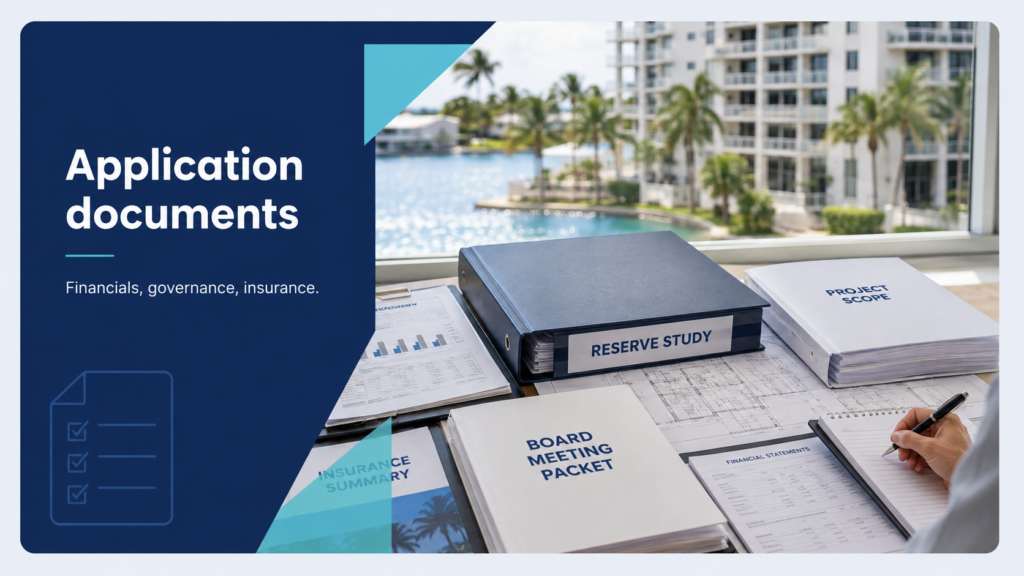
| Document group | Common examples | What the lender is reviewing |
| Financial | Budgets, financial statements, bank statements, delinquency reports and reserve studies | Cash flow, liquidity, expenses, reserves and repayment capacity |
| Governance | Declaration, bylaws, articles, amendments and owner roster | Borrowing authority, voting rules, association structure and assessment powers |
| Operations | Management agreement, board information, minutes, collection policy and existing loan documents | Management oversight, decision history, collections and current obligations |
| Insurance | Property, liability, directors and officers, crime or fidelity, flood and wind coverage | Existing protection, exclusions and project-related insurance issues |
| Project | Budget, contracts, bids, reports and disbursement schedule | Purpose of the loan, cost support, contractor arrangements and timing |
TuCielo provides a similar document outline in its association financing FAQs. Boards should still confirm the current request list before submitting because underwriting needs may change with the project.
Financial records
Recent financial statements give the lender a picture of the association’s revenue, expenses and balance sheet.
The package may include:
- Year-end financial statements
- Current year-to-date financial statements
- Approved annual budget
- Recent bank statements
- Accounts receivable aging report
- Delinquency report
- Reserve study or engineering study
- Schedule of reserve balances
- Current debt schedule
The figures should reconcile. If the aging report shows a receivable total that differs from the balance sheet, include an explanation or corrected report.
The budget should also reflect known expenses. If the association recently received a large insurance renewal, contractor change order or utility increase, an outdated budget may overstate the cash available for loan payments.
Governing documents
Submit a complete set of recorded governing documents rather than one partial declaration.
The package may include:
- Declaration and recorded amendments
- Articles of incorporation
- Bylaws and amendments
- Rules and regulations
- Current owner or unit roster
- Corporate registration information
- Board resolution authorizing the application
A common problem is that the association has the original declaration but not later amendments. Those amendments may change voting thresholds, assessment powers or board authority.
Meeting records and approvals
The lender may request board minutes showing how the project and financing were considered.
Minutes should accurately reflect the meeting. They shouldn’t be rewritten after the fact to make the discussion appear more complete. Where a resolution is needed, counsel can help the board prepare language that matches the governing documents and proposed financing.
Florida condominium associations should pay close attention to meeting notice requirements when a special assessment is being considered. Under Florida Statute 718.112, notice of a meeting involving a nonemergency special assessment generally must meet specific timing and content requirements, including a description of the assessment’s purpose and estimated cost.
That rule applies to condominiums under Chapter 718. HOA procedures under Chapter 720 and the community’s documents may differ. Boards should obtain case-specific legal advice rather than copying another association’s resolution or notice.
Insurance information
Insurance affects both the association’s operating risk and the project itself.
A lender may request evidence of:
- Property coverage
- General liability coverage
- Directors and officers coverage
- Crime or fidelity coverage
- Flood insurance
- Windstorm coverage
- Contractor coverage
- Builder’s risk coverage when applicable
The lender may also ask whether the work is required by an insurer or connected to an open claim. If an insurance payment will fund part of the project, identify the expected amount and whether it has already been approved or received.
Existing contracts and debt
Provide current loan agreements, leases and other material obligations. The lender needs to know whether existing agreements restrict additional borrowing or create competing claims against association revenue.
The debt schedule should include:
- Lender name
- Original balance
- Current balance
- Monthly payment
- Interest structure
- Maturity date
- Collateral or pledged revenue
- Prepayment terms
Don’t omit a loan because the board expects to refinance it. The proposed lender needs the existing documents to evaluate payoff requirements and structure the new financing correctly.
How lenders evaluate association loan eligibility
Submitting the documents starts the underwriting review. It doesn’t complete it.
The lender will compare the records and test whether the proposed loan makes sense for the association’s finances, governance and project.
Financial consistency matters
A lender may compare the budget with year-to-date results, bank statements and reserve records. Large unexplained differences can lead to questions.
For example, suppose the budget shows $900,000 in annual assessment income, but bank activity and current financials suggest collections are running below that amount. The lender may ask whether delinquencies increased, units received credits or the budget assumed an assessment that wasn’t implemented.
Providing a short written explanation can prevent confusion. The explanation should identify the cause and include supporting records.
Low reserves don’t always end the application
Some associations seek financing because available reserves can’t cover the required project. A reserve shortage is therefore part of the reason for the application.
The lender will still want to know why reserves are low. Possible explanations include older reserve estimates, several building systems failing at once, deferred contributions or construction inflation.
The board should provide the factual history without minimizing the issue. It should also explain how the proposed financing and future budget will address the project without creating another immediate shortfall.
TuCielo states that it considers associations with limited reserves or deferred maintenance as part of its broader underwriting review. That doesn’t mean every association will qualify. Approval and terms remain subject to the complete application, repayment analysis and project details.
Project management affects risk
A well-defined project is easier to underwrite than one with unclear scope, uncertain costs or no responsible manager.
The lender may consider:
- Contractor experience
- Engineer or architect involvement
- Permit status
- Contract payment terms
- Construction contingencies
- Draw controls
- Expected completion date
- Responsibility for approving payments
- Plans for handling change orders
A professional property manager may also play an important role in collecting assessments, maintaining records and coordinating the application. Boards can review TuCielo’s financing resources for property managers to understand the manager’s role in the process.
Owner occupancy and community structure
Some lenders review how many units are owner-occupied, rented, vacant or controlled by one owner. They may also examine whether the association includes residential units, commercial units or multiple property types.
These details help the lender understand concentration risk and assessment collection patterns. They may also affect how project costs are allocated under the governing documents.
Provide a current roster rather than an old mailing list. The roster should identify the information requested by the lender without including unnecessary sensitive personal data.
Florida board approvals and legal preparation
A lender’s approval doesn’t replace the association’s own approval requirements.
The board must follow the applicable statute and governing documents before signing a loan or imposing the assessment used to repay it. Depending on the association, this could involve a board vote, owner vote, special meeting, formal notice or recorded amendment.

Don’t assume the board vote is enough
Some governing documents give the board broad authority to borrow. Others require membership approval above a certain amount or for a loan secured by assessment revenue.
The attorney’s review should answer the approval question before the board announces that financing has been secured. A preliminary lender discussion or term sheet usually isn’t the same as final authorization to close.
Present owners with complete information
Owner communications should explain:
- Why the project is needed
- The total project budget
- How much will be financed
- How repayment will be allocated
- Estimated payment timing
- Whether owners may pay their share upfront
- What approvals are being requested
- Which figures remain estimates
- Where owners can review supporting records
Avoid promising an exact payment before underwriting and final loan terms are complete. Interest rates, fees, project costs and the number of participating owners may change the amount.
Keep the association’s legal and financial roles separate
The lender evaluates credit and offers financing terms. Association counsel advises on authority, notices, resolutions and legal obligations. The association’s accountant or financial professional can help confirm budgets, cash flow and accounting treatment.
Each role addresses a different part of the decision. Boards shouldn’t rely on a lender to interpret every provision in their declaration or use legal counsel as a substitute for a complete financial analysis.
This article provides general education and isn’t legal, tax or financial advice. Associations should have qualified professionals review their governing documents, approval process and proposed loan terms.
How to prepare a stronger application
A strong application is accurate, organized and easy to verify. It doesn’t need to hide every weakness.
Use this process before submitting:
- Confirm basic eligibility. Check the lender’s service area, association type, property size and management requirements.
- Complete the legal review. Ask counsel to confirm borrowing authority, voting thresholds, meeting notices and signing authority.
- Finalize the project package. Gather contracts, bids, reports, budget details and the expected disbursement schedule.
- Reconcile the financials. Make sure budgets, statements, bank balances and receivable reports agree.
- Update the owner roster. Confirm the number of units, ownership records and occupancy information requested.
- Document existing obligations. Include current loans, contracts and any known major expenses.
- Assign one coordinator. Give one board member or property manager responsibility for questions, revisions and document delivery.
A hypothetical application scenario
Consider a 120-unit Florida condominium association planning roof and waterproofing work.
The association has contractor proposals and an engineering report, but its first application package includes an outdated budget, incomplete declaration and aging report that doesn’t match the financial statements. The project may be reasonable, but the lender can’t yet confirm the association’s authority or repayment capacity.
Before resubmitting, the board obtains the recorded amendments, asks counsel to confirm the approval process and has management reconcile the receivables. It also prepares a project summary that separates the base contract, contingency and professional fees.
The second package doesn’t change the condition of the property. It gives the lender enough reliable information to evaluate the request.
Avoid these common application problems
Applications often slow down because of preventable record issues:
- Missing governing-document amendments
- Financial statements from different reporting periods
- Unexplained delinquency totals
- Preliminary estimates presented as fixed contracts
- Incomplete insurance certificates
- Undisclosed existing debt
- Minutes that don’t show the required approval
- No clear source for monthly loan payments
- Several people sending conflicting versions of the same file
A document checklist and shared submission folder can reduce these problems. Restrict access to authorized representatives and avoid placing unnecessary owner information in broadly shared folders.

Prepare your association’s next step
Meeting the HOA loan requirements starts before the formal application. The board needs a defined project, reliable financial records, clear borrowing authority and a practical plan for repayment.
TuCielo works with Florida associations seeking financing for major repairs, capital improvements and certain reserve needs. Boards that want to assess their current position can review how TuCielo’s association financing process works and prepare the project, financial and governance information needed for an initial discussion.
FAQs
What are the basic HOA loan requirements?
Most lenders require evidence of borrowing authority, acceptable financial performance, manageable delinquencies, adequate insurance and a defined project. The association must also provide a credible repayment plan and complete supporting documents.
What documents does an HOA need for a loan?
Common documents include budgets, financial statements, bank statements, aging reports, reserve or engineering studies, governing documents, meeting minutes, insurance records and project contracts. The lender may also request an owner roster, management agreement and current debt documents.
Does every HOA need owner approval to borrow money?
No single approval rule applies to every association. The answer depends on Florida law, the association type and the recorded declaration, articles and bylaws. Association counsel should confirm whether board approval is sufficient or a membership vote is required.
Can an association qualify with low reserves?
Low reserves don’t always result in an automatic denial. The lender may consider why reserves are low, the association’s overall cash flow, delinquency history, project urgency and proposed repayment structure. Approval still depends on the complete underwriting review.
Do lenders check individual homeowners’ credit?
Association loan underwriting generally focuses on the association as the borrower rather than treating every owner as a personal loan applicant. The lender may still review owner occupancy, assessment collections, delinquencies and the concentration of ownership within the community.
How long does HOA loan approval take?
There isn’t one standard approval period. Timing depends on the lender, project complexity, required legal approvals and how quickly the association provides complete documents. Missing amendments, inconsistent reports and unresolved project costs can extend the review.
Can an HOA apply before the project contract is signed?
An association may be able to begin an initial discussion using estimates or bids. However, the lender will usually need enough project information to evaluate the amount, scope, contractor and disbursement plan. Boards should clearly label preliminary figures and confirm what must be finalized before approval or closing.