

An HOA loan allows a community association to borrow money for repairs, replacements or capital improvements and repay the debt over time. The association is the borrower, rather than each homeowner taking out a separate personal loan.
For Florida board members, understanding how do HOA loans work means looking beyond the interest rate. The board must confirm its authority to borrow, define the project, prepare financial records, establish a repayment source and explain the obligation to owners.
This guide covers the HOA loan process from planning through repayment for homeowners associations, condominium associations and cooperative associations.
What is an HOA loan?
An HOA loan is financing issued to a community association for an association responsibility. Depending on the property, the borrower may be a homeowners association, condominium association, cooperative association or commercial condominium association.
The financing may cover:
- Roof replacement and waterproofing
- Concrete restoration and structural repairs
- Plumbing or electrical work
- Elevator modernization
- Heating and cooling systems
- Impact windows and doors
- Seawalls and parking areas
- Reserve funding
- Refinancing existing association debt
TuCielo’s association financing FAQs provide more information about Florida association types and projects that may qualify. Actual eligibility depends on the property, project, requested amount and underwriting review.
Unlike a homeowner loan, association financing generally isn’t based on one owner’s income or credit score. The lender evaluates the association’s assessment income, financial condition, reserves, delinquency history, governance and project plan.
The association receives the funds and makes the payments. It may repay the debt through regular assessment income, a special assessment or another authorized source of revenue.
Who owes the lender?
The association signs the loan documents and owes the lender. Individual owners generally don’t become co-borrowers.
Owners may still have a financial obligation to the association. If the board levies an assessment to repay the debt, each owner must pay the share allocated under the governing documents and applicable law.
The structure is straightforward:
- The lender provides money to the association.
- The association uses the funds for an approved project.
- Owners pay assessments to the association.
- The association uses those funds to repay the lender.
The financing documents may include a pledge of assessment revenue or other permitted association income. Association counsel should review the proposed collateral before the board signs.
Why Florida associations consider financing
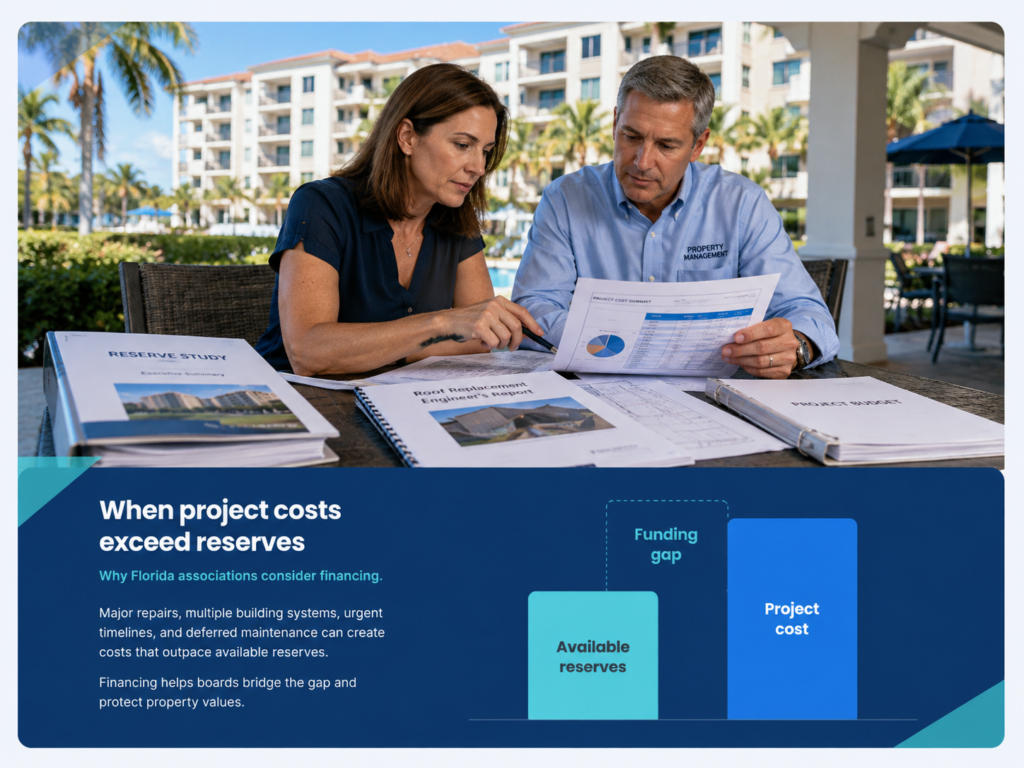
Associations normally collect annual assessments to fund operations, maintenance and reserves. A major project may cost far more than the association has available in unrestricted cash.
Financing may become necessary when:
- Several building systems need work at the same time.
- Construction costs exceed older reserve estimates.
- Previous maintenance was deferred.
- Insurance requirements make repairs urgent.
- Owners can’t reasonably pay a large lump-sum assessment.
- Existing reserves aren’t enough to cover the full project.
Florida condominium associations may also face obligations related to milestone inspections and structural integrity reserve studies. The Florida Department of Business and Professional Regulation explains that a structural integrity reserve study evaluates specified building components, reserve balances and expected funding needs.
The Florida Condominium Act addresses association responsibilities, reserves, assessments and other condominium matters. The requirements for a specific property depend on its building characteristics, governing documents and circumstances.
Common project funding options
| Funding method | Main consideration |
| Operating cash | May reduce the association’s emergency and operating cushion. |
| Reserves | Funds must be available and permitted for the project. |
| Lump-sum assessment | Avoids loan interest but can create owner hardship. |
| Installment assessment | Spreads payments but may not match contractor timing. |
| Association loan | Spreads costs over time but adds interest and fees. |
| Combined structure | Uses reserves or an initial assessment, then finances the balance. |
These options can be combined. An association might contribute some reserves, collect an initial assessment and borrow the remainder.
Boards can also review TuCielo’s comparison of association financing and traditional bank lending when considering available funding structures.
How do HOA loans work from application to repayment?
Most association loans follow six broad stages.
1. Define the project
The board must explain what the community is financing and why the work is needed.
A lender may request:
- Engineering or inspection reports
- A structural integrity reserve study
- A written scope of work
- Contractor bids
- A project budget
- A construction schedule
- Permit information
- A contingency for unexpected costs
A vague request for “building repairs” is rarely enough. The lender needs to understand the project’s cost, urgency and risk.
Boards should also separate required repairs from optional improvements. Structural work presents a different need from adding a new amenity.
2. Confirm borrowing authority
The association must have legal authority to borrow and approve the repayment plan.
The board should review:
- The declaration
- Articles of incorporation
- Bylaws
- Applicable Florida statutes
- Board and membership voting requirements
- Special assessment authority
- Restrictions on pledging association income
- Notice and meeting procedures
Florida nonprofit corporations generally have the power to borrow money under Section 617.0302 of the Florida Statutes. That general authority doesn’t override an association’s governing documents or approval requirements.
Condominium associations must also consider Chapter 718. Homeowners associations are generally governed by Chapter 720. Some documents allow the board to approve borrowing, while others require owner approval.
Borrowing authority and assessment authority should be reviewed separately. The board may be able to sign a loan but still need to follow specific procedures before imposing the assessment used to repay it.
3. Submit the application
Once the project and approval path are reasonably clear, the association submits its application.
TuCielo’s explanation of how association financing works identifies the project scope, timeline and funding situation as starting points. The review may also require financial statements, the current budget, delinquency information, engineering or reserve studies and available bids.
Typical documents include:
- Current financial statements
- Annual budgets
- Reserve balances
- Bank statements
- Existing debt schedules
- Delinquency reports
- Governing documents
- Board or owner resolutions
- Insurance policies
- Engineering reports
- Contractor bids and contracts
The board should assign one person to coordinate requests and track document versions. Incomplete or inconsistent records can delay review.
4. Complete underwriting
The lender evaluates whether the association appears able and authorized to repay the proposed debt.
Assessment income and delinquencies
The lender will examine how much the association collects and how reliably owners pay.
For condominium associations, Section 718.116 addresses assessment liability, collection and association lien rights. Homeowners associations should review Chapter 720 and their governing documents.
A high level of unpaid assessments may raise concerns, especially when the association lacks a consistent collection process.
Existing debt and reserves
An existing loan doesn’t automatically prevent additional financing or refinancing. The lender will review the current balance, payment history, maturity date, collateral and prepayment terms.
Low reserves also don’t automatically prevent approval. The lender will consider why reserves are low, how much cash the association has available and whether it can handle future expenses while making loan payments.
Project and legal risk
The lender may review professional reports, contractor bids, project timing and the proposed contingency. It may also examine litigation, insurance disputes, governance issues or other matters that could affect repayment or project completion.
5. Review the proposed terms
If the initial review is favorable, the lender may issue a term sheet or preliminary approval.
The board should compare:
- Loan amount
- Fixed or variable interest rate
- Repayment term
- Amortization period
- Payment frequency
- Closing costs
- Required reserves or accounts
- Collateral
- Prepayment terms
- Financial reporting requirements
- Construction disbursement rules
- Events of default
A longer term may reduce the periodic payment but increase total interest. A shorter term may cost less overall but require higher owner assessments.
The board should request a complete payment schedule and have association counsel review the final documents.
6. Close and release the funds
After approval, the association signs the documents and completes the remaining closing conditions.
Funds may be released:
- In one payment
- Directly to the association
- Through an escrow account
- In construction draws tied to project progress
For draw-based funding, the lender may require invoices, inspections or lien waivers before releasing additional money.
The association should maintain clear records for loan proceeds, contractor payments, professional fees, change orders, assessment collections and debt payments.
How owners may repay the loan
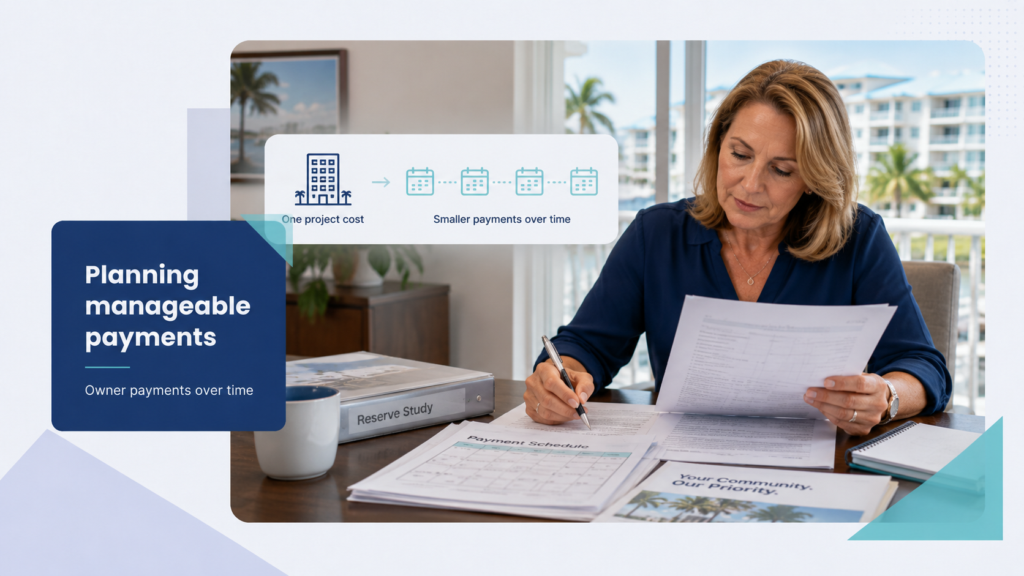
A common repayment structure is a special assessment that follows the association’s debt service schedule. Owners pay the association monthly, quarterly or annually, then the association pays the lender.
The allocation may be based on:
- An equal amount per parcel
- Percentage ownership
- The declaration’s common-expense formula
- Another permitted method
The board shouldn’t assume that every owner can be charged the same amount. The governing documents may assign different expense percentages.
TuCielo provides a board-focused explanation of how association financing can spread project costs over time rather than requiring one large upfront payment.
Can owners pay early?
Some associations allow owners to pay their allocated share in advance while others use installments. This may reduce the amount borrowed.
The board should establish how principal, interest, fees and later adjustments will be allocated. It should also confirm whether early payment fully satisfies that owner’s project obligation.
What happens when a unit is sold?
An outstanding assessment may matter when an owner sells or refinances. The association may need to confirm:
- The unpaid balance
- Whether the seller must pay at closing
- Whether future installments transfer to the buyer
- How the debt appears in association records
- Whether the project is complete
Mortgage lenders may also review association finances, insurance, litigation and special assessments. Fannie Mae’s condominium project standards explain how project-level conditions may affect mortgage eligibility for individual units.
An association loan doesn’t automatically prevent a sale or refinance. Clear records help buyers and lenders understand the obligation.
A hypothetical Florida example
Consider a hypothetical 120-unit Florida condominium that needs $4.2 million for concrete restoration, waterproofing and roof work.
The association has $900,000 available but doesn’t want to use every dollar. It proposes contributing $700,000 and financing the remaining $3.5 million.
Before applying, the board gathers:
- The engineer’s report.
- Contractor proposals.
- The reserve study.
- Current financial statements.
- A delinquency report.
- Insurance policies.
- Governing documents and proposed resolutions.
The lender reviews the project and association finances, then presents a shorter and longer repayment option.
The board compares:
- The annual payment
- Total interest
- Future reserve contributions
- Prepayment terms
- Owner early-payment options
- Project overrun risk
- Disclosure to future buyers
The decision depends on more than approval. The board must connect the project plan, loan terms and owner repayment structure.
HOA loan versus special assessment
A lump-sum special assessment may avoid financing costs but require a large immediate payment from owners.
An association loan spreads the cost over time but adds interest, fees and a continuing budget obligation.

Boards should compare:
Project timing
Can the association wait while it collects money, or must repairs begin soon?
Owner payment capacity
Would a large assessment lead to delinquencies or payment-plan requests?
Total cost
How much will the association pay in interest, fees and other expenses?
Available cash
Would paying cash leave too little for insurance, utilities or emergencies?
Future reserves
Can the association continue reserve funding while making loan payments?
Boards should present owners with the proposed monthly cost and the total amount paid over the full term. Showing only one figure gives an incomplete picture.
What can delay or prevent approval?
Common issues include:
Incomplete records
Missing or inconsistent financial statements make repayment capacity harder to evaluate.
High delinquencies
Delinquency is more concerning when the association lacks a clear collection policy.
Unclear project costs
A preliminary estimate may not be enough for structural or multi-phase work.
Disputed authority
Uncertainty about board authority, voting or assessment procedures can stop closing.
Inadequate insurance
Lenders will normally review current coverage and may require updates before funding.
Litigation or governance disputes
The lender may need to understand whether a dispute could affect repayment or project completion.
An unrealistic repayment plan
A necessary project may still require restructuring if the payment burden is too high.
Associations dealing with reserve deficiencies, deferred maintenance, existing debt or unusually large projects can review TuCielo’s Florida association financing options. Approval and final terms remain subject to underwriting and documentation.
A board checklist before applying
- Confirm that the project is an association responsibility.
- Obtain a complete scope, current bids and a contingency.
- Ask counsel to confirm borrowing and assessment authority.
- Build a budget that includes professional and financing costs.
- Compare reserves, cash, assessments and financing.
- Model payments and total cost over the full term.
- Organize financial, legal, insurance and project records.
- Explain the plan and alternatives to owners.
- Set controls for draws, invoices and change orders.
- Plan how debt and assessments will be reported during unit sales.
- Assign responsibility for loan payments and lender reporting.
Questions to ask a financing provider
Boards should ask:
- What association and project types do you finance?
- How do you evaluate delinquencies?
- Is the rate fixed or variable?
- What fees apply?
- What collateral is required?
- Can the association prepay?
- Can individual owners pay early?
- How are project funds released?
- What happens if costs increase?
- What reporting is required?
- Does the loan restrict additional borrowing?
- Who services the loan after closing?
The written financing documents should control the decision. Verbal explanations shouldn’t replace a careful review of the term sheet, promissory note and repayment plan.
Prepare the project before choosing the debt
An HOA loan can help a Florida association begin necessary work without collecting the full project cost from owners at once. It also creates a long-term obligation and increases the total amount paid.

The board should start with the project, not the loan. It should confirm responsibility for the work, obtain a reliable scope, review its governing documents and compare the full effect of each funding option.
Florida associations considering financing can review how TuCielo association financing works and prepare their project scope, bids and current financial information before discussing available options.
This article provides general educational information. It isn’t legal, tax, accounting or financial advice. Association boards should have qualified Florida counsel and appropriate financial, insurance and engineering professionals review the project and proposed financing.
FAQs
Who borrows the money in an HOA loan?
The association is the borrower and signs the financing documents. Owners may pay assessments that support the association’s payments.
Does an HOA need owner approval?
It depends on the governing documents, association type, collateral and transaction. Some boards may approve borrowing while other associations require a membership vote.
What collateral supports an HOA loan?
A lender may require a pledge of assessment income or other permitted association revenue. The exact collateral depends on the financing documents.
Can an HOA obtain financing with low reserves?
Possibly. The lender will review why reserves are low, the association’s income, delinquency history and ability to make payments.
How long does the process take?
The timeline depends on document readiness, project complexity, approvals and underwriting questions.
Can owners pay their shares early?
Some structures allow early payment. The association must determine how principal, interest and fees will be allocated.
Does an HOA loan affect an owner’s credit?
The association is generally the borrower, so the loan itself doesn’t ordinarily become an owner’s personal debt. The owner’s obligation to pay authorized association assessments still applies.