

A major roof project, concrete repair or building-system replacement can leave a Tampa Bay community association with a difficult funding decision. Available reserves may cover only part of the work while a large special assessment could require owners to produce thousands of dollars at once.
This HOA loan Tampa guide is for board members, property managers and finance committees evaluating association financing in Tampa, St. Petersburg and nearby Tampa Bay communities. It explains how association loans work, what they can fund, how Florida condominium requirements can affect the decision and what boards should compare before accepting financing.
The information below is general education rather than legal, tax or financial advice. Borrowing authority, voting requirements and repayment obligations depend on the association’s governing documents and circumstances. Boards should have association counsel and appropriate financial professionals review a proposed loan before approval.
Why Tampa Bay associations may need financing
Community associations rarely face one expense at a time. A condominium may be budgeting for roof work while also dealing with waterproofing, elevators, plumbing or structural repairs. An HOA may need to replace private roads, repair a clubhouse or address drainage and common-area infrastructure.
The funding problem becomes more difficult when several projects arrive within the same budget cycle.
An association generally has a few ways to cover a major expense:
- Use available reserves or other association funds.
- Levy a special assessment on owners.
- Borrow at the association level.
- Combine cash, reserves, assessments and financing.
Each approach shifts the timing and cost differently.
Using reserves avoids interest expense, but spending most of the available cash on one project can leave little room for other obligations. A lump-sum special assessment avoids long-term loan interest, but owners may have limited time to produce a large amount of money.
Association financing changes the timing. The association borrows the project funds and repays the obligation over an agreed term. TuCielo offers association financing for Florida communities that can be considered for capital improvements, repairs and certain reserve needs. Actual terms, rates and approval depend on underwriting.
That distinction matters for Tampa Bay boards. Financing isn’t automatically cheaper than a special assessment. Its main value may be allowing a necessary project to proceed without requiring the entire cost from owners immediately.
A hypothetical Tampa condo example
Consider a hypothetical 120-unit condominium near Tampa that receives contractor bids for roof replacement and waterproofing work. The project costs substantially more than the unrestricted cash the association wants to use.
The board could levy a large assessment and collect the full amount before construction. It could also investigate financing and spread repayment over several years. A third possibility would be to contribute part of its available funds and finance the remaining project balance.
The board shouldn’t compare those options only by asking which has the smallest payment today. It should compare the total borrowing cost, effect on reserves, collection risk, project schedule and financial burden placed on owners.

How an HOA loan in Tampa works
An association loan is made to the community association rather than separately to every homeowner or condominium owner.
The association signs the loan documents and is responsible for repayment. It then needs a source of association revenue sufficient to make the scheduled payments. Depending on the association’s structure and governing documents, that may involve assessments collected from owners.
A typical process looks like this:
- Define the project and funding gap. The board establishes what work is required, what it is expected to cost and how much can reasonably come from existing association funds.
- Confirm borrowing authority. Association counsel reviews the declaration, bylaws and other governing documents along with applicable Florida law.
- Gather financial and project records. The lender reviews the association rather than treating individual owners as separate borrowers.
- Evaluate proposed terms. The board compares the amount financed, interest structure, fees, repayment term and required payment.
- Complete required approvals. The association follows the voting, meeting, notice and documentation requirements that apply to the transaction.
- Close and fund the project. Loan proceeds are disbursed according to the financing documents and agreed project process.
- Collect association revenue and repay the debt. The board incorporates repayment into its financial plan over the applicable term.
Boards that want to see what the lender side of that process can involve can review TuCielo’s explanation of how association financing works. Its process covers the project discussion, initial documents, underwriting, loan documents and funding.
Borrowing authority needs to be checked before the loan amount
Boards sometimes begin with the question, “How much can we borrow?” The earlier question should be whether the association has authority to enter the proposed financing arrangement and what approvals are required.
For Florida condominiums, Florida Statute 718.111 addresses the condominium association as the corporate entity responsible for operating the condominium. Borrowing decisions still need to be evaluated alongside the association’s declaration, bylaws and other governing documents.
Florida homeowners associations operate under Chapter 720. Their statutory powers and duties also interact with their governing documents, which may impose conditions on borrowing, assessments or pledging association revenue.
That means a general statutory provision doesn’t tell a Tampa board exactly what voting or approval process applies to its proposed loan. Association counsel should review the current governing documents before the board treats a financing proposal as authorized.
What Tampa condo association financing can fund
The financing purpose should be specific before a board approaches lenders. “Building improvements” isn’t enough for a useful comparison because different projects create different budgets, schedules and risks.
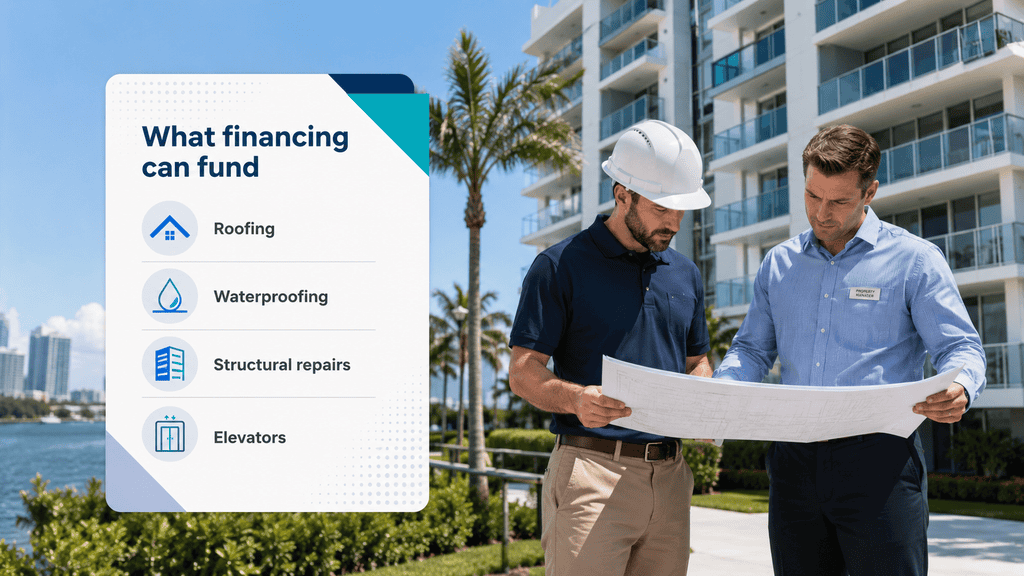
For Tampa Bay associations, potential capital needs may include:
- Roofing and waterproofing work.
- Concrete restoration and structural repairs.
- Plumbing or electrical system replacements.
- Elevator modernization.
- Heating, ventilation and air conditioning work.
- Impact windows and exterior doors.
- Parking area or roadway improvements.
- Seawalls and other association-owned marine structures where applicable.
The project itself is only part of the funding question. Boards also need to know how much cash is available, what reserve obligations remain and whether other significant projects are likely to follow.
Separate the project cost from the funding request
A board shouldn’t automatically request a loan equal to the contractor’s first estimate.
Start by building the full project budget. That may include the construction contract plus legitimate related costs such as engineering, permitting, contingencies and other expenses identified by the association’s professional team.
Then identify how much the association expects to contribute from available funds.
For example, suppose a project budget is $3 million and the board has decided, after professional review, that it can responsibly contribute $500,000 without undermining other obligations. The financing question becomes how to fund the remaining $2.5 million rather than automatically borrowing the entire $3 million.
The numbers here are illustrative only. The appropriate cash contribution depends on the association’s budget, reserve obligations, liquidity needs and professional advice.
Don’t ignore projects likely to follow
Funding decisions can become shortsighted when a board evaluates one repair in isolation.
A condo may need a roof this year but already know that elevators, plumbing or exterior restoration will require attention later. Using nearly all available funds for the first project could create another funding problem soon afterward.
Before finalizing the financing amount, boards should review the association’s reserve study, engineering reports, maintenance plan and known capital schedule together. That produces a better picture of how much cash needs to remain available.
Associations preparing to approach a lender can also review the typical financial, governance and project information outlined in TuCielo’s HOA loan requirements guide.
Tampa Bay condo boards also need to consider Florida inspection and reserve rules
Condominium financing decisions in Tampa Bay can overlap with Florida’s building inspection and reserve requirements. These rules are particularly relevant when a project involves an older condominium building or structural components.
The Florida Department of Business and Professional Regulation explains that qualifying residential condominium and cooperative buildings three or more habitable stories high are subject to milestone inspection requirements based on building age. A milestone inspection evaluates whether substantial structural deterioration exists. Boards can review the state’s current milestone inspection guidance when determining whether the requirement applies to their property.
Structural Integrity Reserve Studies, usually called SIRS, address a different issue. They evaluate designated building components, their estimated useful lives and the funding needed for future repair or replacement.
Florida’s condominium requirements call for applicable residential condominium associations to complete a SIRS at least every 10 years for qualifying buildings. The state’s SIRS guidance for condominium associations explains the required study components, inspection requirements and current deadlines.
Why these requirements affect financing decisions
An inspection or reserve study doesn’t determine whether an association should borrow money.
It can, however, change the information available to the board.
For example, an engineering report may identify work that shouldn’t be postponed. A SIRS may identify future funding needs the association hadn’t fully incorporated into its earlier budgeting assumptions.
That can affect several financing questions:
- How urgent is the work?
- How much needs to be funded now?
- What additional reserve needs are expected?
- How much cash can the association safely contribute?
- Would a short repayment period create excessive assessment pressure?
- Would a longer repayment period produce too much total interest?
- Should multiple related projects be evaluated together?
Tampa condo association financing should therefore be considered alongside the engineering and reserve information the board already has rather than treated as a separate exercise run only by the finance committee.
How Tampa Bay boards should compare funding options
A loan proposal becomes easier to evaluate when the board compares it with realistic alternatives using the same project budget.

A useful comparison looks beyond the headline interest rate.
| Funding approach | What the board should examine | Main tradeoff |
| Existing association funds | Cash available after the project and remaining obligations | Avoids borrowing cost but reduces liquidity |
| Lump-sum special assessment | Amount due from each owner, collection schedule and delinquency risk | Avoids loan interest but creates a larger immediate owner obligation |
| Association loan | Rate, term, fees, total repayment and assessment structure | Spreads payments but creates financing costs and a longer obligation |
| Blended approach | Cash contribution, assessment amount and financed balance | Can reduce borrowing while preserving some liquidity |
The board should run the same project through each scenario.
Compare total dollars, not only monthly payments
A longer repayment period can reduce the required periodic payment. It can also increase the amount of interest paid over the full life of the loan.
That makes “lowest monthly payment” an incomplete decision rule.
Request enough information to understand:
- The principal amount actually being financed.
- Whether fees or other funded amounts are included.
- Whether the rate is fixed or variable.
- The repayment period.
- The payment schedule.
- The total projected repayment if held to maturity.
- Prepayment provisions.
- Default provisions and lender remedies.
- Any accounts or reserves required by the lender.
For early budgeting, TuCielo’s association financing estimator separates the project amount, estimated financing costs, term and unit count so a board can see how those assumptions affect estimated payments. Calculator results are illustrative and don’t replace formal loan terms.
Compare the owner impact
Boards also need to translate the financing proposal into terms owners can understand.
Suppose two proposals fund the same project. Proposal A has a shorter term with a larger monthly association payment. Proposal B extends the repayment period and lowers the periodic payment but increases total financing cost.
Neither is automatically better.
The board needs to decide which structure fits its budget, the useful life of the improvement and the association’s ability to collect the required assessments over time.
Compare the loan term with the improvement
There is also a practical question of duration.
Funding a long-lived capital improvement over several years may allow current and future owners who benefit from the work to share its cost over time. Extending debt far beyond the expected useful life of an improvement creates a different issue because the association may still be paying for the old project when replacement work is approaching again.
Ask the lender how the proposed term was selected. Then compare it with the engineering estimate or expected service life of the improvement rather than choosing a term solely because it produces an appealing monthly figure.
A Tampa Bay board checklist before requesting loan terms
A financing discussion is more productive when the board has already organized the underlying project.
Use this checklist before requesting formal terms:
- Define the work. Identify the specific repairs or improvements and separate urgent work from optional upgrades.
- Confirm the project budget. Gather current contractor proposals plus engineering or professional estimates for associated costs.
- Review available cash and reserves. Determine what funds exist and what other obligations they need to support.
- Check governing documents. Have counsel confirm borrowing, assessment, notice and approval requirements.
- Review financial performance. Check current budget results, cash flow, delinquencies, collections and existing debt.
- Model owner payments. Compare a lump-sum assessment, financed assessment and blended structure using the same project amount.
- Prepare the lender package. Organize financial statements, budgets, governing documents, insurance information, reserve or engineering studies and project contracts.
After those steps, the board can compare actual proposals instead of discussing financing in the abstract.

Questions Tampa and St. Pete boards should ask a financing provider
A board considering a Tampa HOA loan or St. Pete HOA loan should ask the same disciplined questions it would ask about any major association contract.
Start with the amount.
“What exactly is included in the financed balance?” is more useful than asking only how much the lender will approve.
Then work through the terms:
- Is the interest rate fixed for the entire term or can it change?
- What fees, reserves or other amounts are included at closing?
- What repayment terms are available for this project?
- Is there a prepayment penalty or other early-payoff cost?
- What happens if the association already has debt?
- What financial covenants will the association need to maintain?
- How does the lender evaluate assessment delinquencies?
- How are project funds disbursed?
- What happens if the final project cost changes?
- What documents will be required before closing?
The board should also ask what happens after closing. A competitive proposal is less useful if the association doesn’t understand reporting requirements, payment administration or procedures for future project changes.
For Tampa Bay associations, local geography doesn’t change that basic discipline. A board in downtown Tampa, Clearwater, St. Petersburg or another nearby community still needs to understand the same contractual obligation before signing.
Prepare your Tampa Bay association before comparing financing
An association loan can give a Tampa Bay board another way to fund major repairs, capital improvements or qualifying reserve needs when available cash isn’t enough and collecting the full project cost immediately would be difficult.
The decision still deserves a full financial and legal review. Define the project, confirm the association’s authority, understand upcoming reserve needs and compare the total cost of each funding approach before signing a long-term obligation.
Tampa, St. Petersburg and surrounding Tampa Bay associations with a defined project can speak with TuCielo about their project scope, funding requirement and the documentation needed for an association financing review.
FAQs
Can a Tampa HOA take out a loan?
Potentially. A Florida HOA’s authority depends on applicable state law and its governing documents. The board should have association counsel confirm whether borrowing is permitted and what board or member approvals are required.
Can a Tampa condo association borrow for structural repairs?
Association financing may be available for structural and common-area capital work when lender requirements are met. The board should first define the repair scope, determine the amount needed and confirm its authority to borrow.
Can an association loan pay for SIRS reserve needs?
Some financing programs may accommodate reserve-related needs, but eligibility and terms vary by provider. The association must still comply with current Florida reserve requirements and should have its legal and financial professionals review the proposed structure.
Is a special assessment still needed when an HOA borrows?
A loan doesn’t eliminate the association’s need for revenue to repay the debt. Depending on the structure, owners may contribute through assessments collected over time rather than paying the entire project cost in one lump sum.
What does a lender review for a Tampa condo association loan?
A lender may review financial statements, budgets, assessment delinquencies, existing debt, governing documents, insurance and project information. Requirements differ by lender and by the association’s financial and project circumstances.
How should a St. Pete HOA loan be compared with a special assessment?
Compare the full project cost, amount owners would need to pay immediately, total financing cost, loan term, effect on association liquidity and collection risk. Using the same project assumptions for both scenarios gives the board a more useful comparison than looking only at the loan’s monthly payment.
Does every Tampa Bay condo need a milestone inspection and SIRS?
No. Florida’s requirements depend on factors including building type, height and age. Boards should check current state guidance and obtain professional advice to determine which requirements apply to their property and when.