

The search for “HOA loans Miami” often starts when a board has a large repair bill, a reserve shortfall or a project that can’t wait for years of gradual funding. For Miami condominium associations and homeowners associations, the challenge is rarely just finding money. The board also has to decide how much to borrow, how owners will repay it and whether the financing fits the project schedule.
This guide explains how association loans work, the Miami-specific issues that can create funding pressure and what boards should compare before committing to financing. It is intended for board members, property managers and finance committee members evaluating a major community expense.
The information is general education, not legal, tax or individualized financial advice. Borrowing authority, assessment procedures and voting requirements can depend on Florida law and an association’s governing documents, so boards should involve association counsel and qualified financial professionals where appropriate.
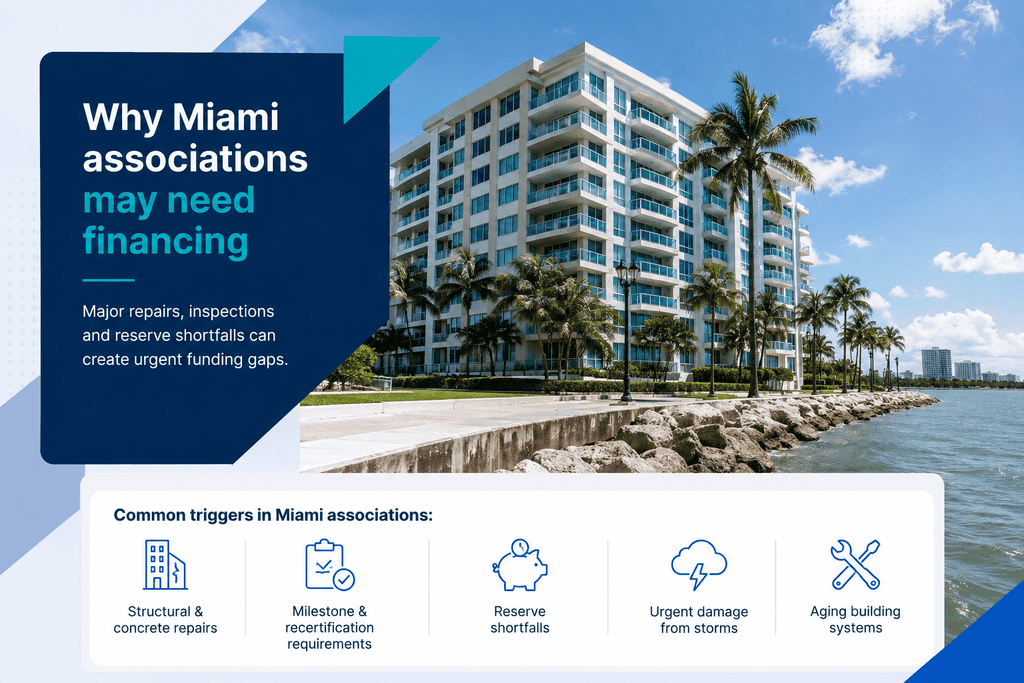
Why Miami associations may need financing
Miami associations can face capital projects large enough that existing reserves alone won’t cover the work.
Common examples include concrete restoration, roofing and waterproofing, elevator modernization, plumbing or electrical work, impact windows and doors, parking areas and seawall repairs. Some condominium associations also need to address reserve funding identified through a Structural Integrity Reserve Study (SIRS).
The timing matters. A board may know that a roof will need replacement in several years and have time to build reserves gradually. A structural or waterproofing problem identified during an inspection can create a much shorter decision window.
Miami-Dade adds another layer because the county operates a building recertification program. Depending on a building’s age, location and type, recertification may begin at 25 or 30 years and recur every 10 years. The county also requires recertification reports to be prepared by appropriately qualified Florida-registered engineers or architects. Boards can review the Miami-Dade County building recertification requirements when determining which local deadlines apply to their property.
Florida law separately requires milestone inspections for certain condominium and cooperative buildings. The Florida Department of Business and Professional Regulation explains that residential condominium and cooperative buildings that are three or more habitable stories generally require a milestone inspection at the applicable statutory building age, followed by inspections every 10 years. Boards can review the state’s milestone inspection and SIRS guidance for current requirements.
These inspections don’t automatically mean an association needs a loan. They can, however, reveal a difference between what the building needs and what the association currently has available.
That funding gap is where a board has to make a deliberate choice.
Inspections can change the funding timeline
Imagine a Miami condominium that has been building reserves for future exterior work. The board expected to begin the project three years from now.
An engineering review then identifies repairs that should be completed sooner. Contractor pricing, engineering fees, permits and related project costs bring the required amount above what the association has set aside.
The board now has several questions:
- Can existing reserves cover part of the work without weakening funding for other scheduled components?
- Can owners reasonably pay the remaining amount through a special assessment?
- Will assessment collections arrive quickly enough to meet the contractor’s payment schedule?
- Would association financing allow the work to begin sooner?
- How much will interest and other financing costs add over the repayment period?
That is the practical decision behind most association borrowing. Financing doesn’t make the project cost disappear. It changes when the association receives the money and when owners are asked to contribute.
What a Miami HOA or condo association loan can fund
An association loan is financing taken out by the community association rather than by each individual owner.
The association becomes the borrower, receives the proceeds and makes payments according to the loan agreement. It then needs an authorized source of association revenue to support those payments.
For boards researching a condo association loan in Miami, TuCielo’s association financing program covers Florida condominium associations, homeowners associations and co-ops seeking funding for major capital improvements and required reserves. Actual availability and terms remain subject to underwriting.
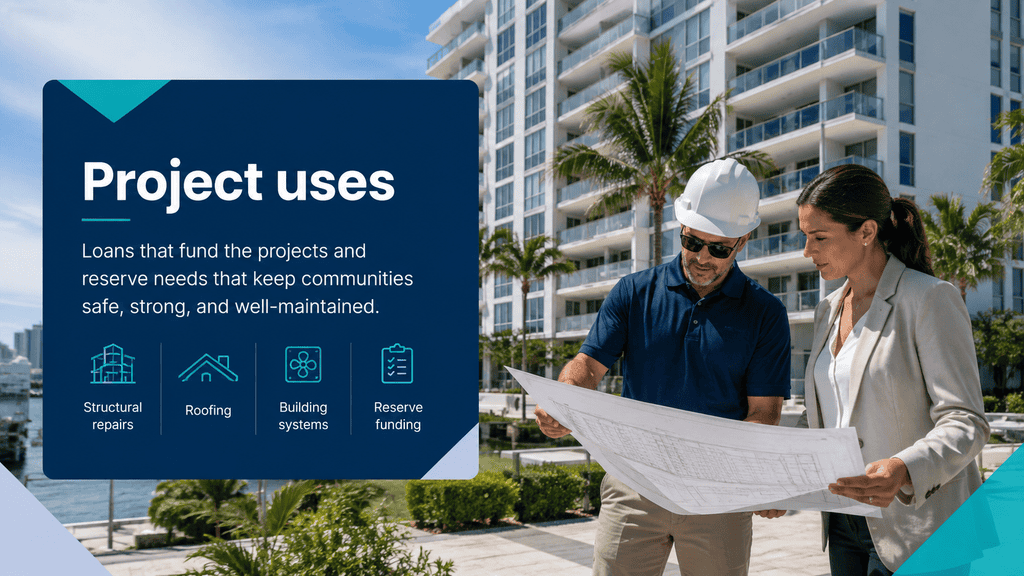
Potential project uses include:
- Concrete restoration and structural repairs.
- Roof replacement and waterproofing.
- Impact windows and doors.
- Elevator modernization.
- Plumbing, electrical and HVAC work.
- Seawall and marine structure repairs.
- Parking area improvements.
- Required reserve funding.
- Refinancing of existing association debt when available under the financing structure.
TuCielo’s published association financing information lists common-area repairs such as roofing, waterproofing, structural work, plumbing, elevators, HVAC, impact protection, seawalls and parking improvements among the projects its program may fund.
A board should define the purpose of the borrowing before requesting proposals. “We need $4 million” gives a lender less useful information than a complete project scope explaining what will be repaired, why it is needed, how much each component costs and when contractors expect payment.
The project budget should extend beyond the construction contract
One common budgeting mistake is treating the contractor’s bid as the complete funding need.
A major Miami condominium project may also involve engineering, architectural work, permits, testing, legal review, temporary access or protection measures and a construction contingency. The specific expenses depend on the project.
Before choosing a loan amount, the board should build a sources-and-uses budget.
On one side, list the entire expected project cost. On the other, identify the money already available from appropriate reserves, unrestricted cash, previously collected assessments or other authorized sources.
The difference is the potential funding gap.
That figure is much more useful than borrowing an arbitrary round number and hoping it covers the project.
How association financing works
A Miami association loan usually involves more underwriting than simply submitting a project estimate and receiving a rate.
The lender needs to understand both the project and the financial organization responsible for repayment. Boards should expect to provide enough documentation for a lender to evaluate the association’s finances, governance, existing obligations and project plan.
1. Define the project
Start with a written scope.
The board should know what work is being funded, why it is required and the expected construction schedule. Contractor bids, engineering reports, SIRS documents or milestone inspection reports may become part of the financing package.
If the scope is still changing significantly, it may be too early to lock in a financing amount.
2. Determine how much the association actually needs
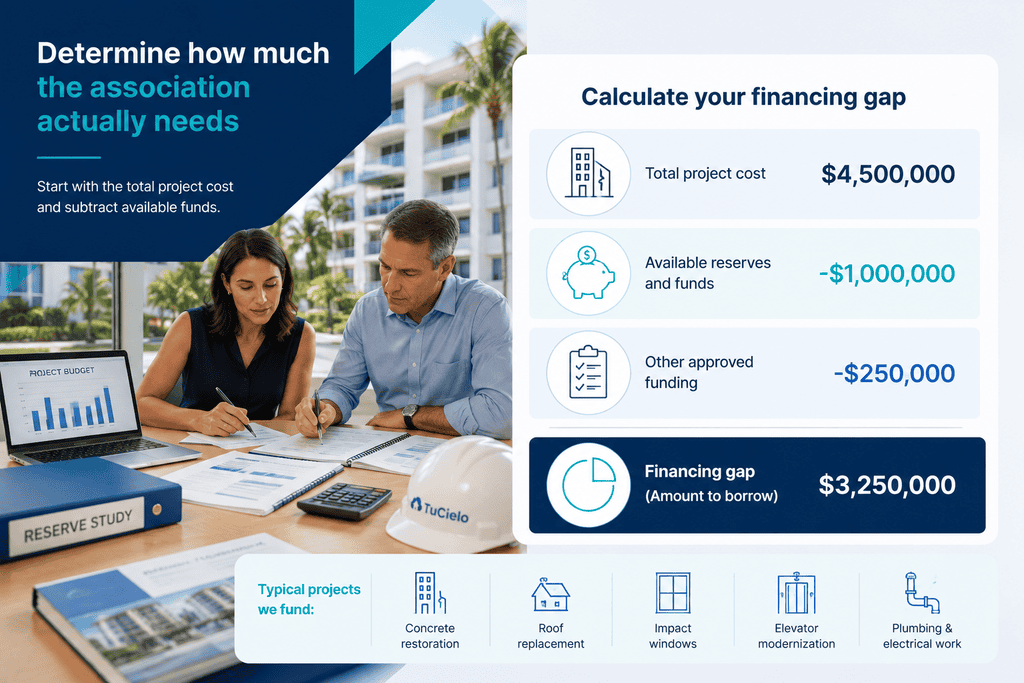
Subtract appropriate available funding from the complete project budget.
Suppose a hypothetical 120-unit Miami condominium expects a $4.5 million restoration project and has $1 million in funds that its advisers confirm can appropriately be applied to that work. Its potential financing requirement is closer to $3.5 million before lender costs or other additions are considered.
The board should then test what that borrowing level could mean for annual association debt service and owner assessments.
3. Assemble association records
Association underwriting focuses heavily on the financial and governance condition of the borrower.
Boards preparing for Miami HOA financing can review TuCielo’s HOA loan requirements for Florida associations for examples of documents lenders may request. These can include financial statements, budgets, delinquency reports, bank statements, governing documents, insurance information, existing debt records and project documentation.
Boards can save time by organizing these records before comparing financing proposals.
Missing documents can also reveal problems that deserve attention independently of the loan. For example, the board may discover outdated financial statements, incomplete project contracts or unclear minutes regarding authorization.
4. Complete underwriting
A lender may evaluate assessment revenue, owner delinquencies, existing obligations, reserves, project scope, insurance and the association’s governance structure.
This is different from evaluating a conventional consumer loan. The association is the applicant.
Underwriting standards vary, so approval from one institution doesn’t guarantee approval from another.
5. Review the proposed terms
The interest rate gets attention first, but it shouldn’t be the only comparison point.
Boards should review the requested loan amount, repayment term, fees, amortization, payment schedule, security or revenue pledge provisions, prepayment terms and any reserves or accounts required by the lender.
Association counsel should review the actual loan documents before execution.
6. Close and manage the proceeds
After closing, proceeds may be disbursed according to the financing agreement and project schedule.
The board should understand how contractor draws will be approved, what documentation is required and whether unused proceeds are treated differently from amounts already disbursed.
The accounting shouldn’t stop after closing. Loan payments, project expenditures and owner assessment collections need to remain visible in the association’s financial reporting.
How Miami boards should compare a loan with other funding options
Borrowing is only one way to fund association work.
A board should compare financing with the alternatives that are actually available to the community rather than treating the decision as “take a loan or cancel the project.”
For many associations, the practical choices look like this:
| Funding method | How it works | Main issue for the board |
| Existing reserves | The association uses money already accumulated for applicable expenditures. | Determine whether the funds can be used and what obligations remain afterward. |
| Lump-sum special assessment | Owners contribute their allocated share over a relatively short period. | Owners must produce substantial cash quickly and collection timing must match project needs. |
| Installment assessment | Owners contribute through scheduled installments. | Collections may arrive more slowly than contractor payments are due. |
| Association loan | The association receives capital upfront and repays it over time. | The association incurs financing costs and must support ongoing debt service. |
| Combined approach | Reserves or owner contributions pay part of the project while financing covers the balance. | The board must coordinate multiple funding sources and repayment obligations. |
None is automatically better.
A well-funded association with a manageable project may reasonably choose reserves. Another community could prefer a special assessment because owners can fund the work without taking on long-term association debt.
A large condominium with a time-sensitive structural project might face a different problem. If the contractor needs millions of dollars during the next 12 months, collecting that money from owners over four years won’t solve the cash-flow mismatch.
That is where financing may become useful.
A loan can solve a timing problem, not a cost problem
This distinction is worth explaining clearly at owner meetings.
Borrowing can provide capital before the association has collected the full project cost from owners. That can make a large project financially workable on the required construction schedule.
But borrowing adds interest and potentially other financing costs.
Boards should therefore compare both the near-term owner impact and the total long-term obligation.
A lower monthly assessment doesn’t necessarily mean a lower-cost funding method. A longer repayment period may reduce the amount collected each month while increasing how long the association pays financing costs.
Consider combining funding sources
The decision doesn’t always require choosing one method exclusively.
For example, an association might use a portion of its appropriately available reserves, collect an owner contribution and finance the remaining project cost.
That approach can reduce the amount borrowed while avoiding an assessment equal to the entire project price.
Before using reserves or approving assessments, the board should confirm that its approach complies with applicable law, governing documents and the association’s current reserve obligations.

How to compare HOA loans Miami boards are offered
Two financing proposals with similar interest rates can create different obligations.
Boards should compare the complete transaction.
A practical review can follow these seven steps.
1. Compare the same loan amount
Don’t compare a $3 million proposal from one lender with a $3.5 million proposal from another and focus only on the payment.
Make sure each proposal covers the same funding need.
2. Review the rate and whether it can change
Confirm whether the interest rate is fixed or variable and what conditions apply.
If a rate can adjust, the board needs to understand how and when that change occurs.
3. Compare the repayment period
Look at both payment affordability and total financing duration.
A shorter loan can create larger periodic payments. A longer loan may spread owner costs more gradually but keep the association in debt for a longer period.
The useful question is whether the term reasonably matches the project, the association’s budget and the community’s ability to carry the obligation.
4. Identify every cost outside the principal
Ask each lender for a clear explanation of closing fees, required accounts and other charges associated with the financing.
Boards should understand whether those amounts are paid at closing, financed as part of the transaction or handled separately.
5. Understand what supports repayment
Association loans may involve a pledge or assignment of association revenues rather than a traditional mortgage on individual condominium units.
The exact security structure depends on the loan documents.
Boards should have counsel explain what revenue is pledged, what the association promises to maintain and what happens if the association fails to meet its obligations.
6. Review early repayment rules
A community’s circumstances can change.
The association may later collect more cash than expected, refinance or decide to retire the debt early. Ask whether prepayment is permitted and whether fees or other conditions apply.
7. Compare lender requirements with the project schedule
A seemingly attractive proposal has limited value if it can’t provide funds when construction payments are due.
Ask what must happen before closing and before each disbursement. Then compare that timeline with contractor deposits, mobilization requirements and scheduled draws.
For a board meeting, it can help to reduce every proposal to one comparison sheet covering:
- Amount financed.
- Interest structure.
- Repayment term.
- Estimated debt service.
- Fees and financed costs.
- Required accounts or reserves.
- Security provisions.
- Prepayment terms.
- Closing conditions.
- Disbursement procedure.
That gives directors a common basis for discussion instead of comparing different term sheets from memory.
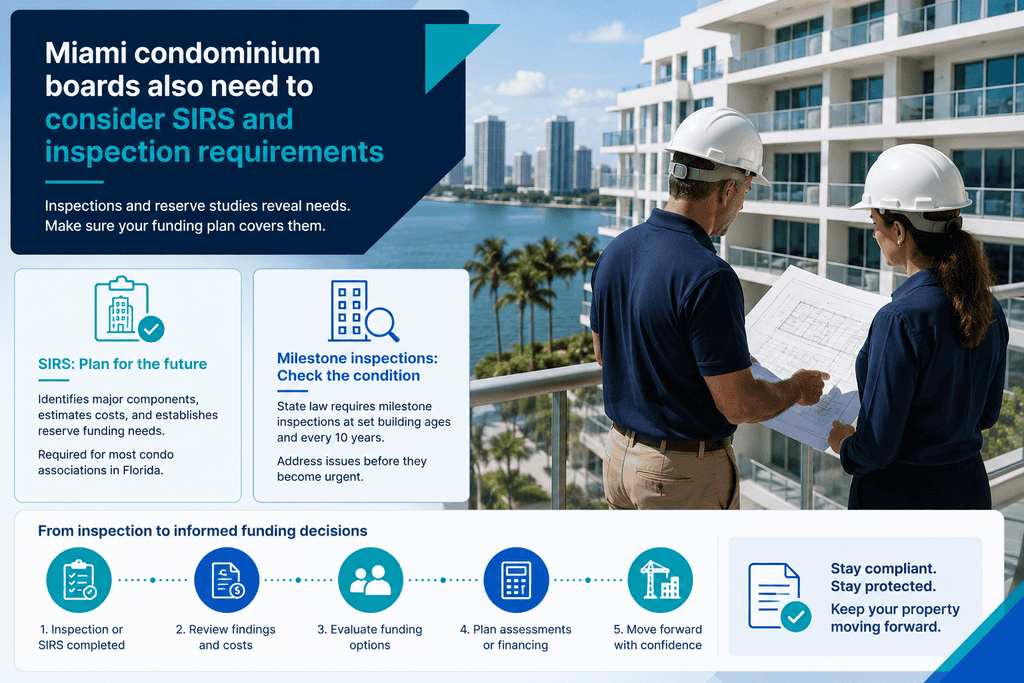
Miami condominium boards also need to consider SIRS and inspection requirements
Association financing decisions in Miami increasingly intersect with building inspections and reserve planning.
A Structural Integrity Reserve Study is a budget-planning study covering specified condominium property components. Florida’s DBPR guidance explains that a SIRS includes a visual inspection of covered components, estimates remaining useful life and replacement or deferred maintenance costs and provides a recommended reserve funding schedule.
Current Florida guidance also allows certain associations with milestone inspections due on or before December 31, 2026 to complete the SIRS at the same time as the milestone inspection. Boards should review the DBPR condominium inspection FAQs because the circumstances in which inspections can overlap are specific.
That doesn’t mean every Miami condominium should borrow to meet reserve requirements.
The study should instead become part of the board’s broader funding analysis.
Separate reserve funding from immediate construction cash
A SIRS may identify expenses expected over a long period. An engineering report or contractor scope may identify work that needs funding much sooner.
Boards should distinguish those two needs.
For example, a condominium might have:
- A current concrete restoration project requiring funding this year.
- A roof replacement anticipated later.
- Elevator work expected on another schedule.
- Annual reserve contributions required under its current SIRS.
Combining every future expenditure into one undifferentiated borrowing request can make the financing harder to evaluate.
Start with the current obligations and timing. Then determine whether financing current construction, reserve obligations or both is appropriate.
Miami-Dade recertification and state requirements aren’t interchangeable
Boards also shouldn’t assume that satisfying one inspection requirement automatically satisfies every other one.
Miami-Dade has its local recertification program while Florida has statewide milestone inspection and SIRS requirements for applicable condominium and cooperative buildings. State guidance explains that a qualifying milestone inspection or similar local inspection completed within the applicable period may, in some circumstances, satisfy the visual inspection portion of a SIRS.
Boards facing overlapping inspection deadlines should confirm the required scope with the applicable building department, engineer, reserve professional and association counsel rather than assuming one report covers everything.
A practical financing scenario for a Miami condo
Consider a hypothetical 150-unit condominium in Miami preparing for exterior restoration, waterproofing and related structural work.
Its board receives a project budget of $6 million after engineering and other expected project costs are included. The association has $1.5 million that its advisers determine can appropriately be applied toward the work.
That leaves a $4.5 million gap.
The board could ask owners to fund the entire amount through a special assessment. Before doing so, it should calculate each unit’s allocation under the condominium documents and evaluate how quickly the money must be collected.
It could also consider financing some or all of the gap.
Suppose the board evaluates three structures:
- Use $1.5 million of available association funds and assess owners immediately for the remaining $4.5 million.
- Keep more cash available, collect part of the project cost from owners and finance the balance.
- Apply the $1.5 million and finance the remaining $4.5 million, using future authorized assessment revenue to service the loan.
The correct choice can’t be determined from the project price alone.
The board has to compare owner affordability, financing costs, reserve needs, contractor timing, existing debt, expected future projects and the legal requirements governing the transaction.
That analysis is more useful than simply asking which lender has the lowest advertised rate.
What to prepare before speaking with an association lender
A board can make the financing process more productive by organizing its information before requesting terms.
Start with this checklist:
- Prepare a complete project scope. Include engineering reports, relevant inspection findings, contractor proposals and expected construction timing.
- Build a full project budget. Account for costs beyond the main construction contract where applicable.
- Identify available funding. Document reserves and other association funds that may be available, subject to proper review.
- Calculate the financing gap. Know how much capital the project actually requires after available funds are considered.
- Organize association financial records. Gather current financial statements, budgets, bank information, delinquency reports and existing debt records.
- Review governing documents and authority. Have counsel confirm the board’s borrowing and assessment procedures before execution.
- Model the owner impact. Translate proposed association debt service into the assessment structure owners would actually see.
When the board reaches the lender with these questions already answered, it can spend more time comparing terms and less time reconstructing basic project information.
Build the financing decision around the project
For a Miami board, the most useful starting point isn’t a loan amount or an interest rate. It is a clear picture of the work that must be completed, when the money is needed and what the association can reasonably fund from existing resources.
Once those facts are established, the board can compare a special assessment, available reserves, association financing or a combination of funding sources on the same basis.
Miami condominium associations, HOAs and co-ops that want to evaluate a specific project can use TuCielo’s association financing information to review the next steps and determine what project and association information will be needed for a financing discussion.
FAQs
Can an HOA get a loan in Miami?
Yes. Community associations in Miami may be able to obtain association financing for qualifying common-property repairs, improvements or other approved purposes. Eligibility depends on the lender’s underwriting, the association’s finances, project details and governing authority.
Can a Miami condo association borrow money for structural repairs?
A condominium association may be able to finance qualifying structural work such as concrete restoration, waterproofing or related repairs. The board should confirm its authority to borrow and approve assessments under Florida law and its condominium documents before entering into a loan.
Does every condo owner have to apply for the association loan?
Generally, no. In an association loan, the condominium or homeowners association is the borrower rather than each individual owner. TuCielo’s published FAQ similarly states that the association is responsible for repayment rather than individual board members or unit owners.
Can association financing be used after a milestone inspection?
It may be an option when a milestone inspection identifies work that the association can’t fully cover with available funds. Boards should first establish the repair scope, project cost and available reserves, then compare financing with assessments and other permissible funding sources.
Are Miami HOA loan interest rates the same for every association?
No. Rates and loan terms can depend on underwriting, market conditions, the requested amount, association finances and other transaction details. TuCielo states that its quoted rates are subject to underwriting review, credit qualification, market conditions and project details.
Is an HOA loan better than a special assessment?
Neither method is automatically better. A lump-sum assessment can avoid borrowing costs but requires owners to provide money sooner, while a loan can make project capital available upfront and spread repayment over time. The board should compare total cost, owner impact and project timing.
What documents should a Miami association prepare for a loan application?
Typical requests can include financial statements, the current budget, delinquency information, governing documents, insurance records, existing debt information, engineering or reserve studies and contractor bids. The exact list varies by lender and transaction. TuCielo’s Florida HOA loan requirements provide a more detailed application document checklist.