

A condo roof replacement cost Florida associations face can vary dramatically from one property to another. Roof area matters, but so do the existing system, deck condition, insulation, drainage, building height, access, engineering requirements and work discovered after demolition begins.
For condominium boards and property managers, that means the useful question isn’t simply, “What does a new roof cost?” It’s “What will our complete project cost, how much cash is actually available and how do we fund the difference?”
This guide explains how Florida associations can build a realistic reroof budget, why seemingly similar buildings receive very different proposals and how reserves, special assessments and association financing can fit into the decision.
How much does condo roof replacement cost Florida associations?
There isn’t a dependable statewide price per unit or per building that a condominium board can use as its final roof budget.
Two Florida condominiums with roughly the same roof area can receive substantially different bids because the contractor may be pricing very different work. One project might involve a relatively straightforward roof-covering replacement. Another could require wet-insulation removal, deck repairs, drainage corrections, equipment relocation, engineering work and substantial waterproofing.
Even a price per square foot needs context. Boards should ask exactly what square footage the contractor measured and what the quoted rate includes.
The most useful cost figure is therefore a property-specific project budget built from a defined scope of work and comparable bids.

Start with the project total, not the cost per unit
Associations sometimes jump directly from a contractor proposal to a per-unit assessment.
That calculation can be useful for communicating with owners, but it comes too early if the proposal doesn’t represent the full cost of the project.
Consider a hypothetical 120-unit condominium with a $1.8 million roofing budget. Dividing the project amount evenly by 120 produces $15,000 per unit before considering how the declaration allocates expenses, existing reserves, financing expenses or other project costs.
If the association has $600,000 properly available for the project, the initial funding gap falls to $1.2 million. If the final construction budget later increases because engineering, permits and deck repairs weren’t included in the first proposal, that gap changes again.
That is why the board should establish four separate numbers:
- The complete anticipated project cost.
- The amount of reserve or unrestricted cash legally available for the project.
- The amount of cash the association intends to retain.
- The remaining amount that must be collected or financed.
This approach gives the board a clearer starting point than an advertised “average Florida roof cost.”
A roof estimate and a roof budget aren’t the same thing
A roofing contractor’s estimate may cover the contractor’s work only.
The association may also have costs involving architects, engineers, consultants, permitting, testing, legal review and construction administration. Some projects require allowances for concealed deterioration that can’t be quantified until the old roofing materials are removed.
When boards begin comparing the project cost with available reserves, special assessments and borrowing, it can help to review how HOA roof replacement financing works for Florida community associations. The financing decision should be based on the complete funding requirement rather than the first roofing proposal alone.
For a board comparing contractor proposals, the useful question is not simply which bid has the lowest total. It is whether each bidder priced the same scope.
Why condo reroof prices in Florida vary so much
An HOA roof replacement cost can change for reasons that aren’t obvious from the building’s footprint.
A large roof with straightforward access and a relatively simple assembly may cost less than a smaller roof with difficult staging, multiple elevations, extensive rooftop equipment or widespread substrate damage.
Several factors deserve particular attention.

The existing roof system
Removing and replacing a low-slope membrane system presents a different scope from replacing tile, metal or another roof covering.
The existing assembly also determines what happens beneath the visible roof surface. Contractors may need to remove multiple layers, replace insulation or address substrate deterioration before installing the new system.
When comparing bids, boards should confirm whether each contractor is proposing the same roof assembly rather than assuming all “replacement” proposals are equivalent.
Moisture and hidden deterioration
A roof can look relatively predictable from above while concealing significant damage underneath.
Leaks may have affected insulation, fasteners, sheathing, decking or other parts of the assembly. Moisture surveys, test cuts and professional inspections can reduce uncertainty, but demolition may still reveal conditions that weren’t accessible beforehand.
A bid that contains no allowance or process for concealed conditions deserves additional scrutiny.
The goal isn’t to inflate the budget with an arbitrary contingency. It is to understand which costs are fixed, which are allowances and which will be determined after demolition.
Building height and contractor access
Equipment and labor logistics become more complicated when crews are working on a multistory occupied condominium.
Material hoisting, debris removal, pedestrian protection, staging areas and equipment placement can all affect the contractor’s approach. Properties with limited ground-level access may require a different logistics plan than communities with open service areas around each building.
Boards should ask whether mobilization, temporary protection and staging are included in each proposal.
Rooftop equipment and penetrations
Condominium roofs may contain HVAC equipment, vents, plumbing penetrations, antennas, exhaust systems and other installations.
A reroof can require coordination with several trades. Curbs may need work. Equipment might need to be temporarily moved or disconnected. Flashing details around penetrations can require additional labor.
A proposal that focuses only on roofing material may not reflect that coordination.
Drainage and waterproofing
Replacing the roof without addressing known drainage problems can leave the association with a new roof system and an unresolved source of trouble.
The project may need to address drains, scuppers, gutters, tapered insulation or transitions to walls and other building components. Waterproofing work may also extend beyond the horizontal roof surface.
Ask the engineer or roofing consultant whether the project is simply a replacement in kind or an opportunity to correct known performance problems.
Florida code requirements
Reroofing work must comply with the applicable Florida Building Code and local permitting requirements. The Florida Building Commission’s code resources provide access to current code information and related technical resources.
Code requirements can affect roof assemblies, fastening methods, product selection, wind resistance and other elements of the project. The applicable requirements can also depend on the building, location, permit date and scope of work.
Boards planning a reroof should have the project’s engineer, architect, roofing professional and local building department confirm the requirements that apply to the specific property rather than estimating them from a roof replacement completed years ago.
What should be included in a condo roof replacement budget?
A useful roof budget should cover the project from investigation through closeout.
That means looking beyond the roofing contract itself.

| Budget category | What the board should verify |
| Roofing contract | Demolition, materials, installation, flashing, labor, equipment and contractor mobilization |
| Design and investigation | Engineering, architectural work, roof surveys, moisture testing and other preconstruction services |
| Existing-condition repairs | Deck, substrate, insulation or structural repairs identified before or during construction |
| Drainage and related work | Drains, scuppers, gutters, tapered systems and associated waterproofing |
| Permits and inspections | Local permit expenses, required inspections and project administration |
| Rooftop coordination | HVAC, electrical, plumbing or other trades affected by roof work |
| Contingency | A defined allowance for reasonably possible conditions that can’t be confirmed before demolition |
The association may have additional costs depending on the property and contract structure.
Ask bidders to identify exclusions
The exclusions page of a proposal can be as important as the total price.
Suppose Contractor A quotes $1.5 million and Contractor B quotes $1.65 million. Contractor A initially looks less expensive. But the first proposal excludes deck replacement, equipment relocation, temporary weather protection and several permit-related costs that Contractor B includes.
Those aren’t necessarily reasons to reject Contractor A. They are reasons to normalize the proposals before comparing them.
Boards can create a simple bid matrix listing each major scope item and marking whether it is included, excluded or priced as an allowance.
Understand unit prices and allowances
Some roofing costs can’t be fixed before demolition.
A contractor might provide a unit price for replacing deteriorated decking rather than guessing how much will be needed. That can be a reasonable structure if the board understands the rate and how quantities will be documented.
Ask:
- What items are allowances rather than fixed-price work?
- What unit prices apply if additional deterioration is discovered?
- Who verifies quantities?
- What approval is required before change-order work proceeds?
- How will the association receive documentation of additional work?
A low base bid with significant open-ended allowances may create more budget uncertainty than a somewhat higher bid with a better-defined scope.
Don’t drain reserves without looking at what comes next
Having enough cash to pay the roofing contractor doesn’t automatically mean spending every available dollar is prudent or permissible.
The association may have upcoming obligations involving concrete restoration, waterproofing, elevators, electrical work, plumbing or another component included in its reserve planning.
Boards should therefore model the reserve position after the roof project, not only before it.
A useful cash analysis shows the current balance, the amount applied to the roof, expected contributions during construction and the projected balance after completion.
For associations dealing with several reserve obligations at once, the broader association financing options available to Florida communities can provide context when comparing existing cash, owner assessments and borrowed funds.
How Florida reserve rules affect the funding decision
Roof replacement has a specific place in Florida condominium reserve planning.
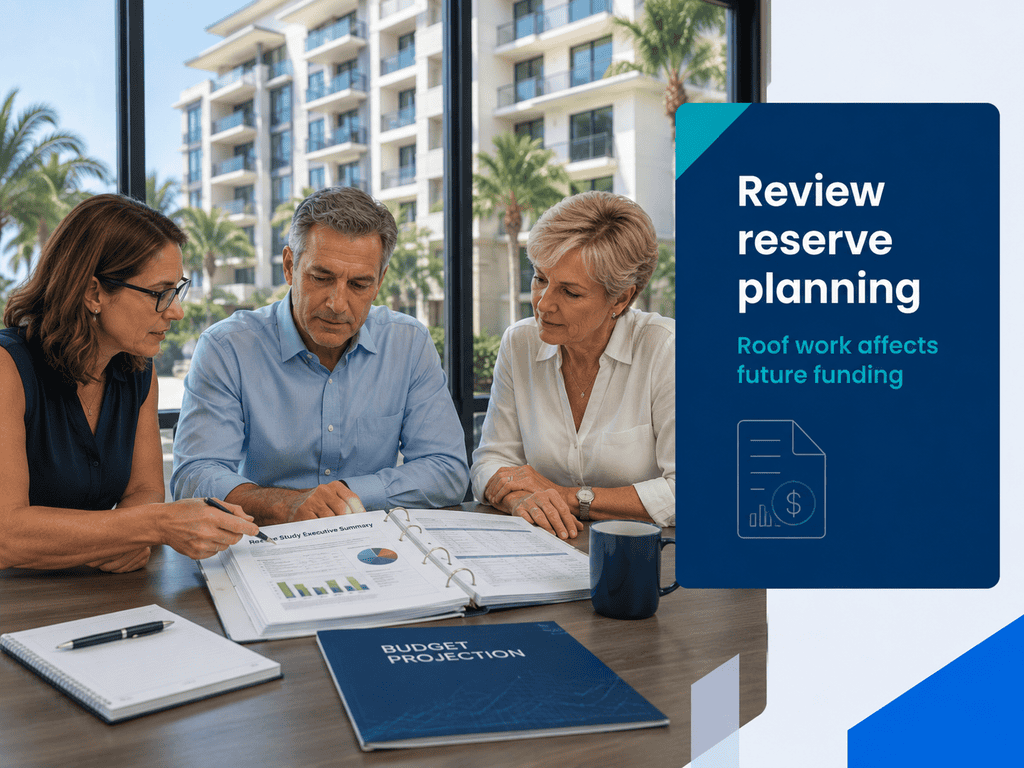
Under Section 718.112 of the Florida Statutes, condominium budgets must include reserves for certain capital expenditures and deferred maintenance, including roof replacement. For residential condominium buildings subject to Structural Integrity Reserve Study requirements, the roof is also one of the components specifically addressed by the study.
A Structural Integrity Reserve Study, commonly called a SIRS, evaluates designated building components and includes estimates of remaining useful life, replacement cost or deferred maintenance expense and an associated reserve funding plan. The Florida Department of Business and Professional Regulation provides additional SIRS inspection guidance for condominium associations.
Required reserves can change the board’s cash strategy
Florida’s reserve requirements affect more than the amount an association budgets each year. They can also affect how a board approaches the funding of a major roof project.
A board may have substantial cash on its balance sheet but still need to determine:
- Which reserve account holds the money.
- Whether the funds may be used for the roof.
- How the expenditure affects the current SIRS funding schedule.
- What other component expenditures are approaching.
- Whether the reserve study should be updated after the project or funding structure changes.
Current Florida law also addresses the use of regular assessments, special assessments, lines of credit and loans within the SIRS funding framework. The statute includes requirements that can apply when an association selects a funding method that changes its reserve funding schedule.
Because those requirements depend on the association’s circumstances, governing documents and proposed transaction, the board should have association counsel and its financial professionals review the intended structure before committing funds or debt.
Replacing the roof can affect the reserve study
Once a major component is replaced, its remaining useful life and anticipated future replacement schedule may change substantially.
Florida law allows a SIRS to be updated to reflect changes to the useful life of reserve items after repair or replacement. It also addresses updates when the association chooses a funding method that affects the reserve funding schedule.
This creates a useful sequence for boards:
First, establish the technical scope. Next, determine the project cost and funding method. Then confirm how the completed project and funding structure should be reflected in the association’s reserve planning.
The SIRS should remain connected to the association’s actual capital plan rather than being treated as a document that gets filed away after completion.
How associations can fund a Florida condo roof replacement
Once the board knows the anticipated project cost and available cash, it can evaluate how to cover the gap.
The main choices are reserves, a special assessment, owner installments, association financing or a combination of methods.
Use available reserves
Properly available roof reserves can reduce or eliminate the need to borrow.
This is usually the simplest source of project funds because the money has already been accumulated. There’s also no loan interest associated with the amount paid directly from reserves.
The board still needs to confirm that the expenditure is permitted and determine what the reserve position will look like afterward.
Using $1 million from reserves for a $1.2 million roof may sound preferable to borrowing. But if that leaves almost no available cash while another required component approaches replacement, the broader financial picture may favor a different allocation.
Levy a lump-sum special assessment
A special assessment can collect the required money directly from owners.
If owners can pay and the collection schedule matches the contractor’s payment requirements, the association can avoid financing interest.
The disadvantage is concentration. Owners may be asked to absorb a substantial obligation over a short period.
The board should calculate the actual owner payment rather than simply saying the assessment will be “spread out.” A $24,000 obligation collected over six months remains $4,000 per month before considering differences in how expenses are allocated among units.
Collect an assessment in installments
Longer owner payment schedules may reduce the immediate burden, but they create another issue: when does the association receive enough cash to pay the contractor?
A roofing contractor may require a deposit, mobilization payment and progress payments well before every owner installment has been collected.
That makes timing critical.
Boards considering this structure can compare the cash-flow differences between an owner installment schedule and a special assessment payment plan supported by association financing. The important comparison is not only what owners pay each month, but when the association receives enough money to meet the project’s construction schedule.
Finance some or all of the project
With association financing, the condominium association borrows the project funds and repays the debt from association revenue under the approved repayment structure.
This can be useful when construction needs to begin sooner than the association can accumulate the required cash.
Financing doesn’t make the roof less expensive. Interest, fees and other financing requirements increase the total amount paid. What borrowing changes is the timing of those payments.
TuCielo states in its association financing FAQs that eligible common-area projects can include roofing and waterproofing. Actual approval and terms depend on the association, project and underwriting review.
Boards considering a loan should compare more than the monthly payment. Review the principal amount, interest rate, amortization period, fees, required reserves or accounts, security provisions, prepayment terms and total repayment obligation.
Use a blended funding structure
Many associations don’t have to choose between paying entirely from cash and financing the whole project.
Suppose a hypothetical condominium expects a $2.4 million complete project cost and has $1.1 million available for the roof. The board might decide that using the full $1.1 million would leave too little liquidity for other obligations.
Instead, it could allocate $700,000 to the project and evaluate funding options for the remaining $1.7 million.
That approach lets the board balance three competing needs:
- Reduce the amount that must be borrowed.
- Avoid an unusually large immediate owner assessment.
- Retain enough association liquidity for other obligations.
There is no universal percentage of reserves that an association should contribute. The appropriate amount depends on reserve restrictions, projected expenses, cash-flow needs and professional advice specific to that property.

A board checklist before approving the roof project
Roof replacement decisions become easier to explain when the technical and financial information is assembled in one place.
Before the final vote, the board can work through this process:
- Confirm responsibility for the roof. Review the declaration and other governing documents to establish exactly which roof components the association maintains and pays for.
- Document current conditions. Gather inspection reports, leak history, warranties, repair records, photographs and relevant SIRS findings.
- Define one bid scope. Give bidders a consistent specification so pricing can be compared on the same basis.
- Build the complete budget. Add engineering, permits, testing, related trades, likely allowances and other costs outside the base roofing contract.
- Identify available funds. Separate roof reserves, other restricted reserves and unrestricted association cash rather than treating every dollar as interchangeable.
- Calculate the funding gap. Determine how much remains after the board’s planned cash contribution, then compare assessment and financing structures against the contractor’s payment schedule.
- Review the decision professionally. Have the association’s attorney, accountant and appropriate engineering or roofing professionals review the legal, financial and technical issues within their areas of responsibility.
If financing remains part of the plan, prepare the information a lender will need before requesting terms.
TuCielo’s explanation of how its association financing process works lists initial materials such as recent financial statements, the current budget, a delinquency report, SIRS or engineering documentation and available project contracts or bids.
A well-prepared package also helps the board itself. If the association can clearly explain the scope, cost, available reserves, funding gap and repayment source to a lender, it should also be able to explain them to owners.
Turn the roof budget into a funding plan
A roof replacement budget becomes useful only when the board connects the construction cost to the association’s available cash, reserve obligations and owner payment capacity.
Start with a complete scope rather than a headline price per square foot. Identify exclusions and allowances. Confirm what reserve funds can be applied. Then calculate the remaining funding gap and compare the timing and total cost of assessments and financing.
Florida condominium boards that have established their roof budget but still face a funding gap can speak with TuCielo about available association financing and the documentation needed for an initial review. Any proposed loan should be compared with the association’s cash, assessment alternatives, governing documents and advice from its legal and financial professionals.
FAQs
How much does a condo roof replacement cost in Florida?
There is no reliable statewide price that applies to every condominium. The condo reroof price in Florida depends on roof area, system type, existing conditions, access, deck or insulation repairs, engineering, drainage work and the final project specification.
Boards should rely on a property-specific scope and comparable contractor bids rather than a generic per-unit estimate.
What costs are commonly missed in an HOA roof replacement budget?
Engineering, moisture investigation, permits, testing, deck repairs, insulation, drainage work, equipment coordination and construction administration can sit outside an initial roofing quote.
The board should also identify allowances and unit-price work that may increase the contract after demolition begins.
Does Florida require condominium associations to reserve for roof replacement?
Florida condominium law includes roof replacement among the items addressed by statutory reserve requirements. Buildings subject to SIRS requirements must also include the roof among the components evaluated by the study.
The exact obligations depend on the association, building and current law, so boards should review the applicable statute and their current reserve study with qualified professionals.
Can a Florida condo association borrow money for a roof?
Association financing can be used to fund major common-property projects, including roof replacement. Florida condominium law also recognizes loans and lines of credit within the current SIRS funding framework.
The association’s authority, approval process and repayment structure can depend on applicable law and its governing documents, so the proposed transaction should receive appropriate legal and financial review.
Is a special assessment cheaper than an association loan?
A cash-funded special assessment avoids the interest expense associated with borrowing, so its financing cost can be lower. That doesn’t automatically make it the better option for every community.
Boards also need to consider how quickly money must be available, how much each owner would have to pay and whether collections will match the construction schedule.
Should a condo use all of its roof reserves before borrowing?
Not automatically. The board should confirm which reserves can be used, what other reserve or capital obligations are approaching and how much liquidity the association needs to retain.
A combination of reserves and financing may be appropriate in some situations, while another association may be able to pay entirely from existing funds.
What should a Florida condo board prepare before seeking roof financing?
Start with the roof inspection or engineering report, current project budget, contractor proposals, reserve information, financial statements, annual budget and delinquency report. A lender may request additional governing, insurance, financial and project documentation during underwriting.
Preparing these materials before requesting financing makes it easier to compare proposed terms against the association’s actual funding gap.