

HOA roof replacement financing gives a community association a way to complete major roofing work when available reserves won’t cover the full project cost. Instead of asking every owner for a large payment at once, the association may combine reserves, a special assessment and an association loan to fund the work.
This guide is for HOA and condominium board members, property managers and owners evaluating how to pay for a shared roof replacement. It explains the main funding options, how an association roof loan works, what lenders may review and how Florida reserve requirements can affect the board’s decision.
The right approach depends on the association’s governing documents, available reserves, project urgency, owner finances and the terms offered by each financing provider. Boards should review legal and financial decisions with qualified professionals who understand the association’s circumstances.
Why roof replacement creates a difficult funding decision
A roof is one of the largest shared building components an association may need to replace. The cost can extend beyond removing old materials and installing a new roof system.
A complete project budget may also include:
- Engineering or consultant fees
- Moisture testing and damage investigation
- Permit costs
- Insulation or decking repairs
- Drainage improvements
- Temporary weather protection
- Contractor mobilization
- Material price adjustments
- Construction administration
- A contingency for conditions discovered after work begins
This makes early contractor estimates useful but incomplete. A board that secures financing based only on the first roofing proposal may face another funding gap once design work, permits and concealed damage are added.
The timing can also be difficult. An association may have planned to replace the roof several years from now, only to learn that its remaining useful life is shorter than expected. An engineer may identify deterioration, an insurer may request repairs or repeated leaks may make further patching impractical.

Reserves may cover only part of the project
Associations often maintain reserve accounts for major repairs and replacements. However, the roof reserve balance may be lower than the current project cost because:
- Earlier reserve studies used outdated construction estimates.
- Material and labor costs increased faster than expected.
- The roof reached the end of its useful life sooner than projected.
- Reserve contributions were reduced or waived when permitted.
- Some roof funds were already spent on emergency repairs.
- The project now includes waterproofing, drainage or structural work that wasn’t part of the original estimate.
- Multiple building components require attention at the same time.
For example, an association may have accumulated a substantial roof reserve but still face a shortfall after receiving current bids. Using the entire reserve balance could also leave little room for related repairs or other near-term obligations.
The board then has to decide whether to use reserves alone, levy a special assessment, finance the shortfall or combine several methods.
Waiting may change the scope of work
Deferring a roof replacement doesn’t simply delay the same invoice. Active leaks can damage insulation, decking, ceilings, electrical systems and interior finishes. Water intrusion may also make occupied areas harder to use while increasing the number of owner complaints and emergency service calls.
That doesn’t mean every aging roof must be replaced immediately. Boards should rely on professional inspections, maintenance records and project-specific recommendations rather than assumptions about age alone.
The practical question is whether the existing roof can be maintained safely and economically until the association accumulates more funds. A roofing consultant, architect or engineer can help the board understand that distinction.
HOA roof replacement financing options
Community associations generally have five ways to fund a shared roof project. Some use one method while others combine two or more.
| Funding method | How it works | Main issue for the board to review |
| Existing reserves | The association pays from money already set aside for roof replacement or related work. | Confirm that the funds may be used for the project and determine what reserve balance will remain. |
| Operating cash | Available unrestricted cash pays part of the cost. | Avoid reducing the association’s operating or emergency cushion to an unsafe level. |
| Lump-sum special assessment | Owners pay their allocated share by a set deadline. | The association avoids loan interest but owners may have difficulty making a large payment. |
| Installment assessment | Owners pay the assessment over several months or years. | Collections may not provide cash quickly enough to meet the contractor’s schedule. |
| Association loan | The association borrows project funds and repays the lender from association revenue. | Review the full financing cost, repayment source, security terms and approval requirements. |
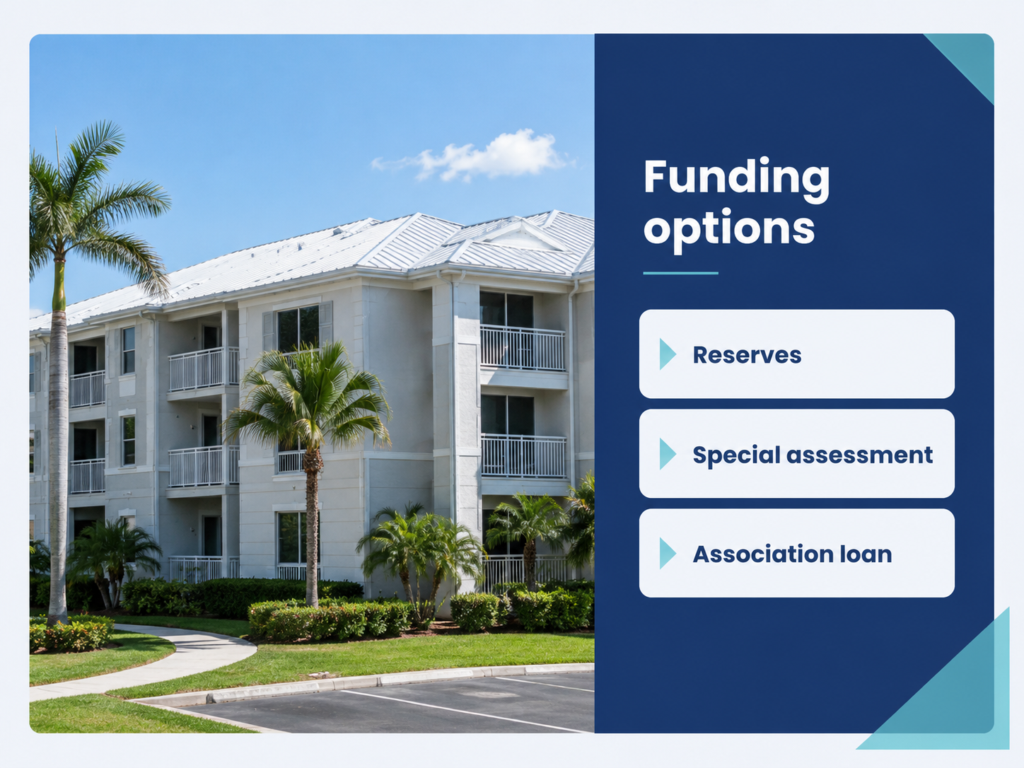
Paying from reserves
Using properly available reserves is usually the most direct option. The association doesn’t incur financing costs and owners don’t receive a separate demand for the full project amount.
Before spending the funds, the board should confirm:
- How much is available for the roof.
- Whether the funds are restricted to a specific component or purpose.
- Whether the proposed scope matches that purpose.
- What other projects are expected during the same period.
- Whether the remaining balance will support near-term reserve obligations.
- What owner vote, board action or notice may be required.
Florida condominium associations should pay particular attention to restrictions applying to reserves identified through a Structural Integrity Reserve Study (SIRS). The Florida Department of Business and Professional Regulation describes a SIRS as a budget-planning study that evaluates specified building components, existing reserve funds and the funding required for future major repairs. The listed components include the roof. Florida’s SIRS reporting guidance explains the current reporting framework.
A reserve balance shown on a financial statement shouldn’t automatically be treated as unrestricted cash. The board, association counsel and accounting professionals should confirm how the funds may be used.
Levying a lump-sum special assessment
A special assessment collects the project cost from owners rather than a lender. The association may avoid loan interest and can proceed without a long repayment obligation.
The challenge is affordability. A large roof project divided among a limited number of units can produce a significant per-owner charge. Even when the community supports the work, some owners may need time to access savings, arrange personal financing or sell assets.
Boards should also consider collection risk. A project budget based on every owner paying on time can become difficult to manage if a portion of the assessment remains unpaid when contractor invoices are due.
Before relying on a lump-sum assessment, calculate:
- The total project amount
- The portion covered by reserves
- The remaining amount allocated to owners
- Each unit’s share under the governing documents
- The assessment due date
- The expected collection rate
- The consequences of delayed collections
- The cash needed before the contractor mobilizes
The board should avoid presenting the assessment as a simple division of project cost by unit count unless every unit has the same allocation. The declaration may assign different percentages or shares.
Offering owner installments
An association may allow owners to pay a special assessment in installments. This can reduce the immediate burden but may create a mismatch between owner payments and construction expenses.
A roofing contractor may require a deposit, progress payments and final payment within a much shorter period than the owner installment schedule. The association needs enough cash to bridge that timing gap.
Installments also create administrative work. Management must track balances, late payments and owner accounts while continuing to meet the association’s obligations to the contractor.
Using an association loan
An association loan provides project funds to the association. The association, rather than each owner, is the borrower. Repayment commonly comes from assessments or other association revenue under the structure approved for the project.
This option can spread a large roof expense over time. It may also let the association align the cost more closely with the years in which owners benefit from the new roof.
However, lower periodic payments don’t necessarily mean a lower total cost. The board should compare principal, interest, fees, reserves required by the lender and any early payoff provisions.
TuCielo provides association financing for Florida community projects, including roofing and waterproofing work. Product availability, approval and terms depend on underwriting and the association’s circumstances.
Combining reserves and financing
Many boards don’t need to choose between using all reserves and borrowing the full project amount. A blended structure may use part of the available roof reserve as an equity contribution while financing the remaining shortfall.
This can reduce the amount borrowed without draining every available dollar. The board still needs to decide how much liquidity the association should retain.
Consider three figures separately:
- Available reserves: Funds legally and practically available for this roof project.
- Minimum retained cash: Money the association should keep for operations, emergencies and other scheduled obligations.
- Financeable shortfall: The remaining project amount after available funds are applied.
This approach produces a more useful financing request than simply asking a lender for the contractor’s base bid.
How an association roof loan works
Condo roof financing and HOA financing follow the same broad principle: the community association enters into the loan and uses the proceeds for common-property work.
The exact structure can vary. The lender may review the association’s right to collect assessments, financial history, owner delinquencies, governing documents, insurance and project contracts. Loan documents may assign or pledge association revenue as security.
Individual owners generally don’t sign the association’s promissory note merely because they own a unit. However, owners remain responsible for assessments properly levied under the governing documents and applicable law. Boards should avoid promising that financing will have no effect on owners. It may change the amount owners pay to the association even when the loan isn’t a personal consumer loan.
TuCielo’s association financing FAQ explains its product structure and the relationship between the association loan and owner payments. Boards should still review the actual term sheet and loan documents provided for their transaction.

The association remains responsible for repayment
The lender advances funds to the association, which then pays contractors according to the project and disbursement arrangements. The association makes scheduled payments from its revenue.
That repayment source must be realistic. Before approving financing, the board should model:
- The proposed loan payment
- Current regular assessments
- Any separate debt-service assessment
- Existing loans
- Owner delinquency levels
- Anticipated reserve contributions
- Insurance and operating cost increases
- The effect of vacancies or collection delays
- The association’s required cash cushion
A monthly payment that appears manageable in isolation may become difficult when combined with rising insurance premiums, reserve contributions and another major repair.
Owners may receive a choice
Some associations give owners an opportunity to pay their allocated share up front while other owners pay over time through the financing structure. Whether this can be offered and how it should be administered depends on the association’s governing documents, loan terms and legal advice.
The board should clarify:
- Whether owners can prepay before closing
- Whether later prepayments are permitted
- How owner balances are calculated
- Whether financing costs are allocated only to participating owners
- How transfers are handled
- What happens if an owner becomes delinquent
- Whether the association can partially prepay the loan
These details should be settled before the owner vote or assessment notice when possible. Changing the payment structure after owners have made decisions can create confusion and disputes.
Commercial roof funding may follow a similar process
Commercial condominium associations, business parks and other shared-property organizations can also face common roof obligations. Commercial roof funding may involve different governing documents, tenant arrangements, budgets and insurance requirements.
A business park association should determine whether the roof is maintained by the association, individual parcel owners or building owners before seeking financing. The legal maintenance obligation should match the borrower and project scope.
A practical process for boards
Financing is easier to evaluate when the board first builds a complete project record. A vague request for “roof money” gives contractors, owners and lenders too little information.
The following process helps turn an urgent repair need into a financing decision the board can explain.
1. Confirm who is responsible for the roof
Review the declaration, maintenance provisions, plats and any amendments. Determine whether the association is responsible for the entire roofing system, selected buildings or only certain common elements.
This step matters in communities with townhomes, villas, mixed-use buildings or limited common elements. The party responsible for maintenance may differ from the party responsible for interior damage.
Association counsel should address unclear language before the board signs a construction or financing agreement.
2. Document the roof’s condition
Gather inspection reports, leak records, repair invoices, photographs, warranties and insurance correspondence. Ask the roofing professional to separate immediate concerns from work that can reasonably wait.
The board should understand:
- The roof type and approximate installation date
- The remaining useful life
- Known leak locations
- Existing moisture or deck damage
- Whether repairs remain practical
- Whether code-related upgrades may apply
- Whether several buildings can be phased
- What temporary work is needed before replacement
For a condominium subject to SIRS requirements, compare the project scope with the roof findings and funding schedule in the study.
3. Establish the full project budget
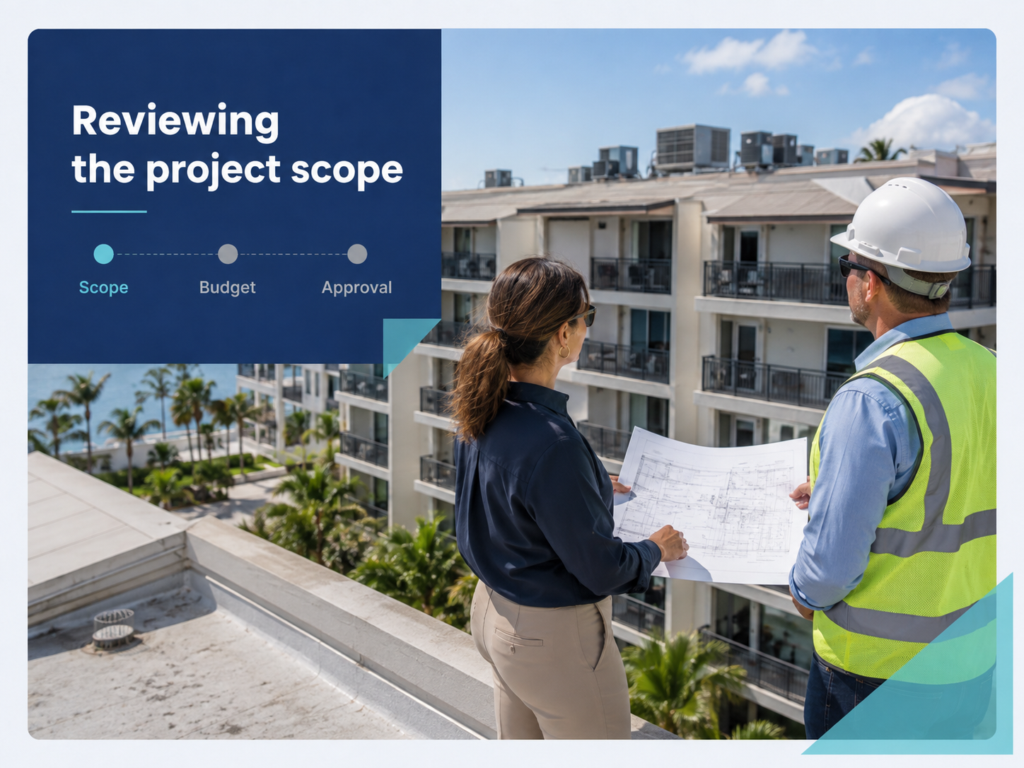
Request comparable proposals based on a consistent scope. A low proposal may exclude important items included by another bidder.
Build a budget that identifies:
- Construction contract amount
- Design and engineering fees
- Permits and inspections
- Testing
- Legal review
- Financing expenses
- Owner communication costs
- Contingency
- Temporary repairs
- Potential change orders
- Any required debt-service reserve
The contingency should reflect project conditions rather than an arbitrary amount. An occupied coastal building with uncertain deck conditions may carry different risk than a simple replacement with recent documentation.
4. Determine the funding gap
List every confirmed funding source and avoid counting restricted funds twice.
A basic calculation is:
Full project budget minus available project funds equals the funding gap.
Available project funds may include the applicable roof reserve, approved operating surplus and special assessment proceeds already collected.
The board can then compare borrowing the full gap with using more reserves or collecting a partial owner payment.
5. Compare repayment structures
Don’t compare proposals by periodic payment alone. Create a side-by-side review that includes:
- Amount financed
- Interest rate structure
- Repayment period
- Estimated periodic payment
- Origination and closing costs
- Required deposits or reserve accounts
- Total scheduled repayment
- Prepayment provisions
- Default provisions
- Collateral or revenue pledge
- Disbursement conditions
- Reporting requirements
- Personal guarantees, if any
- Conditions that must be met before closing
Boards comparing a bank with a specialized association lender can review TuCielo’s explanation of how its financing compares with traditional bank lending. The final decision should be based on the written terms offered to the association rather than general website comparisons.
6. Check the approval path
The board should identify every approval before committing to a schedule. Depending on the association and transaction, the process may involve:
- Board approval
- Owner approval
- A special assessment vote
- Notice and meeting requirements
- Lender review of governing documents
- Legal opinions
- Contractor approval
- Insurance confirmation
- An updated engineering report
- Existing lender consent
Florida condominium and HOA requirements aren’t identical. Governing documents may also impose stricter approval rules than the statute.
Association counsel should confirm the correct procedure, including the voting threshold and notice language.
7. Prepare the financing file
Lenders commonly request enough information to understand the association’s financial condition, authority and construction plan.
A board should be ready to provide:
- Current budget
- Year-to-date financial statements
- Prior-year financial reports
- Bank and reserve statements
- Owner delinquency report
- Assessment roll
- Governing documents and amendments
- Board or owner resolutions
- Insurance policies
- Existing loan documents
- Roofing proposals and contracts
- Engineering, SIRS or inspection reports
- Construction schedule
- Proposed disbursement schedule
TuCielo’s association financing process lists the initial documents it requests and the information reviewed during underwriting.
Organizing these records early can also expose issues the board should resolve, such as expired bids, inconsistent project totals or an outdated delinquency report.
8. Explain the decision to owners
Owners need more than a statement that the roof must be replaced. A clear presentation should explain:
- What the inspection found
- Why the proposed scope was selected
- What alternatives the board considered
- How much is available in reserves
- Why a funding gap remains
- What each payment option would require
- How long repayment may last
- What assumptions are still subject to change
- What approvals are required
- Where owners can review supporting records
Avoid presenting an estimated owner payment as final before the rate, term, fees, allocation and financed amount are confirmed.
Florida considerations for condominium roof projects
Florida condominium boards may have additional reserve and reporting issues when a roof project falls within the association’s structural obligations.
The Florida condominium financial guidance states that condominium budgets must include reserve accounts for capital expenditures and deferred maintenance including roof replacement, building painting and pavement resurfacing. It also explains that SIRS-related reserves generally can’t be waived or reduced where the statutory requirements apply.

SIRS requirements don’t apply to every community called an HOA. They primarily concern qualifying condominium and cooperative buildings under Chapter 718 and related provisions. A homeowners association governed by Chapter 720 should obtain advice based on its own property, reserve structure and governing documents.
Reserve compliance doesn’t automatically provide construction cash
An association may be increasing annual reserve contributions but still lack enough cash to replace the roof now. Reserve funding schedules build money over time. A project that becomes urgent before the reserve is fully accumulated creates a timing problem.
Financing may address that timing gap, but it doesn’t remove the association’s other statutory, contractual or budget obligations. The board should understand how loan payments, reserve contributions and owner assessments work together.
Hypothetical example
Consider a Florida condominium association with several residential buildings. Its SIRS identifies the roofs as a required component with limited remaining life. Recent inspections also find recurring leaks and sections of deteriorated decking.
The association has money in its roof reserve but current proposals exceed that balance. The board evaluates four paths:
- Delay the project and continue repairs.
- Use all roof reserves and collect the balance through a lump-sum assessment.
- Use part of the reserves and finance the shortfall.
- Finance most of the work while retaining more cash for another scheduled building project.
The board asks its engineer whether delay is reasonable, its attorney what approvals are required and its accountant how each option affects cash flow. It then compares the total cost and owner impact of the viable choices.
This scenario doesn’t point to one universal answer. It shows why the financing decision should follow the project analysis rather than come before it.
Prepare the project before choosing the financing
A roof loan can help an association move forward when the required work exceeds available cash, but financing works best when the project scope and repayment plan are already clear.
Before speaking with a provider, prepare the current roof reports, complete budget, contractor proposals, reserve information, delinquency report and expected project schedule. Decide how much cash the association can contribute without weakening other obligations.
Florida community associations that want to compare funding paths can speak with TuCielo about their roof project, available association financing and the documents needed for an initial review. Any proposal should be considered alongside legal advice, the association’s governing documents and a full comparison of costs and obligations.
FAQs
Can an HOA borrow money for a roof replacement?
An HOA may be able to borrow for a common-property roof replacement if its governing documents and applicable law authorize the transaction. The required approval may involve the board, owners or both. Association counsel should confirm the correct process before the board signs a loan agreement.
What’s the difference between an association loan and a special assessment?
An association loan provides funds from a lender and creates a repayment obligation for the association. A special assessment collects money from owners under the association’s governing authority. Financing may let the association spread collections over time, while a lump-sum assessment avoids lender interest but requires owners to pay sooner.
Can roof reserves be used as part of the down payment?
Available roof reserves may be used to reduce the amount financed when the expenditure is permitted and properly approved. The board should confirm that the funds are assigned to the roof project and determine how much liquidity should remain after the contribution.
Does every Florida HOA need a structural integrity reserve study?
No. Florida’s SIRS requirements apply to specified condominium and cooperative buildings rather than every homeowners association. Building height, association type and other statutory conditions matter, so boards should check current DBPR guidance and consult association counsel.
What documents are needed for condo roof financing?
Common requests include budgets, financial statements, reserve balances, delinquency reports, governing documents, insurance records, engineering reports and roofing proposals. The lender may request more information after reviewing the association and project.
Should the association finance the entire roof project?
Not necessarily. The association may finance the full cost, only the funding gap or a portion that preserves operating and reserve liquidity. The board should compare total financing cost, remaining cash, owner payments and other planned projects before deciding.
How should a board compare roof financing proposals?
Compare the amount financed, rate structure, term, periodic payment, fees, total scheduled repayment, security provisions and prepayment terms. Also review disbursement requirements, closing conditions and how the proposed payment fits the association’s broader budget.