

A condo association loan Fort Lauderdale boards consider is usually tied to a large building expense that can’t be covered comfortably from existing reserves. Concrete restoration, roofing, waterproofing, structural work, elevators and reserve funding can all create costs that arrive faster than an association can collect them.
This guide is for condominium board members and property managers in Fort Lauderdale and elsewhere in Broward County. It explains when association financing may make sense, what local building requirements can affect the timing and how boards can compare borrowing with special assessments and other funding methods.
This is general educational information, not legal or financial advice. Florida condominium law, an association’s governing documents and the terms of a proposed loan can materially affect a board’s options. Association counsel and qualified financial professionals should review significant financing decisions.
Why Fort Lauderdale condo associations may need financing
Condominium financing is rarely a standalone decision. Usually, the board is trying to solve a timing problem.
A building may need several million dollars of work while the association has only part of that amount available in reserves. Waiting years to accumulate the rest may not be practical if the roof is failing, structural repairs have been identified or an inspection creates a specific repair timetable.
That issue is especially relevant in Fort Lauderdale because associations can face both statewide condominium requirements and Broward County building inspection requirements.
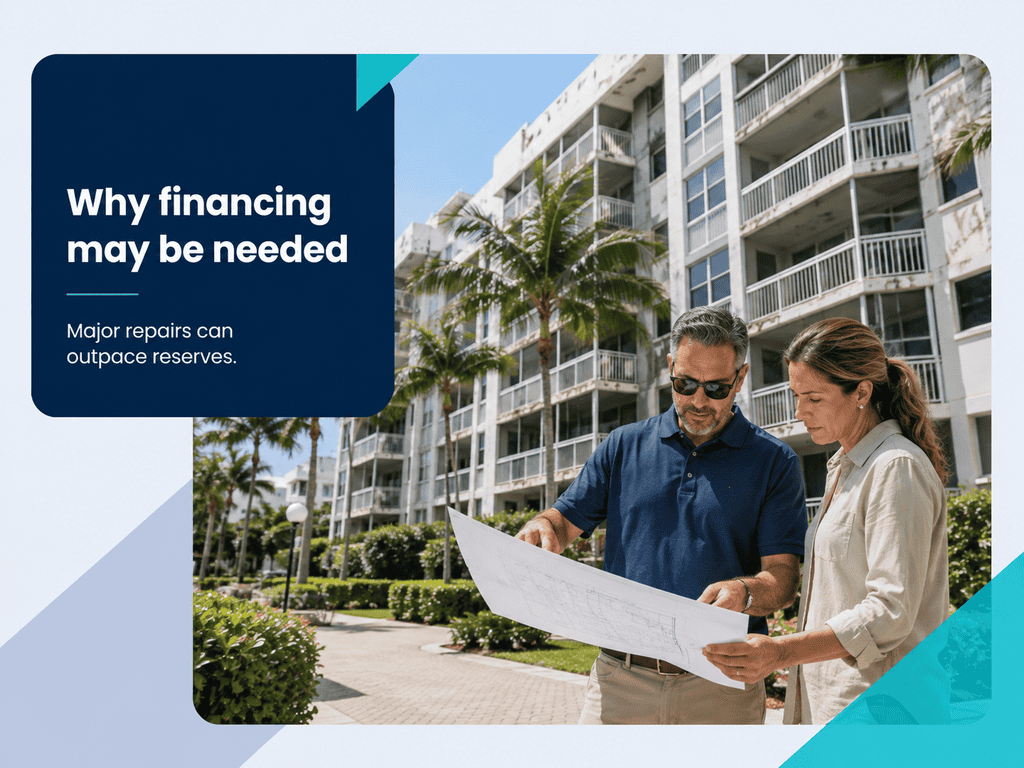
The City of Fort Lauderdale Building Safety Inspection Program applies to many buildings and structures once they reach 25 years of age, followed by inspections every 10 years. Qualified architects or engineers perform the required structural and electrical reviews. If repairs are required, the inspection process can move a building from long-term capital planning into a much more immediate funding decision.
Florida law also establishes milestone inspection requirements for qualifying condominium and cooperative buildings. Under Florida Statute 553.899, residential condominium or cooperative buildings that are three stories or more generally require a milestone inspection by the end of the year in which the building reaches 30 years of age, followed by inspections every 10 years.
For a Fort Lauderdale board, those requirements can expose costs that were previously expected but not fully funded. The board may know that exterior restoration or electrical work is coming. An inspection can clarify how much work is needed and when it must occur.
Common financing needs include:
- Concrete restoration and structural repairs identified through engineering work or inspections.
- Roof replacement, waterproofing and exterior envelope repairs.
- Electrical or plumbing improvements in aging buildings.
- Elevator modernization and mechanical system work.
- Impact windows, doors and other common-area improvements.
- Seawall or marine infrastructure work at waterfront properties.
- Reserve funding where borrowing is permitted and appropriate.
TuCielo’s association financing options are designed for Florida condominium associations, homeowners associations and cooperative associations funding eligible capital improvements, repairs and reserve needs.
The important distinction is that the loan should follow the project. Boards shouldn’t begin with, “How much can we borrow?” They should begin with, “What work must we complete, when must it happen and what does a realistic project budget require?”
How a condo association loan Fort Lauderdale boards consider actually works
An association loan is taken out by the condominium association rather than by individual unit owners.
The association receives financing for an eligible association expense and becomes responsible for repaying the lender. The board then needs a reliable source of association revenue to make those payments. That revenue often comes from regular assessments or a specially approved assessment structure.
This differs from asking every owner to obtain a personal loan for his or her share of the project. The financing agreement is between the lender and the association.
Boards that want a more detailed look at the borrowing structure can review TuCielo’s guide explaining how HOA loans work for Florida associations. It covers the association’s role as borrower, the project-planning process and the records lenders may review.
Financing doesn’t eliminate the owners’ cost
Borrowing changes when the association receives the money. It doesn’t make the underlying project cheaper.
If a $3 million repair is financed, the association still has to repay principal, interest and any applicable financing costs under the loan documents. Those costs ultimately have to be supported by association revenue.
That makes owner communication important. A board comparing financing with a special assessment should explain both the near-term payment difference and the total financing obligation.
A large lump-sum assessment may cost less overall because there’s no long-term borrowing cost. A loan may make a required project financially manageable by distributing the payments over a longer period.
Neither option is automatically better.
A hypothetical Fort Lauderdale example
Consider a hypothetical 90-unit Fort Lauderdale condominium that receives engineering recommendations for concrete restoration, waterproofing and electrical work.
The association has $800,000 available for the project but bids and professional costs indicate it needs substantially more. The board could consider several approaches.
It might impose a larger special assessment and collect the remaining amount before construction starts. It could combine available reserves with a smaller special assessment and financing. Or it could borrow a larger portion of the project cost and spread repayment over time.
The right comparison would include more than the monthly payment. The board would need to review the project schedule, existing reserve obligations, owner affordability, loan costs and the legal authority required for each funding method.
That is the type of decision where Broward condo financing becomes part of a larger capital plan rather than a standalone banking exercise.
Broward County inspections and Florida reserve rules can affect the funding decision
For older Broward County buildings, financing decisions often overlap with inspection and reserve requirements.
Those rules should be treated separately because they solve different problems. An inspection determines or evaluates building condition. A Structural Integrity Reserve Study (SIRS) addresses long-term reserve planning for specified building components. Financing determines how the association obtains money to meet an obligation.
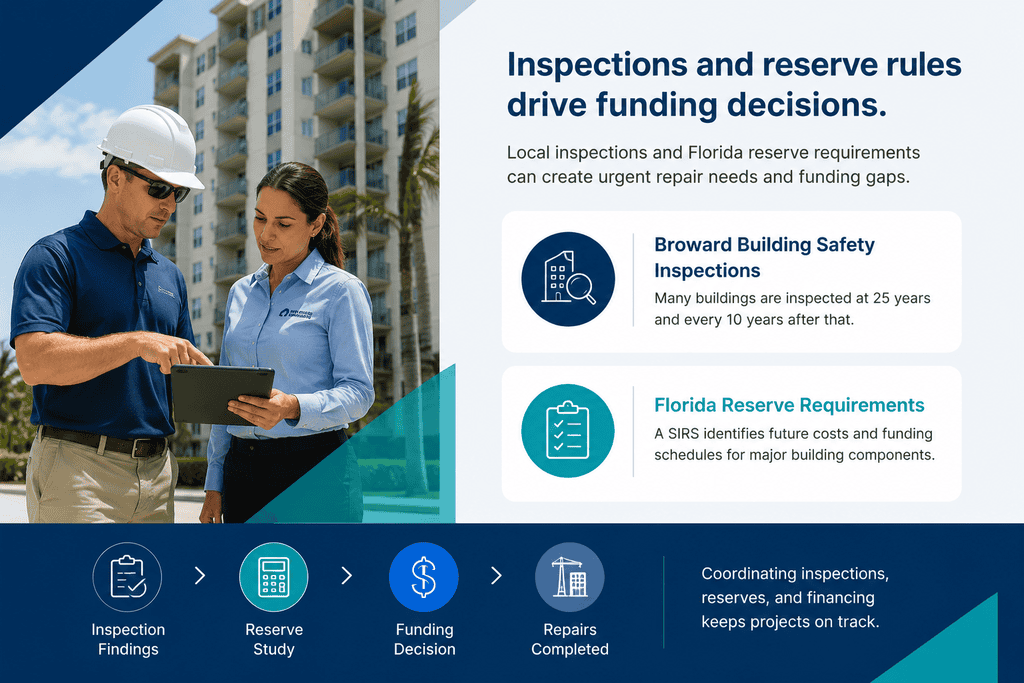
Broward’s building safety inspection program
Fort Lauderdale’s current building safety program requires covered buildings to undergo their first inspection at 25 years and repeat inspections every 10 years.
The city sends notices when a building is due. According to the City of Fort Lauderdale’s inspection guidance, owners generally have 180 days after receiving the notice to submit a safety report prepared by a qualified licensed professional.
For an association, the practical financing issue is timing.
A reserve plan may anticipate a future expenditure over several years. An inspection finding can create a much shorter window for engineering, permitting and repairs. Boards therefore need to keep the inspection process and the funding process moving together.
Florida Structural Integrity Reserve Study requirements
Florida’s SIRS rules apply to qualifying residential condominium buildings that are three habitable stories or higher.
Under Florida Statute 718.112, a SIRS must address specified building components including roofs, structural elements, fire protection systems, plumbing, electrical systems, waterproofing, exterior painting, windows and exterior doors. The study also addresses certain higher-cost components whose failure could negatively affect structural integrity or safety.
A SIRS identifies estimated remaining useful life, estimated replacement or deferred maintenance costs and a recommended reserve funding schedule.
That means a study can reveal a funding need even when the building isn’t facing an immediate emergency.
Florida law expressly recognizes several ways applicable SIRS reserves may be funded. These include regular assessments, special assessments, lines of credit and loans. A special assessment, line of credit or loan used under the applicable SIRS provisions requires approval by a majority of the association’s total voting interests.
Boards shouldn’t assume that having authority to borrow under their governing documents automatically satisfies every statutory approval requirement. Association counsel should review the proposed structure before a vote or loan closing.
Don’t assume one inspection satisfies every requirement
Fort Lauderdale boards may be dealing with a Broward building safety inspection, a state milestone inspection and a SIRS within the same general period.
There can be overlap, but boards shouldn’t assume one report automatically replaces another.
Florida law allows certain qualifying milestone or local inspections to be used as the visual inspection portion of a SIRS when statutory requirements are satisfied. The association’s engineer, reserve study professional and counsel should confirm whether an existing report qualifies.
The distinction matters because a board can otherwise budget or finance around an incomplete picture of its obligations.
How Fort Lauderdale boards should build a financing plan
A board will get a more useful financing proposal when it has already defined the project and its financial position.
The following process helps avoid applying for a number that later turns out to be too high, too low or disconnected from the actual work.
1. Confirm what the project includes
Start with the latest engineering reports, inspection findings and contractor proposals.
Separate required work from optional upgrades. A structural repair that must be completed shouldn’t be buried inside a broad wish list containing lobby renovations or cosmetic improvements.
Boards should also check whether related costs are missing. Engineering, permitting, project management, temporary protection and construction contingencies can materially affect the amount the association eventually needs.
The goal is a defensible project scope, not a rough figure discussed informally at a board meeting.
2. Determine how much cash the association can use
Next, review current reserves and operating cash.
Not every dollar in the association’s accounts is available for the project. Some funds may be restricted or already allocated to other obligations.
Florida condominium reserve rules also limit how certain reserve funds can be used. Boards should have the association’s accountant and counsel verify which funds can legally and practically be applied before treating reserves as available project cash.
3. Calculate the actual funding gap
Suppose the approved project budget is $4 million and the association can properly contribute $1 million from available funds.
The financing question isn’t necessarily whether the association can borrow $4 million. It may need to solve a $3 million gap.
From there, the board can test different combinations.
A portion could come from existing funds. Another portion could come from an immediate owner assessment. The remainder could potentially be financed.
That blended approach can reduce the amount borrowed without requiring owners to provide the entire shortfall at once.
4. Prepare the association for underwriting
Lenders typically need more than a project budget.
TuCielo’s association financing process explains that underwriting may include a review of the association’s finances, governance, insurance and project details. Initial materials may include current financial statements, an approved budget, delinquency reports, a SIRS or engineering report and available contracts or bids.
Boards preparing for an HOA loan Fort Lauderdale application can reduce avoidable back-and-forth by organizing these records before requesting a formal proposal.
Depending on the lender and transaction, additional documentation may include several years of financial records, governing documents, insurance information, board materials and contractor information.
5. Compare the loan structure, not just the rate
The interest rate matters, but it doesn’t describe the entire financing obligation.
Boards should compare:
| Item to review | Why it matters |
| Amount financed | Confirms whether the loan covers the actual project gap rather than the headline construction price alone. |
| Interest rate structure | Shows how borrowing costs are calculated and whether the rate can change. |
| Loan term | Affects both periodic debt service and total interest paid. |
| Fees and funded reserves | Determines whether additional costs are added to the amount borrowed. |
| Prepayment terms | Matters if the association later wants to reduce or retire the debt early. |
| Security and assignment provisions | Shows what rights the lender receives under the agreement. |
| Disbursement process | Determines how and when project funds become available. |
| Required assessment structure | Shows how association revenue will support repayment. |
Boards should request a written term sheet or financing proposal that makes these items easy to compare. Published examples or calculators can be useful for preliminary planning but shouldn’t be treated as the final terms available to a particular association.
6. Model the owner impact
A board should translate the association-level debt into a clear owner-level explanation.
That doesn’t mean every unit will necessarily pay an identical amount. Allocation depends on the condominium declaration, applicable law and the assessment structure approved by the association.
The board should model at least:
- What an immediate special assessment would require from owners.
- What financed repayment could require over the proposed term.
- How total borrowing costs change with different repayment periods.
- Whether early or partial repayment is permitted under the proposed documents.
- How the new obligation fits alongside regular assessments and existing association debt.
This step often changes the board’s view of the financing options.
A loan with a longer term may reduce the periodic payment while increasing total borrowing cost. A shorter term may cost less overall but place more pressure on owner cash flow.
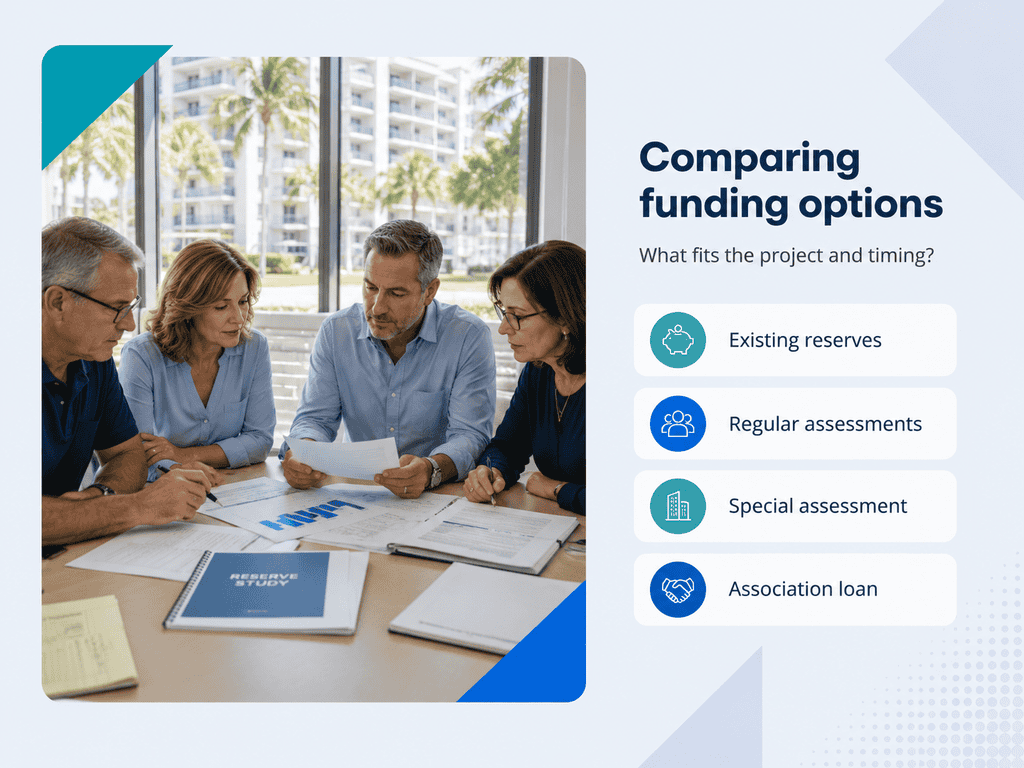
How to compare a loan with other Broward condo financing options
Association financing is one funding method among several.
Boards should compare alternatives against the same project scope, funding gap and construction schedule so the analysis remains meaningful.
Existing reserves
Using available reserves avoids borrowing costs.
This may be the simplest approach when the association has enough legally available funds and using them won’t leave other near-term obligations underfunded.
The drawback appears when reserves are already thin. Spending nearly all available cash on one project can leave the association exposed when another major component needs repair.
Regular assessment increases
Higher regular assessments can build reserves progressively.
This works best when the expense is predictable and enough time remains before the money is needed. It becomes less practical when repairs need to begin quickly.
For SIRS obligations, boards also need to make sure the funding schedule aligns with the association’s current study and statutory requirements.
Lump-sum special assessments
A special assessment can raise project money without long-term loan interest.
For owners with available cash, that may be economically attractive. For others, a large assessment can create a significant household budget problem.
Collection timing matters as well. If construction requires substantial upfront payments, the board needs to know whether the assessment schedule will provide enough cash when contractor invoices become due.
Line of credit
A line of credit can be useful when project spending occurs in phases or when the final draw amount isn’t known at the beginning.
Boards should compare commitment terms, interest structure, draw rules, maturity requirements and repayment obligations.
Florida’s condominium statute recognizes lines of credit as one potential funding source for applicable reserve and capital obligations, subject to the law’s approval and funding requirements.
Association loan
A term loan can provide a defined source of funding for a defined project and spread repayment over a longer schedule.
It may be worth considering when construction needs to begin before the association can reasonably accumulate enough cash.
The tradeoff is financing cost and a longer association obligation. Boards comparing a loan with owner-funded assessments can also review TuCielo’s explanation of a special assessment payment plan, which outlines practical differences between direct owner installments and association financing.
Questions Fort Lauderdale boards should ask before signing
Loan documents can create obligations that last for years, so the board’s review should go beyond the presentation made at the initial financing meeting.
A practical board checklist includes the following:
- Confirm the association’s borrowing authority. Ask counsel what the declaration, bylaws and Florida law require before the association can sign the proposed debt.
- Match the requested amount to the approved project scope. Use current contracts, engineering estimates and legitimate project contingencies rather than a rounded borrowing target.
- Verify the repayment source. Determine which assessment revenue will support debt service and how that obligation will be communicated to owners.
- Review all financing costs. Ask for the rate, fees, total amount financed, repayment term and any prepayment provisions.
- Understand the lender’s security. Have counsel explain assignments of assessments, deposit account requirements and other lender protections in plain language.
- Coordinate financing with inspections and reserve planning. Make sure the funding schedule actually supports required work and the current SIRS.
- Document the board’s decision process. Keep the engineering reports, financing comparisons, meeting materials and professional advice used to reach the decision.
This isn’t simply good recordkeeping. It gives current and future board members a clear explanation of why the association selected a particular funding structure.
Common financing mistakes Broward associations can avoid
One common mistake is applying before the project scope is stable.
If the board asks for financing based on an early engineering estimate but later adds waterproofing, electrical repairs and permitting costs, the approved amount may no longer cover the project. Updating the financing later can introduce delays when contractors are already scheduled.
Another mistake is comparing only monthly payments.
A lower periodic obligation can result from a longer repayment period. Boards should review total financing costs as well as near-term affordability.
A third mistake is treating reserves, inspection compliance and financing as separate conversations. They often affect one another.
Florida’s SIRS provisions require the reserve study to consider the funding methods the association uses for its maintenance and reserve obligations. If a special assessment, line of credit or loan is approved after the study is completed, the study may need to be updated to reflect the selected funding method and its effect on the reserve schedule. Boards can review these requirements directly in Florida Statute 718.112.
Finally, boards shouldn’t wait until a contractor requires a deposit to begin collecting financial records.
Association underwriting can involve financial statements, insurance information, governing documents and project materials. Getting those files in order early gives both the lender and the board a clearer view of the association’s financial position.
When an association loan may be worth considering
A loan becomes more relevant when three conditions come together.
First, the project is necessary or strongly justified. Second, the association doesn’t have enough readily available funds to complete it. Third, delaying the project long enough to accumulate the money isn’t a reasonable option.
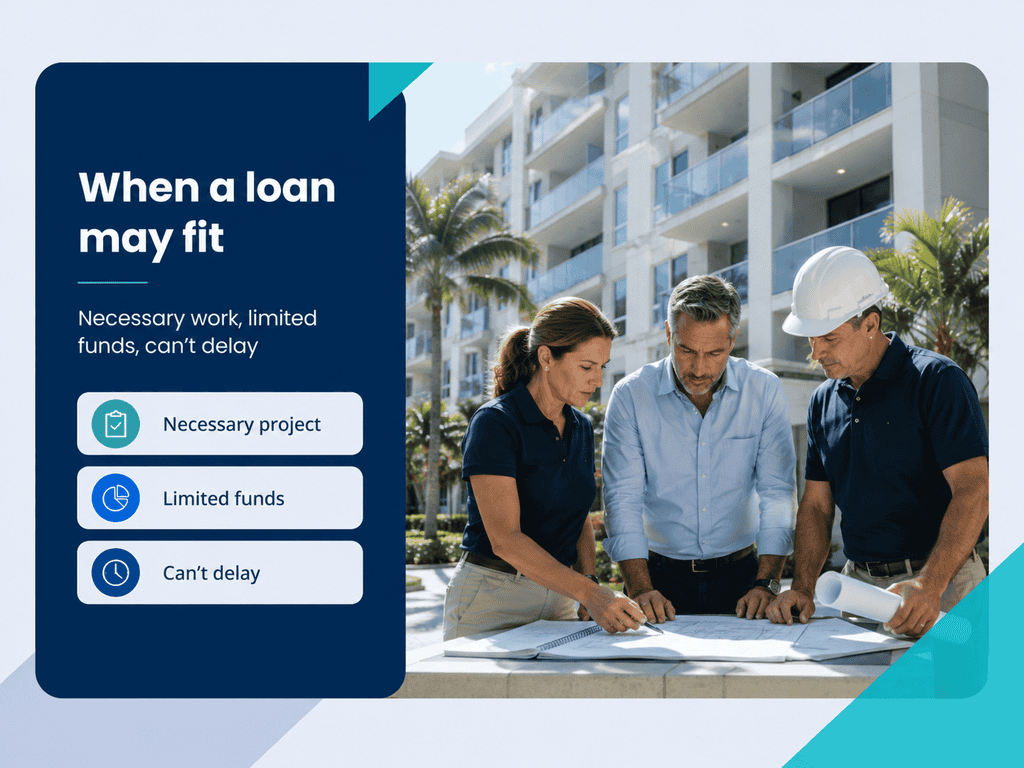
That pattern may occur after an inspection identifies required repairs, when a SIRS reveals a material funding shortage or when a major building component fails earlier than expected.
Financing may be less compelling when the association already has sufficient available reserves, can collect a manageable assessment quickly or has enough time to build the required amount through regular assessments.
The decision should reflect the building’s actual needs rather than a general preference for or against debt.
Explore financing for a Fort Lauderdale condo association
Fort Lauderdale and Broward County boards may have to coordinate structural work, local building inspections, Florida reserve requirements and owner affordability at the same time. A financing plan should connect those pieces rather than treating the loan as an isolated transaction.
Boards that want to explore borrowing for a current project or qualifying reserve need can review TuCielo’s Florida association financing and prepare the project scope, financial records and supporting reports needed for a financing discussion.
Before committing to a loan, have association counsel and appropriate financial professionals review the governing documents, approval requirements and final financing terms.
FAQs
Can a Fort Lauderdale condo association borrow money for repairs?
Yes, condominium associations can borrow for association expenses when they have the required legal authority and satisfy the lender’s underwriting requirements. The board should review its governing documents and Florida law with association counsel before approving debt.
Can a condo association loan pay for concrete restoration?
Association financing may be used for concrete restoration when the lender permits that project type and the association qualifies. The board should base the requested amount on engineering recommendations, contractor pricing and related project costs rather than on a rough estimate.
Can a Florida condo association use a loan to fund SIRS reserves?
Florida law allows applicable SIRS reserves to be funded through regular assessments, special assessments, lines of credit or loans. Certain funding methods require approval by a majority of the association’s total voting interests, so boards should review the current statute and obtain professional guidance before proceeding.
What does a lender review for a Broward condo association loan?
A lender may review financial statements, budgets, delinquency levels, reserves, governing documents, insurance, existing debt and information about the proposed project. Requirements vary by lender and association, so boards should request a complete document checklist before applying.
Does an association loan automatically place a lien on every condo unit?
An association loan is made to the association rather than separately to each unit owner. However, owners remain responsible for assessments properly imposed by the association and unpaid assessments can have separate legal consequences, so owners shouldn’t treat association borrowing as eliminating their assessment obligations.
Should a board use a special assessment or finance the project?
That depends on the project timing, available reserves, owner affordability, total borrowing cost and the association’s ability to collect the required funds. A special assessment can avoid long-term loan interest while financing can spread a large obligation over a longer period.
Are Fort Lauderdale condo buildings subject to special inspection requirements?
Many older buildings are. Fort Lauderdale administers Broward County’s Building Safety Inspection Program, which generally begins at 25 years for covered buildings and repeats every 10 years. Qualifying condominium and cooperative buildings may also be subject to Florida’s separate statewide milestone inspection requirements.