

A large special assessment can create an immediate problem for condominium and homeowners association boards. The repair may be urgent, but many owners may not have enough cash to pay thousands of dollars within a few weeks or months.
A special assessment payment plan can spread that obligation into smaller monthly payments. Depending on the association’s governing documents, project schedule and financial position, the board may collect installments directly or use association financing to fund the work upfront.
This article explains how each approach works, what affects the per-unit payment and what Florida boards should review before presenting a plan to owners. It provides general education, not legal, tax or financial advice. Associations should have their attorney, accountant and other qualified advisers review the structure for their specific community.
What a special assessment payment plan actually does
A special assessment is an assessment charged outside the association’s regular annual budget. It may be used when reserves and operating funds aren’t enough to cover a major expense, such as:
- Concrete restoration or structural repairs
- Roof replacement or waterproofing
- Elevator modernization
- Plumbing or electrical system replacement
- Seawall repairs
- Impact windows and doors
- Insurance-related work
- Required reserve funding
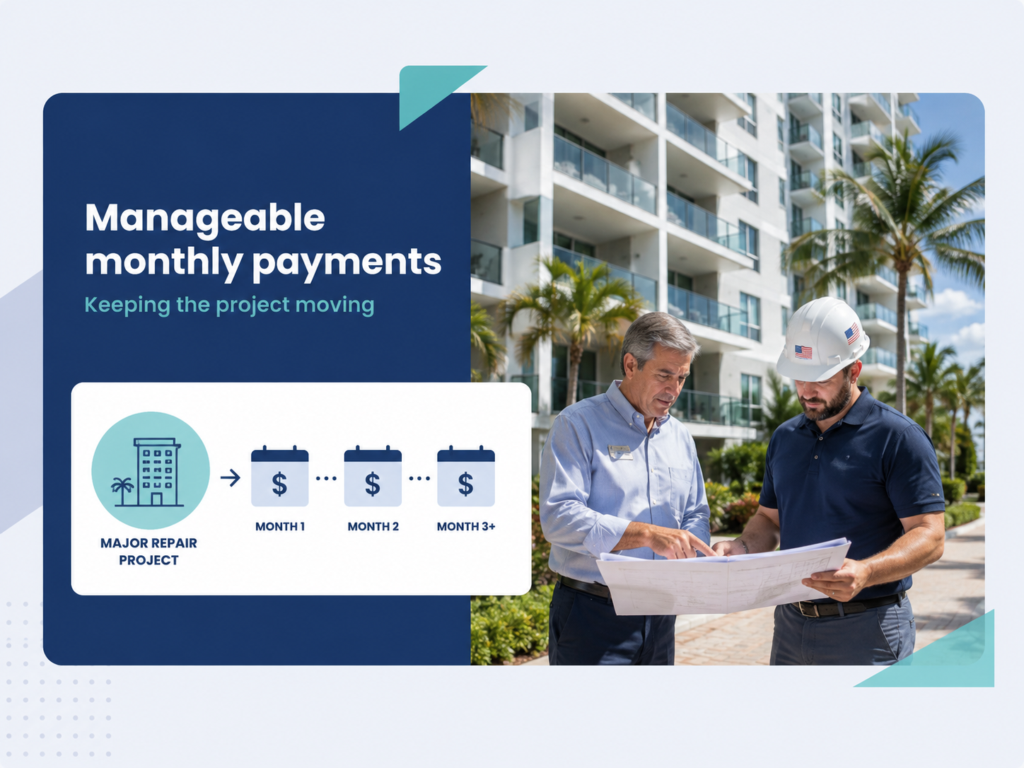
A payment plan changes when owners must contribute the money. Instead of making the full amount due at once, the association divides each owner’s obligation into scheduled installments.
For example, an association might determine that each unit owes $12,000 toward a project. A lump-sum assessment could make the entire $12,000 due within 60 days. An installment arrangement might collect $1,000 a month for 12 months.
That sounds straightforward, but the board must answer a more important question:
Will the collection schedule provide money quickly enough to pay the contractor and keep the project moving?
If the association collects the assessment gradually, it may also receive the project funds gradually. That can work when contractors accept phased payments and construction follows a similar schedule. It may not work when the association needs a large deposit, must purchase materials upfront or faces an urgent compliance deadline.
Association financing addresses that timing gap. The association receives project funding and repays the loan over time using monthly assessment revenue.
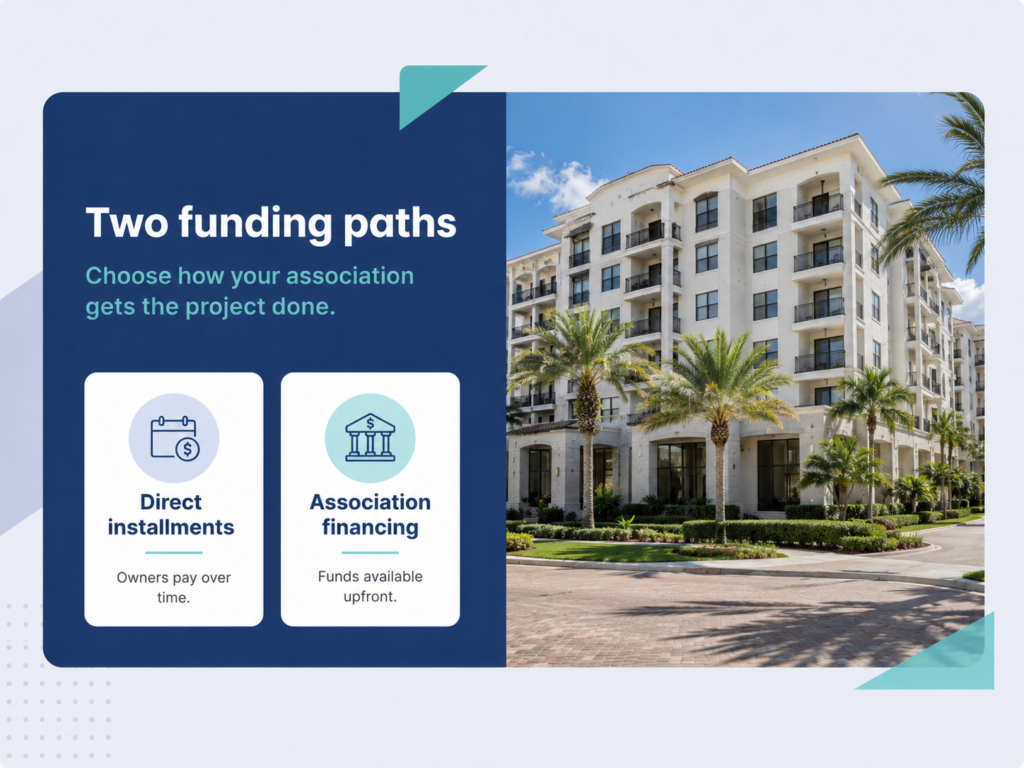
Two ways to spread a special assessment
Boards generally consider two different structures when they want to spread a special assessment.
An owner installment schedule
Under this approach, the association levies the special assessment and allows owners to pay it in installments.
The association itself isn’t necessarily borrowing money. It collects each installment from owners and uses the funds for the stated project.
This structure may be practical when:
- The project can begin in phases.
- The association has enough cash to pay initial costs.
- The collection period is relatively short.
- The contractor’s payment schedule matches owner collections.
- The board expects a high collection rate.
- Delayed payments won’t interrupt the work.
The association still carries collection risk. If several owners pay late, the association may not receive enough cash to meet a contractor invoice.
A board should also avoid assuming that “monthly” automatically means affordable. Dividing a $20,000 obligation into six payments still produces a monthly bill of more than $3,300.
An association loan repaid through monthly assessments
With association financing, the association borrows the money needed for the project. The contractor can be paid according to the approved construction and disbursement schedule while owners contribute through a monthly special assessment or another properly adopted repayment structure.
The association is generally the borrower. Individual owners don’t each apply for a separate loan.
TuCielo describes its association financing as funding provided to Florida condominium associations, homeowners associations and cooperative associations for major repairs, improvements and certain reserve needs. Available amounts, terms, rates and approvals depend on underwriting and project details.
Financing may be more suitable when:
- Construction can’t wait for owner installments to accumulate.
- The project requires a substantial deposit.
- The contractor needs reliable progress payments.
- A short collection period would produce unaffordable owner payments.
- The association’s current reserves won’t cover early project costs.
- The board wants the repayment period to better reflect the useful life of the improvement.
Financing adds interest and transaction costs. In return, it can give the association access to project funds before all owner contributions have been collected.
Direct installments and association financing compared
The best structure depends on cash flow, urgency, project size and the association’s governing documents.
| Consideration | Direct owner installments | Association financing |
| When project funds become available | Gradually as owners pay | Based on the loan closing and approved disbursement structure |
| Interest expense | Usually none unless the association charges or incurs financing costs | Interest and applicable loan costs apply |
| Typical repayment period | Often shorter | May extend over several years |
| Monthly owner payment | Can remain high if the collection period is short | May be lower when repayment is spread over a longer term |
| Collection risk | Late owner payments can reduce available project cash | The association must still collect assessments to make loan payments |
| Contractor scheduling | Must match incoming assessment cash | Can be supported by an agreed project disbursement schedule |
| Administrative needs | Billing, tracking and collecting owner installments | Loan administration plus assessment billing and collection |
| Approval requirements | Controlled by applicable law and governing documents | Requires association authorization and lender underwriting |
A direct installment schedule can cost less overall because there may be no loan interest. However, it doesn’t solve every cash-flow problem.
Financing can provide the money sooner and extend repayment, but owners may pay more over the full term. Boards should present both the monthly amount and the total expected cost so owners can understand the tradeoff.
How a monthly special assessment is calculated
A basic per-unit calculation starts with four pieces of information:
- The amount the association needs to raise
- The allocation assigned to each unit or parcel
- The number of payment periods
- Any financing costs, reserves or related expenses included in the plan
For a simple example, assume a 100-unit association needs $1.2 million. If every unit has an equal share, the starting obligation would be:
$1,200,000 ÷ 100 units = $12,000 per unit
The payment depends on the schedule:
- Over six months: $2,000 per unit each month
- Over 12 months: $1,000 per unit each month
- Over 24 months: $500 per unit each month
These figures don’t include interest, lender fees, contingency amounts, debt service reserves or differences in how expenses are allocated.
Many condominium declarations don’t divide common expenses equally. A unit’s share may be based on the percentage stated in the declaration. An association with different unit sizes or assigned ownership percentages may therefore have several monthly payment amounts.
For an association loan, the calculation is more involved. The board must account for:
- Principal borrowed
- Interest rate
- Repayment term
- Closing or origination costs
- Required debt service account
- Number of units
- Each unit’s allocated share
- Expected assessment collection rate
- Existing association debt
Boards can use an association financing estimator to develop an initial illustration. An estimator isn’t a commitment, final quote or substitute for reviewing the proposed loan documents.
Why the repayment term matters
A longer term normally lowers the scheduled monthly payment because the balance is spread across more months. It also normally increases the total interest paid.
Suppose the association is comparing a 10-year option with a 20-year option. The 20-year structure may make the monthly special assessment easier for owners to absorb. The 10-year structure may result in a higher monthly amount but a lower total financing cost.
The board should compare more than the lowest monthly payment. It should review:
- Total payments over the full term
- Whether the term matches the improvement’s expected useful life
- Prepayment provisions
- Rate structure
- Required reserves
- Fees financed into the transaction
- Effects of delinquencies
- Treatment of future unit sales
A 25-year payment schedule may be difficult to justify for an improvement expected to last only a few years. It may be more reasonable for structural work or a major building system with a longer service life, subject to professional review.
Building a workable special assessment payment plan
A good plan starts with the project, not with a preferred monthly number. The board first needs to establish what must be completed, what it will cost and when money must be available.
1. Confirm the project scope
The board should obtain a clear description of the work from the appropriate engineer, architect, contractor or other professional.
The scope should identify:
- The components being repaired or replaced
- The reason the work is needed
- Any immediate safety or insurance concerns
- Expected construction phases
- Likely start and completion dates
- Required permits or professional services
- Potential contingency needs
A vague scope produces an unreliable assessment. If major items are added after the assessment is approved, the association may need to revise the budget or levy another assessment.
2. Establish the complete funding need
The contractor’s base price isn’t always the full project cost. Depending on the work, the budget may also need to include engineering, permitting, inspections, project administration and a reasonable contingency supported by professional estimates.
Boards should distinguish between confirmed expenses and allowances. They should avoid presenting an early estimate as though it were a final contract amount.
The association should also identify funds already available from:
- Applicable reserves
- Insurance proceeds
- Operating cash permitted for the purpose
- Prior assessment collections
- Grants or other verified sources
- Existing approved financing
Subtracting available funds from the complete project budget shows the amount that still needs to be raised or financed.
3. Map the contractor’s payment schedule
Ask when each payment will be due, not merely when construction starts.
A project may require:
- A deposit when the contract is signed
- A materials payment before mobilization
- Monthly progress payments
- Payments after inspections or completed phases
- Retainage released after final completion
This schedule determines whether an owner installment plan can support the work. If the contractor needs $800,000 during the first three months but the association will collect only $300,000, the board still has a $500,000 timing gap.
4. Review collection risk
A per-unit payment plan works only when enough owners pay on schedule. Boards should examine the association’s actual assessment history rather than assuming full and immediate collection.
Relevant information includes:
- Current delinquency rate
- Number and value of seriously delinquent accounts
- Average collection delay
- Pending foreclosures or bankruptcies
- Historical response to previous assessments
- Existing payment arrangements
The association’s attorney and accountant can help determine how expected delinquencies should be handled in the budget and repayment plan.
5. Compare realistic payment periods
Calculate several periods instead of selecting one arbitrary term.
For direct assessment installments, the board might compare six, 12 and 18 months. For financing, it might review several available amortization periods.
For every option, show:
- Initial amount due
- Monthly amount
- Number of payments
- Estimated total paid
- Included fees and interest
- Deadline for the first payment
- Consequences of late payment
- Whether voluntary prepayment is available
This gives owners a meaningful comparison. Simply saying the assessment has been “spread out” doesn’t tell them whether the arrangement fits their household budget.
6. Confirm legal authority and required approvals
Florida law, the declaration, bylaws and other governing documents may affect who can approve the assessment, how expenses are allocated and what notice must be provided.
For Florida condominiums, section 718.112 of the Florida Statutes generally requires advance written notice for a board meeting where a nonemergency special assessment will be considered. The notice must state that assessments will be considered and provide an estimated cost and description of the purpose.
Florida condominium law also states that the specific purpose of a special assessment must appear in the written notice sent or delivered to owners. Funds collected for that assessment must be used for the stated purpose, subject to the treatment of excess funds described in section 718.116.
Florida homeowners associations have separate statutory provisions and may also be subject to detailed requirements in their declarations. Under section 720.303, an assessment can’t be levied at a board meeting unless the notice states that assessments will be considered and identifies their nature.
These are general statutory points. Emergency circumstances, community type, governing documents and later legislative changes can affect the required process. The association’s Florida community association attorney should review the proposed assessment and financing approvals before the board acts.
7. Give owners a written explanation
Owners need more than a payment coupon. A clear communication package should explain:
- Why the project is needed
- What work will be completed
- How the total amount was established
- What funds are already available
- Why the board selected the payment structure
- How each owner’s share was calculated
- When each payment is due
- Whether early payment is permitted
- What happens if an owner pays late
- Who can answer project, legal and billing questions
The board should separate verified facts from estimates. If a rate, construction cost or completion date may change, say so.
Hypothetical example: spreading a $3 million repair cost
Consider a hypothetical 120-unit Florida condominium association that needs $3 million for concrete restoration, waterproofing and related engineering work.
Assume each unit has an equal allocation and no other project funds are available. The base special assessment would be:
$3,000,000 ÷ 120 units = $25,000 per unit
The board first considers collecting the amount over 12 months. That would require about $2,083 per unit each month. It avoids loan interest, but the contractor needs a substantial deposit and early progress payments. The association also knows that several owners may struggle with a payment above $2,000.
The board then evaluates association financing. A longer repayment period could reduce the monthly per-unit requirement, although interest and financing costs would increase the total amount paid. The association would also need to qualify through underwriting and comply with the loan covenants.
Neither option is automatically better. The board must compare:
- The urgency of the repairs
- Contractor cash-flow requirements
- Total financing cost
- Owner affordability
- Delinquency risk
- Available repayment terms
- Legal authority
- The useful life of the improvements
After receiving professional advice, the board could present owners with a comparison showing the direct 12-month collection and the available financing structures. Owners would then see both the immediate payment impact and the long-term cost.
Common mistakes when spreading a special assessment
Choosing a monthly amount before pricing the project
A board may begin with a statement such as, “We need to keep the increase below $300 per month.” That goal can guide the comparison, but it can’t determine the project budget.
The required work, professional scope and contractor schedule must come first. Otherwise, the board may select a payment level that doesn’t raise enough money.

Ignoring early construction payments
A 24-month owner payment plan may look affordable on paper. It can still fail if half the project cost is due during the first six months.
Boards should place the owner collection schedule beside the contractor disbursement schedule. Any gap must be covered by available cash, reserves, revised contract terms or financing.
Comparing only the monthly payment
The lowest monthly figure may come with the longest repayment period and highest total interest expense.
Owners should receive enough information to compare both cash-flow relief and total cost. The board should also explain any prepayment option or restriction.
Treating all units as though they have equal shares
The declaration may assign different percentages to different units. Using an equal split without confirming the governing documents can create an incorrect assessment schedule.
The association’s attorney and accountant should verify the allocation method before owner notices are issued.
Assuming financing removes the assessment
An association loan provides project funds to the association. The association still needs revenue to repay that obligation.
In many cases, owners make regular assessment payments that support the association’s loan payments. Financing changes the timing and structure of the cost rather than making it disappear.
Leaving delinquency planning until after billing begins
Late payments can affect both a direct installment plan and an association loan. Florida law may permit assessment liens and collection remedies when the statutory and governing-document requirements are satisfied.
For homeowners associations, section 720.3085 of the Florida Statutes addresses assessment payment obligations, lien claims and collection procedures. Condominium associations are governed by separate provisions, including section 718.116.
Boards shouldn’t improvise collection policies after accounts become delinquent. The process, notices and owner communications should be reviewed before the first payment is due.
What to prepare when exploring association financing
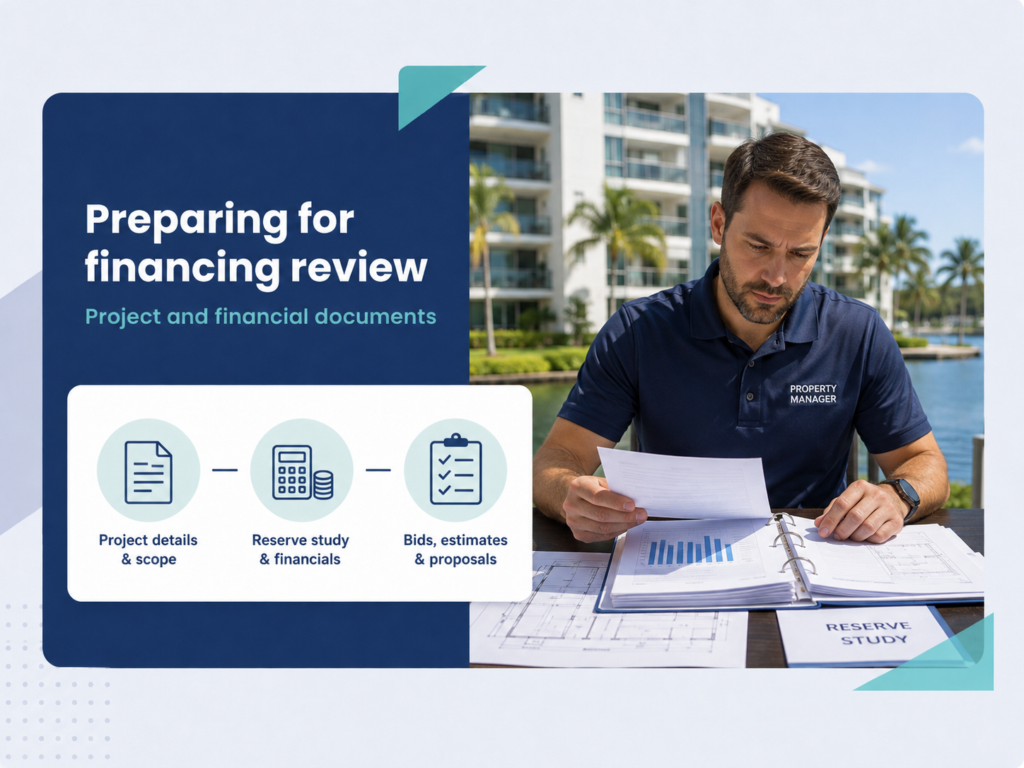
A lender needs enough information to evaluate the association, project and repayment capacity. Requirements vary, but boards may be asked to prepare:
- Governing documents
- Current budget
- Recent financial statements
- Reserve information
- Assessment aging and delinquency reports
- Unit or parcel count
- Owner-occupancy information
- Existing loan documents
- Insurance information
- Project bids or signed contracts
- Engineering or inspection reports
- Construction and disbursement schedule
- Minutes or resolutions supporting the project
- Proposed special assessment structure
Submitting complete and consistent records can make the review more efficient. It also helps the board identify financial or documentation issues before an owner meeting.
TuCielo’s frequently asked questions about HOA and condominium financing provide additional information about eligible association types, common project categories, loan terms and application materials. Any estimate remains subject to underwriting, final documentation and the association’s legal approval process.
Compare the payment structure before the assessment is due
A monthly plan can reduce the immediate burden of a special assessment, but the payment amount must still support the project’s actual funding schedule. Boards should compare direct installments with association financing, document the total cost of each option and confirm the approval process with qualified advisers.
Florida associations that need funds before owner installments can accumulate may explore TuCielo’s available financing paths. Start by preparing the project scope, budget, contractor payment schedule, association financials and proposed per-unit allocation, then request a financing review based on the community’s actual needs.
FAQs
Can an HOA offer monthly payments for a special assessment?
An HOA may be able to establish installment due dates if its governing documents, applicable law and approval process permit the structure. The board should have association counsel confirm its authority, notice requirements and collection procedures before adopting the plan.
Is a monthly special assessment the same as an HOA loan?
No. A monthly special assessment describes how owners pay the association. An HOA loan is financing borrowed by the association, which may then use monthly assessment revenue to make its loan payments.
Can owners pay their full share early?
That depends on the resolution, governing documents and financing terms. A direct installment plan may allow early payment more easily, while an association loan may require the board to determine how individual prepayments are credited and whether they reduce the association’s debt.
How long can a special assessment be spread out?
There’s no single period that fits every association. A direct collection plan may last several months or longer, while association financing may offer a multi-year repayment term. Available structures depend on legal authority, project timing, affordability and lender requirements.
What happens when an owner doesn’t pay an installment?
The unpaid installment may become delinquent under the association’s governing documents and applicable law. Interest, late charges, collection costs or lien remedies may apply when properly authorized. The association should follow advice from its attorney rather than using informal collection practices.
Does association financing place a loan on each owner’s credit report?
The association is generally the borrower under an association loan, not each individual owner. Owners should still review the proposed documents and ask how the repayment obligation, unit sales, estoppel information and delinquent assessments will be handled.
Should owners vote on the payment plan?
Voting requirements depend on Florida law, the type of association and the community’s governing documents. Some actions may be authorized by the board while others may require membership approval. Association counsel should confirm the correct process before notices or payment schedules are finalized.