

For a concrete restoration cost Florida condo boards can actually budget around, a simple statewide price per square foot usually isn’t enough. A ground-level surface patch and an engineered balcony repair may both be called “concrete restoration,” yet their labor, access, engineering and safety requirements are very different.
This guide is for Florida condominium board members and property managers trying to turn an inspection finding or early contractor estimate into a realistic project budget. It explains 2026 pricing ranges, what drives the total cost, how spalling repair is priced and what expenses boards should include before deciding how to fund the work.
How much does concrete restoration cost a Florida condo in 2026?
There is no standard price for an entire Florida condominium concrete restoration project. Published Florida pricing illustrates why.
For relatively simple surface work, some contractors publish spall or surface repair prices below $15 per square foot. Those figures generally apply to ground-level residential concrete, cosmetic deterioration or localized patches.
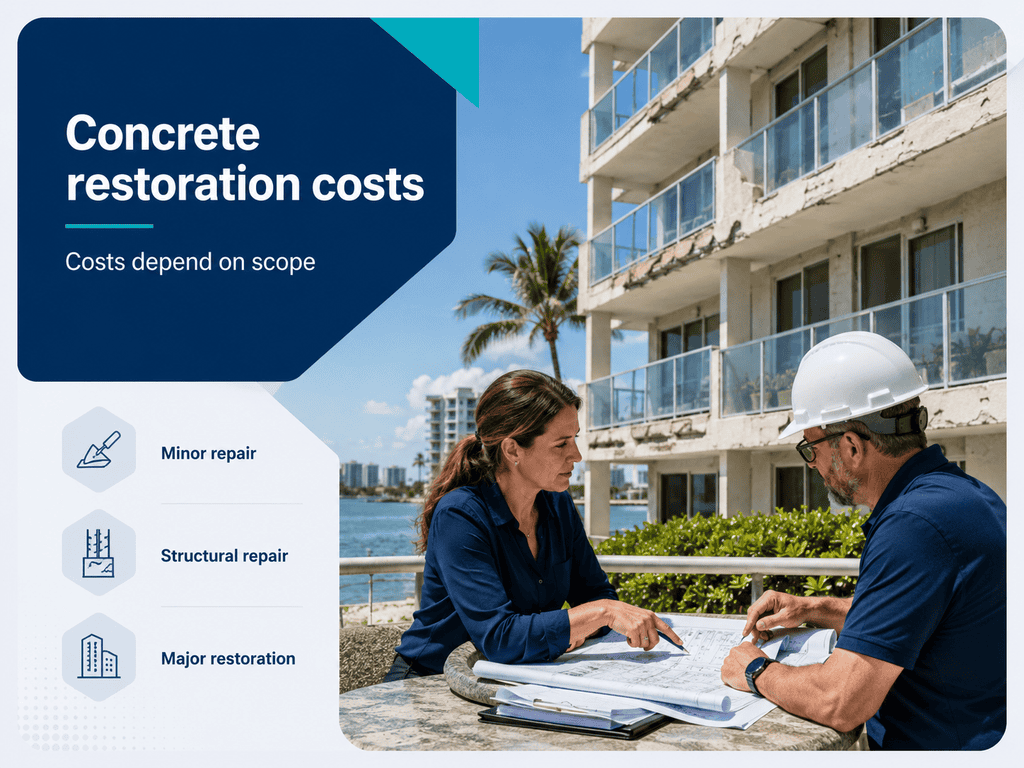
The numbers change significantly when the concrete is structural, elevated or affected by reinforcing steel corrosion. A Tampa-area commercial contractor publishes planning ranges of $150 to $300 per square foot for concrete spalling remediation and $75 to $150 per square foot for balcony reconstruction in some remediation scopes. A South Florida structural restoration contractor lists minor sound-concrete patches at roughly $20 to $50 per square foot, moderate repairs involving reinforcing steel at $50 to $150 and major structural restoration at $150 to $400 or more per square foot.
Those figures aren’t interchangeable. They describe different conditions and scopes. They do show why a board shouldn’t take a residential driveway repair price and multiply it across the building.
For planning purposes, a condo concrete restoration price may fall into very different categories:
| Type of work | What the scope may involve | How boards should approach the estimate |
| Minor localized repair | Small nonstructural spalls, cracks or surface deterioration | Price identified repair locations rather than assuming a building-wide rate |
| Moderate structural repair | Concrete removal, exposed rebar treatment, repair mortar and coatings | Use engineer-defined quantities and contractor unit prices |
| Balcony or elevated slab work | Structural repair, waterproofing, railing work and difficult access | Include access systems, resident coordination and restoration of finishes |
| Major structural restoration | Deep removal, substantial corrosion, reinforcing work and widespread deterioration | Develop an engineered project budget with contingencies and professional fees |
| Building-wide program | Multiple elevations, balconies, garages, waterproofing and related work | Budget by construction phase and total project scope rather than a single repair rate |
The most useful number for a board is therefore not the lowest advertised per-square-foot rate. It is the projected cost of completing the engineer’s defined scope, including work that sits around the concrete repair itself.
Florida contractors’ published pricing can provide early context. For example, Florida Construction Specialists’ remediation cost guidance illustrates how commercial structural work can cost far more than ordinary surface patching. South Florida pricing published by Souffront Structural Contractors similarly separates minor repairs from deeper restoration involving deteriorated reinforcing steel.
A contractor proposal based on the actual building remains much more useful than either range.
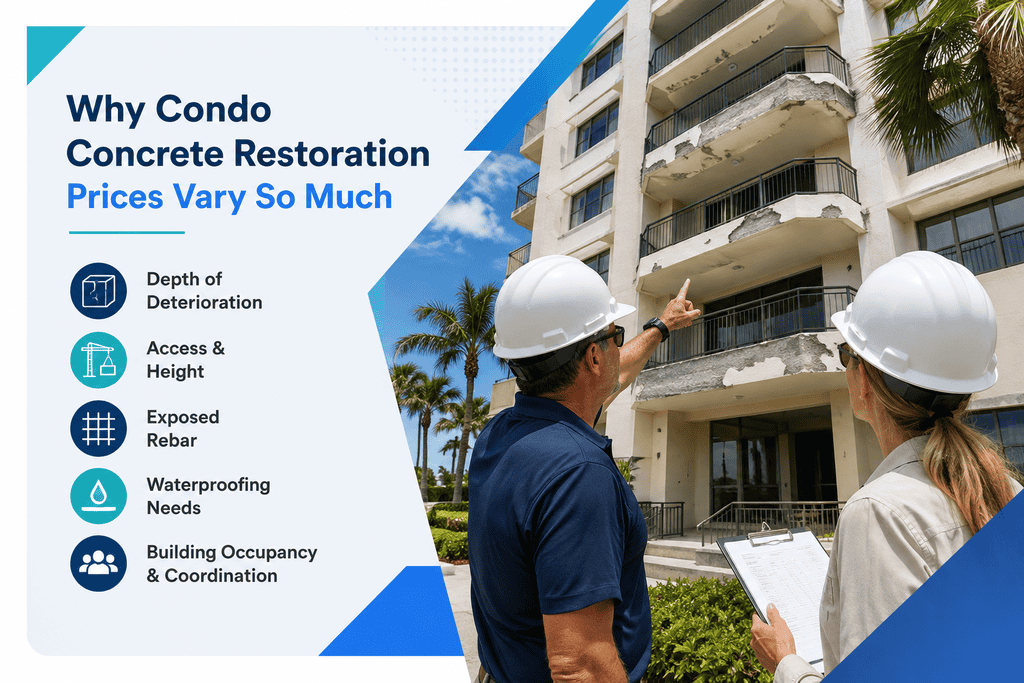
Why condo concrete restoration prices vary so much
Concrete restoration isn’t priced solely by the visible square footage of damaged concrete. The contractor has to determine what must be removed, what lies behind the damaged surface and how crews can safely reach it.
That creates several major cost variables.
The depth of deterioration matters more than the visible stain
Rust staining or a small spalled patch may be the exposed portion of a larger problem. When moisture and chlorides reach embedded reinforcing steel, corrosion can expand the steel and fracture the concrete around it.
The repair may then involve removing unsound material until competent concrete is reached, cleaning or replacing steel, treating the reinforcement and rebuilding the section with an appropriate repair material.
Two patches that look similar from the ground can produce very different quantities after demolition begins.
This is one reason boards should be cautious with an early spalling repair cost based entirely on a visual walk-through. A preliminary estimate is useful for planning, but destructive investigation or repair demolition may reveal additional quantities.
Access can become a major line item
Repairing a parking slab at grade is different from repairing balcony edges 15 stories above the street.
Depending on the building, crews may need:
- Swing stages or suspended scaffolding for exterior elevations.
- Boom lifts where site access and height allow them.
- Garage shoring or temporary protection around overhead repairs.
- Sidewalk, driveway or parking closures during active construction.
- Protection for residents, vehicles and adjacent property.
- Special mobilization for waterfront or tightly developed sites.
Access costs can remain substantial even when the physical repair area is modest.
For high-rise associations, ask whether access is included in each unit price or listed separately. Otherwise, two bids with similar concrete repair rates may have very different final totals.
Exposed reinforcing steel changes the repair
Surface deterioration without exposed reinforcement is usually less involved than a repair requiring corrosion treatment or steel replacement.
Once reinforcing steel has deteriorated, the engineer may specify additional demolition, cleaning, supplemental steel, corrosion protection or other measures. Repairs to columns, beams, balcony slabs and structural edges can require more engineering oversight than cosmetic surface work.
That distinction also explains why low residential resurfacing prices aren’t a useful benchmark for structural condo restoration.
Waterproofing may be part of the same problem
Concrete deterioration and water intrusion often interact.
A board may initially focus on the damaged concrete, only to find that balcony coatings, deck membranes, joints, sealants or other water-management systems also need work. Rebuilding the concrete without addressing the source of recurring moisture may leave the association paying for another repair cycle sooner than expected.
The budget should therefore separate the structural repair from related waterproofing rather than assuming that one automatically includes the other.
Building occupancy affects productivity
Condominium restoration takes place around people.
Crews may need to coordinate balcony access, protect occupied units, move vehicles, maintain safe entrances and limit work during certain hours. A contractor working on an empty commercial structure can often sequence work differently from one working around hundreds of residents.
Boards should ask bidders what resident coordination assumptions are built into the price.
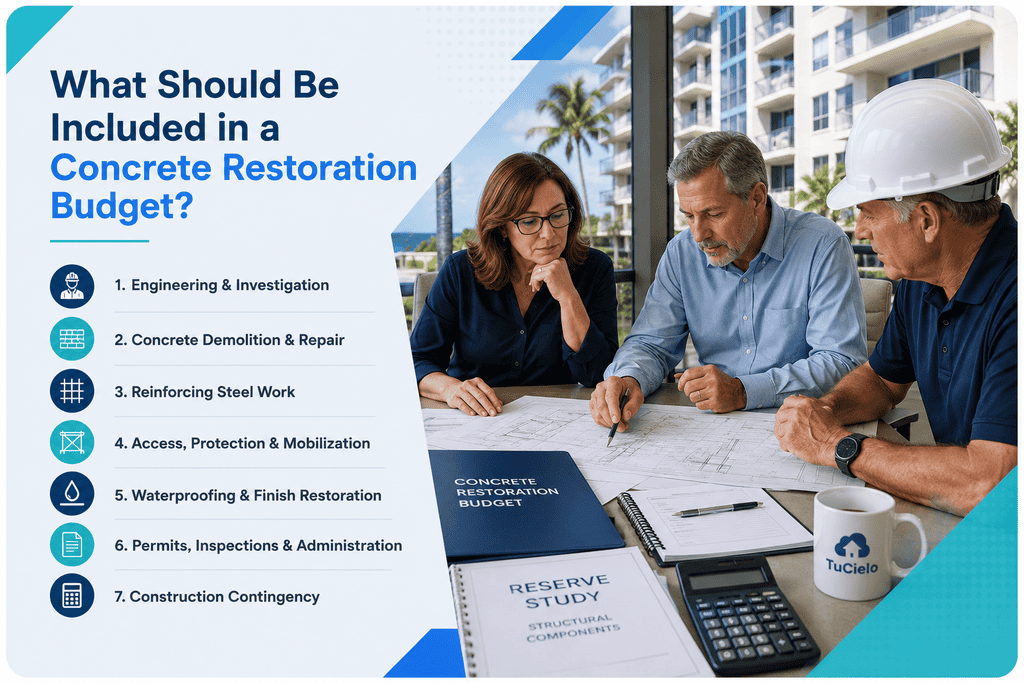
What should be included in a concrete restoration budget?
The construction contract is the largest expense in many projects, but it isn’t necessarily the entire financial obligation.
A useful budget follows the project from investigation through closeout.
1. Engineering and investigation
The association may need engineering work before a contractor can provide a reliable final price. Depending on the condition of the building, this can include field observations, testing, repair drawings, specifications and quantity estimates.
Florida’s milestone inspection rules also matter for qualifying older condominium and cooperative buildings. Under section 553.899 of the Florida Statutes, covered residential buildings generally require milestone inspections beginning at 30 years of age and every 10 years afterward. A local enforcement agency can require the initial inspection at 25 years when local conditions justify it.
An inspection isn’t the same thing as a repair scope. If the report identifies deterioration, the board may still need design and construction documents before bidding the work.
For associations dealing with repairs that arose from an inspection, TuCielo’s guide to financing repairs after a Florida milestone inspection explains the additional project costs that can sit between an inspection report and completed construction.
2. Concrete demolition and repair quantities
Contractors may price repairs by square foot, linear foot, location, balcony or another unit defined by the drawings.
Boards should make sure bids use comparable quantity assumptions. A low unit rate isn’t particularly useful if one contractor carries 2,000 square feet of repair and another expects 4,000.
A bid summary should identify both the price and the assumed quantity.
3. Reinforcing steel work
Where corrosion is present, the scope can include cleaning steel, coating exposed reinforcement or installing supplemental reinforcement when specified.
This work is one reason the condo concrete restoration price can change once demolition begins. The full condition of embedded steel isn’t always visible before the surrounding deteriorated concrete is removed.
4. Access, protection and mobilization
Scaffolding, swing stages, lifts, protection and repeated mobilization should appear somewhere in the budget.
Boards also need to understand whether access can remain in place throughout the project. Moving equipment repeatedly from elevation to elevation can affect both time and cost.
5. Waterproofing and finish restoration
A completed structural patch may still require waterproof coatings, traffic membranes, paint or finish restoration.
Balcony projects can also interact with railings, tile, pavers and drainage. The board should distinguish necessary structural work from finish choices that may be priced as separate alternatives.
6. Permits, inspections and professional administration
Permit fees vary by jurisdiction and project. Engineering inspections during construction, contractor submittal review and closeout documentation can also add cost.
Ask the engineer and contractor which services are included in their agreements. Don’t assume every professional service continues through project completion.
7. A construction contingency
Concrete restoration has a particular budgeting problem: part of the final quantity can remain hidden until demolition starts.
That doesn’t justify adding an arbitrary percentage without analysis. Instead, the board and engineer should discuss what conditions remain unknown, how additional quantities will be measured and what allowance is appropriate for that specific project.
The contract should also establish the unit prices or change-order process that will apply if actual deterioration exceeds the bid quantity.
How to estimate the association and per-unit cost
Once a board has a defensible project budget, it can translate the total into an owner-level funding discussion.
Consider a hypothetical 80-unit coastal condominium. An engineer develops drawings for concrete restoration, balcony waterproofing and related work. After bidding, the board develops the following planning budget:
- Construction contract: $2,400,000
- Engineering and construction administration: $180,000
- Permitting and related project expenses: $40,000
- Board-approved allowance for uncertain repair quantities: $280,000
The planning total would be $2.9 million.
If every unit shared expenses equally, a simple mathematical allocation would equal $36,250 per unit. Actual condominium assessments shouldn’t automatically be divided equally, however. Each association must follow its declaration, governing documents and applicable Florida law when allocating common expenses.
The example is useful because it shows why the total project budget matters more than a headline price per square foot.
Suppose the board had initially discussed a $2.4 million contractor bid as the “project cost.” Owners could reasonably assume their collective obligation ended there. Once engineering, project administration and the allowance are included, another $500,000 must be funded.
That difference can materially affect a special assessment or borrowing decision.
Use this budgeting workflow before presenting a number to owners
A board can reduce surprises by working through the project in this order:
- Obtain the engineer’s defined repair scope instead of pricing deterioration from photographs alone.
- Request comparable contractor bids using the same drawings, specifications and assumed repair quantities.
- Separate concrete repair from access, waterproofing, finishes and other related work.
- Add engineering, permit and project-administration expenses that aren’t inside the contractor’s number.
- Identify uncertain quantities and agree with the engineer on an appropriate contingency or allowance.
- Confirm how common expenses will be allocated under the association’s governing documents.
- Compare existing reserves, owner assessments and financing before adopting a final funding plan.
This process won’t make unforeseen conditions disappear. It gives the board a much clearer picture of which costs are known and which remain variable.
How Florida reserve rules affect the funding decision
Concrete restoration can become both a construction issue and a reserve-funding issue for a Florida condominium.
Florida’s Structural Integrity Reserve Study (SIRS) requirements apply to qualifying residential condominium buildings that are three habitable stories or higher. The study addresses specified structural and building components, including the structure, waterproofing and exterior painting.
According to the Florida Department of Business and Professional Regulation’s SIRS guidance, the study identifies covered components, estimates remaining useful life and estimates replacement or deferred-maintenance costs. It also provides a recommended reserve funding schedule.
Current Florida condominium reserve law provides several mechanisms that can be relevant to major capital work. For qualifying SIRS associations, the statute addresses funding through regular assessments, special assessments, lines of credit or loans, subject to applicable approval requirements and other statutory conditions.
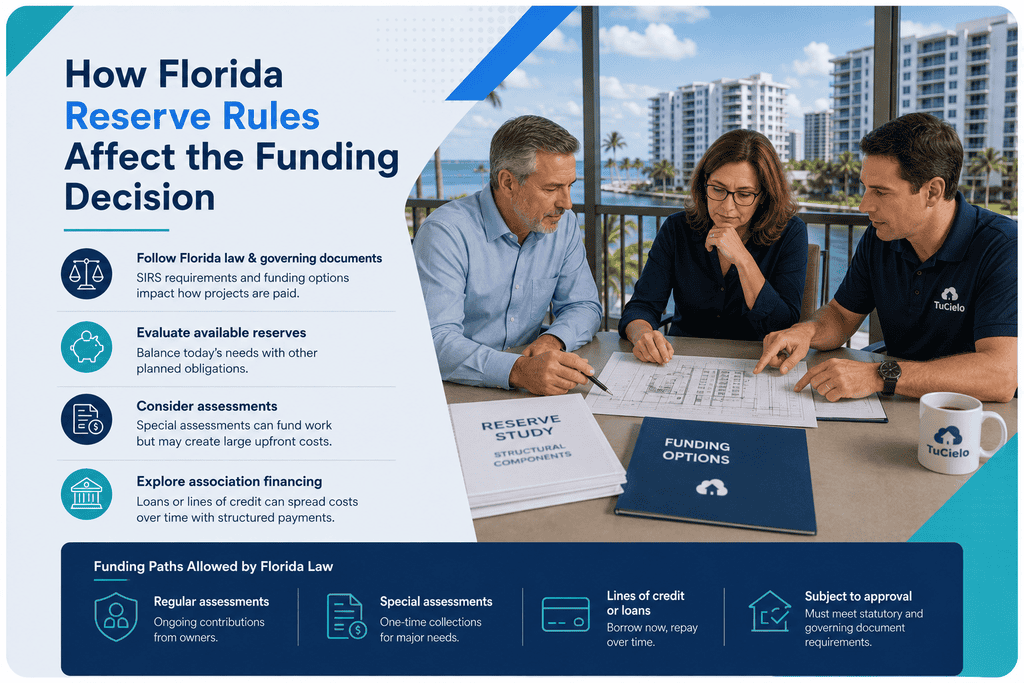
That gives boards several possible sources of project funding, but it doesn’t mean every structure works for every association.
Existing reserves
Available reserves can reduce the amount that needs to be assessed or financed. The board first needs to determine what funds are legally available for the particular work and what other scheduled obligations remain.
Using most available cash for concrete work may solve the immediate construction problem while leaving another major component underfunded.
A lump-sum or short-term special assessment
A special assessment can fund work without association borrowing if owners can provide the required money when the contractor needs it.
The challenge appears when a major restoration program creates a large per-unit obligation. Collection timing becomes especially important because construction payments continue even when individual owners pay late.
Association financing
Borrowing can allow the association to fund construction while collecting assessments over a longer period.
Boards evaluating this path should compare the total borrowing obligation, repayment schedule, fees, prepayment terms, collateral or security arrangements and the assessment structure used to repay the debt. Approval and documentation requirements vary by lender and association.
TuCielo provides association financing for Florida community associations undertaking capital repairs and improvements. Boards can also review the information commonly requested for an HOA or condo association loan before starting a financing discussion.
A combined approach
A project doesn’t always need a single source of funds.
An association might use part of its available reserves, collect some owner contributions upfront and finance the remaining gap. A blended structure may reduce borrowing while avoiding an assessment that requires every owner to produce the entire amount at once.
The board should model each option using the same total project cost. Comparing a $2.4 million loan against a $2.9 million special assessment produces a misleading result if $2.9 million is the actual budget required to finish the work.
Because association borrowing, assessments and reserve obligations carry legal and financial consequences, boards should review their governing documents and obtain advice from their association attorney, accountant and other appropriate professionals before approving a funding structure.
Questions to ask before approving a restoration contract
By the time a board receives bids, the pressure to choose a contractor can be high. Asking a few precise questions can expose gaps before the contract is signed.
Ask the engineer and bidders:
- What repair quantities are included in the base contract and how were they measured?
- Which unit prices apply if additional deterioration appears after demolition?
- Is access equipment included and how long does the price assume it remains in place?
- Are waterproofing, coatings, painting and finish restoration included or separate?
- Who pays for testing, permits, engineering inspections and project closeout?
- Which conditions would trigger a change order rather than use an existing unit price?
- How will the contractor document actual repair quantities as work progresses?
The answers give the board a better basis for comparing bids than total price alone.
A $2 million bid with unclear quantities may create more financial uncertainty than a $2.2 million bid built around well-defined unit prices and an engineer-controlled measurement process.
Turn the repair estimate into a workable funding plan
Before deciding how to pay for concrete restoration, Florida condo boards need a reliable view of the entire project cost. Start with the engineer’s scope, reconcile contractor quantities, account for access and related work, then add professional costs and a reasoned allowance for conditions that remain unknown.
Once that budget is established, the board can compare reserves, assessments and borrowing on the same basis.
If your association is preparing for a major concrete restoration project and needs to evaluate how the funding gap could be financed, TuCielo can review the project scope, available estimates and association information and explain the association financing process and the documentation needed to move forward.
FAQs
What is the average condo concrete restoration price in Florida?
There isn’t a reliable statewide average for complete condominium restoration because the term covers everything from localized surface patches to major high-rise structural repairs. Published Florida contractor pricing can range from tens to hundreds of dollars per square foot depending on repair depth, rebar condition, access and structural complexity.
Boards should use local published pricing only for early context. An engineered scope and competitive bids are needed for a building-specific budget.
How much does spalling repair cost?
Spalling repair cost depends heavily on whether the deterioration is cosmetic or extends to reinforcing steel. Simple surface repair can be relatively inexpensive, while structural spalling on balconies, beams, columns and elevated slabs can require deep demolition, steel treatment and specialized access.
For a condominium project, ask for separate unit prices for each repair type instead of relying on one general spalling rate.
Why does the concrete restoration price increase after work starts?
Additional deterioration can become visible after contractors remove loose or damaged concrete. Corroded reinforcement may also be more extensive than the surface condition suggested.
A well-prepared contract anticipates this possibility. It should explain how extra quantities are documented, measured and priced.
Does a milestone inspection include concrete repairs?
No. A milestone inspection evaluates the structural condition of a qualifying building and identifies substantial structural deterioration or needed repair. The inspection itself doesn’t perform the construction work.
The association may still need repair design, permits, contractor bidding, construction and follow-up professional services.
Can a Florida condo association borrow money for concrete restoration?
Florida law allows qualifying condominium associations to use financing mechanisms that can include loans or lines of credit for certain capital and reserve obligations, subject to applicable statutory and association requirements. The association must also determine how the debt will be repaid.
Boards should review the proposed loan, governing documents and assessment structure with qualified legal and financial professionals before approval.
Should a board wait for final repair quantities before arranging funding?
Waiting for every quantity to become certain may not be practical because some conditions remain concealed until demolition. However, a board should have an engineered scope, credible bid quantities and a method for handling additional work before committing to a funding amount.
A financing plan can also account for an appropriately supported construction allowance rather than pretending the initial bid can never change.
What should owners look for when reviewing a concrete restoration assessment?
Owners should look beyond the assessment amount and ask what total project budget supports it. Useful details include the construction price, professional fees, contingency assumptions, available reserves, allocation method and payment schedule.
They should also review association communications and governing documents to understand how their individual share was calculated.