

HOA loan interest rates can materially change the cost of a major repair project, but Florida associations won’t find one standard rate that applies to every borrower. Association loans are typically priced individually based on the community’s finances, project, repayment structure, loan term and current lending conditions.
For condominium association and HOA board members comparing financing in 2026, the useful question isn’t simply, “What rate can we get?” It’s how the rate is determined, what the quoted number actually includes and how different loan structures affect what owners ultimately pay.
This guide explains those factors, provides a practical way to compare proposals and shows how a board can prepare before requesting a formal financing quote.
What are HOA loan interest rates in Florida in 2026?
There is no single published market rate for Florida HOA and condominium association loans.
Unlike a conventional residential mortgage, where consumers can readily compare advertised rates, association financing is generally underwritten as commercial credit. The association is the borrower and the lender evaluates its financial condition, assessment income, owner delinquencies, existing debt, project requirements and other factors before setting terms.
That distinction matters when someone asks for the “average” HOA loan rate.
As of September 2026, the Federal Reserve’s H.15 Selected Interest Rates release provides current benchmarks for the broader cost of credit. These figures are useful market context, but they don’t represent the interest rate a Florida association should expect to receive.
The Federal Open Market Committee maintained the federal funds target range at 3.50% to 3.75% at its July 2026 meeting. That monetary policy backdrop can influence lending costs, but an association’s final rate still depends on its own underwriting profile.
TuCielo, for example, publishes illustrative association financing scenarios to help boards understand how loan amount, term and interest rate can affect payments. These examples should be treated as planning tools rather than guaranteed pricing because actual terms depend on underwriting.

Why the federal funds rate isn’t your HOA loan rate
The federal funds rate influences borrowing costs throughout the economy, but an association loan includes additional pricing for the specific transaction.
A lender has to consider the length of the loan, the likelihood that the association can reliably collect assessments, its existing obligations and the amount of capital being committed. A fixed loan that may remain outstanding for many years also creates different risks from short-term credit.
The association therefore receives its own rate after underwriting rather than automatically receiving the Federal Reserve rate plus a predetermined amount.
For a board, the practical takeaway is simple: changes in benchmark rates matter, but association-specific factors matter too.
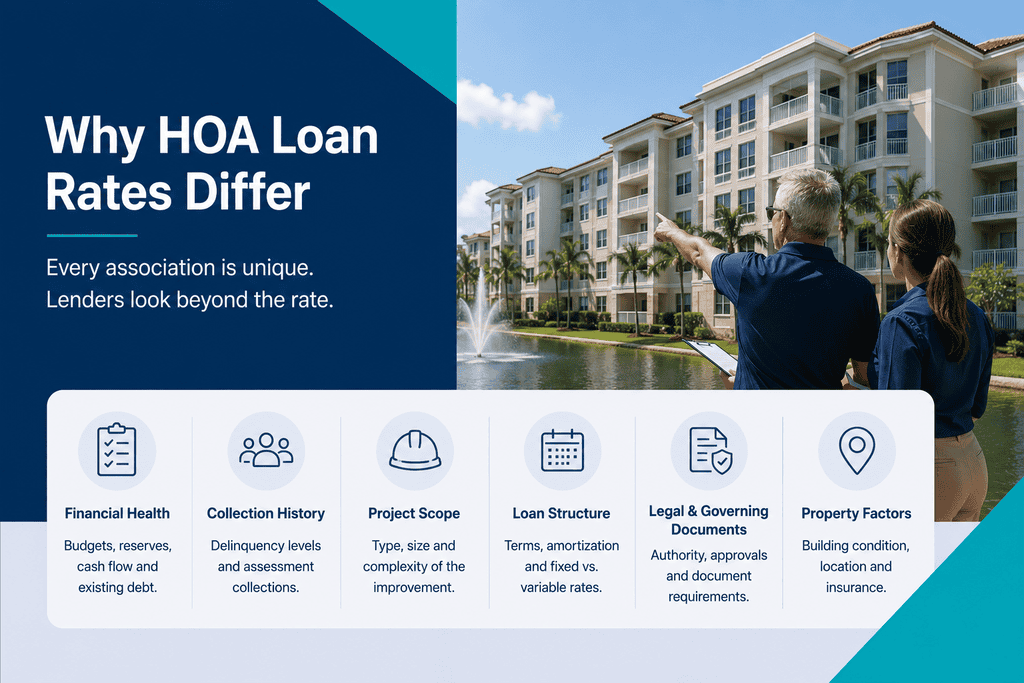
What determines HOA loan interest rates?
Two Florida communities can need the same amount for similar projects and still receive different loan proposals.
A lender is evaluating whether the association can support the requested debt over the proposed repayment period. The rate is one way the financing reflects that assessment.
The association’s financial condition
Expect lenders to review recent budgets, financial statements, reserve information, bank records and other evidence of the association’s financial position.
TuCielo’s association financing process outlines the types of financial, governance and project documents that may be reviewed as an association moves from an initial financing discussion into underwriting.
A lender wants to see how much revenue comes into the association, where the money goes and whether sufficient cash flow remains to service new debt.
A large reserve account can be helpful, but reserves alone don’t determine the rate. An association may still be financeable when it has reserve deficiencies if the overall transaction meets the lender’s underwriting requirements.

Owner delinquency and collection history
Association lenders depend heavily on the community’s ability to collect assessments.
If many owners are behind, the lender has to consider what would happen if the same collection problem affects the assessments supporting the loan. A stable collection history generally presents a different credit profile from an association with substantial or persistent delinquencies.
Boards preparing to borrow should make sure the delinquency report is current and reconciles with the financial statements. A lender may ask about collection policies, aging balances and unusually large past-due accounts.
Boards can also review common HOA loan requirements before requesting proposals so they know which records may need to be organized.
Loan amount and project scope
A $400,000 paving project isn’t underwritten in exactly the same way as a multimillion-dollar structural restoration.
The lender will usually want a clear project budget, contractor bids or contracts and an explanation of how loan proceeds will be used. Projects with several phases or construction draws may require a more detailed funding structure.
Boards should avoid requesting an arbitrary maximum amount simply to create a cushion. Establish the expected construction cost, appropriate contingency and other legitimate project expenses before determining the requested financing amount.
Loan and amortization term
The length of the repayment period affects both the monthly payment and the total cost of borrowing.
Longer amortization can reduce monthly debt service because principal is spread across more payments. The tradeoff is that the association may pay interest for a longer period.
A board therefore shouldn’t assume that the proposal with the lowest monthly payment is the least expensive.
Suppose two lenders finance the same project. One offers a shorter term with a larger monthly payment while another offers a longer term with a smaller payment. Even if their interest rates are similar, the total amount repaid may differ significantly.
Request the complete payment schedule rather than comparing monthly payments alone.
Fixed versus variable pricing
A fixed rate provides a known interest rate for the period specified by the loan documents. This can make future association budgeting easier because the rate itself doesn’t change during that fixed period.
A variable rate can move according to its stated benchmark and adjustment formula.
If a lender offers variable financing, the board should identify:
- The benchmark used to calculate the rate.
- The margin added to that benchmark.
- How frequently the rate can reset.
- Whether there is a minimum rate or floor.
- Whether there is a maximum rate or cap.
- Whether the loan can later convert to fixed pricing.
The Federal Reserve explains through its monetary policy materials how changes in policy rates influence broader financial conditions. For an association considering variable-rate financing, that makes the reset formula particularly important.
How boards should compare condo association loan rates
Comparing condo association loan rates only by looking at the percentage beside “interest rate” can produce a misleading result.

A useful comparison puts every proposal into the same financial framework.
| What to compare | Why it matters |
| Interest rate | Determines the stated cost charged on outstanding principal. |
| Fixed or variable structure | Determines whether the rate can change after closing. |
| Amount financed | Fees or reserves added to the loan can increase the balance beyond the project cost. |
| Amortization period | Changes the payment size and how long principal is repaid. |
| Loan maturity | May differ from amortization and could create a remaining balance at maturity. |
| Closing and lender costs | Increase the association’s overall financing expense. |
| Prepayment provisions | Affect whether the association can reduce debt early without additional cost. |
| Debt service requirements | May require additional funds to be maintained as part of the financing structure. |
The goal is to compare economic cost and flexibility, not simply rate.
Ask for the total amount financed
Imagine an association has a $2 million construction contract.
If financing expenses and required reserves are added to the loan, the principal balance may exceed $2 million. Interest would then be calculated using the financed amount according to the loan documents.
Whatever lender a board considers, it should request a clear breakdown showing the project amount, financed costs, required reserves and final principal balance.
Calculate total debt service
The monthly payment answers one question. Total debt service answers another.
Before voting on financing, boards should know:
- How much principal the association will borrow.
- How much each scheduled payment will be.
- How many payments are expected.
- How the interest rate is calculated.
- What fees are paid separately or financed.
- Whether any balance remains at maturity.
- What happens if the association prepays.
This calculation also helps the board explain the financial decision to owners.
A lower payment obtained by stretching repayment over many additional years may solve an immediate affordability problem. That could be appropriate for a long-lived capital improvement, but the additional interest expense still belongs in the comparison.
Translate the loan into an owner-level impact
Boards ultimately fund association debt from association revenues, which generally means assessments paid by owners.
A hypothetical example shows why rate comparisons need context.
Assume a 100-unit association is evaluating financing for a major roofing and structural project. It receives two proposals with different rates and terms. Comparing the headline percentages tells the board very little about what residents will actually experience.
The treasurer should instead model:
- The association’s monthly debt payment.
- Each unit’s allocated share under the governing documents.
- Existing assessment obligations.
- Any owner prepayment option.
- Expected collection performance.
- The amount of financial cushion remaining after debt service.
The final allocation may not be identical for every owner. Under Florida Statutes section 718.115, condominium common expenses are governed by the statute together with the declaration and other applicable condominium documents. Boards therefore shouldn’t automatically divide every financing obligation equally among units without reviewing the association’s governing documents.
Why HOA loan rates in Florida can differ from one association to another
Florida adds its own practical considerations to an association financing decision.
A lender evaluating a Florida condominium may be looking at major roof work, concrete restoration, waterproofing, elevators, plumbing systems, seawalls or structural projects rather than a discretionary amenity upgrade. The underlying project can affect both underwriting and the amount the association needs.
Reserve needs can change the financing requirement
For some Florida condominium associations, the funding conversation also involves structural integrity reserve study obligations.
An association may have immediate repair work, future reserve requirements and limited existing cash. Those issues should be evaluated together because borrowing enough for the construction contract while ignoring other financial requirements could leave the board with another shortfall.
Boards dealing specifically with reserve funding can review TuCielo’s guide to SIRS funding options in Florida for more context on ways associations may approach major reserve obligations.
Borrowing doesn’t remove the underlying cost. It changes when the association receives funds and how repayment occurs.
Governing documents still matter
The lender’s willingness to make a loan doesn’t by itself establish that an association has completed the approvals required to borrow.
Florida law provides the statutory framework for condominium associations and homeowners associations, but the association’s declaration, articles, bylaws and other governing documents may impose additional requirements.
Boards should have association counsel determine the required approval procedure before signing a loan commitment.
This article provides general educational information and isn’t legal, tax or individualized financial advice.
How to prepare for a better loan comparison
A board can’t control every factor affecting HOA loan rates in Florida. It can, however, control the quality of the financing package it presents and the way proposals are evaluated.
Use the following process before choosing a lender.
1. Confirm exactly how much the project requires
Start with current contractor bids, engineering information and a realistic project schedule.
Separate the construction cost from contingency funds, professional fees and any other expected expenses. If several projects are being combined into one financing request, identify each component rather than presenting one unexplained total.
2. Review the association’s finances before applying
Reconcile the latest financial statements with the current budget and bank records.
Review delinquencies carefully. Make sure the board understands unusual receivables, existing debt and any significant recent changes in assessment income.
A lender will probably ask about these items, so resolving inconsistencies before underwriting can prevent unnecessary questions later.
3. Gather the governance and project documents
Prepare the documents a lender is likely to need, including:
- Current and recent financial statements.
- The association budget.
- Delinquency reports.
- Governing documents.
- Owner or unit information where requested.
- Board resolutions and relevant meeting records.
- Insurance documents.
- Engineering reports.
- Contractor bids or contracts.
Having these records organized before requesting financing makes it easier to answer underwriting questions consistently.
4. Request comparable proposals
Ask each financing provider to quote the same project amount and, where possible, comparable repayment periods.
Then request enough information to identify the true differences. The proposal should make the rate, term, fees, payment structure, prepayment rules and continuing requirements understandable.
If one proposal finances fees and another requires them at closing, adjust the comparison before deciding which costs less.
5. Stress-test the payment
Run the budget using the proposed debt service and consider what happens if assessment collections weaken.
A financing structure that leaves almost no operating margin could create pressure even if the initial rate looks attractive.
Boards should also consider other expected increases in insurance, maintenance, reserve contributions and existing contracts rather than treating the loan payment in isolation.
6. Review the legal authority before closing
Have association counsel review borrowing authority, required votes or resolutions, the assessment structure and lender documents.
The review should happen before the association becomes committed to a structure, not after the board has already presented it as final to owners.
7. Compare affordability with total cost
The lowest total cost and the lowest monthly payment often won’t be the same option.
The board has to decide how much weight to give each objective. A shorter loan may reduce long-term interest while a longer structure may make a large required project more manageable for owners.
That decision should be documented and explained using actual numbers from the proposed financing.
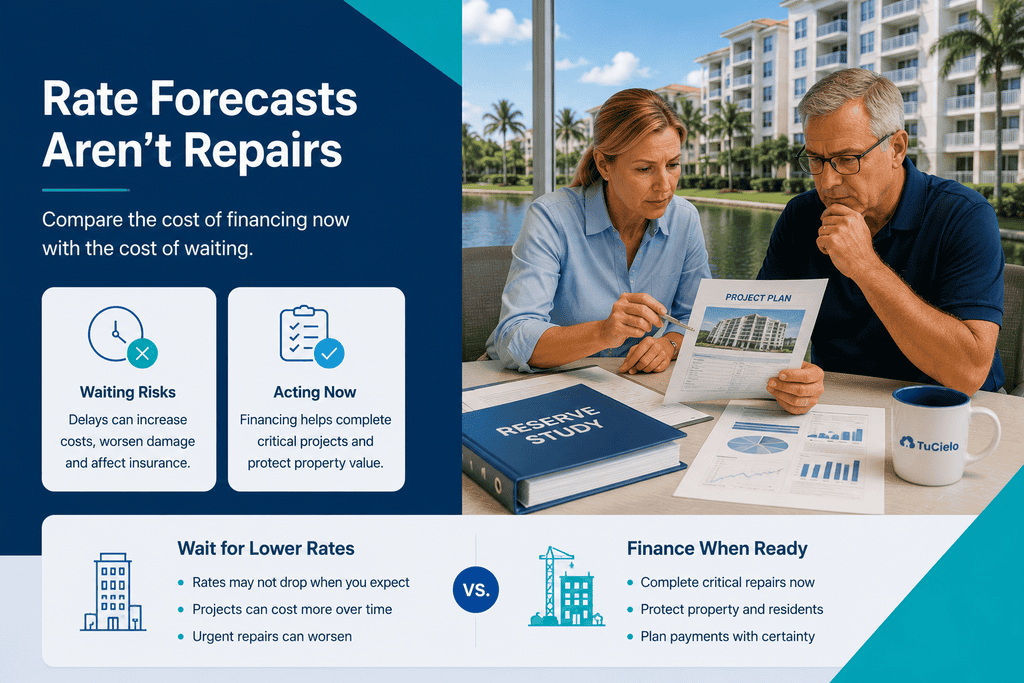
Should a Florida association wait for lower interest rates?
Waiting for interest rates to fall can sound appealing, particularly when a project is large enough that even a modest rate change affects long-term interest expense.
The difficulty is that nobody can guarantee when rates will change or by how much.
At its July 2026 meeting, the Federal Open Market Committee maintained the federal funds target range at 3.50% to 3.75%. Three members preferred a 0.25 percentage point increase, which shows why boards shouldn’t base a required building project on the assumption that borrowing costs will move in one particular direction.
Instead, compare the cost of financing now with the consequences of delaying the project.
For an optional clubhouse renovation, waiting may be reasonable.
For active water intrusion, structural deterioration or a failing roof, the board also needs to consider whether postponement could increase construction costs, interfere with insurance or allow physical conditions to worsen. Those questions require input from the association’s engineer, contractor, counsel and insurance professionals where applicable.
The financing decision should follow the project’s actual urgency rather than an interest-rate forecast.
Compare financing based on your association’s actual project
HOA loan interest rates make more sense when the board evaluates them alongside the project cost, repayment period and expected owner payment rather than searching for one statewide percentage.
Florida condominium associations, HOAs and co-ops preparing for a major repair or capital project can speak with TuCielo about the financing structure, documentation and project information needed to obtain a project-specific quote.
FAQs
What is a good HOA loan interest rate in 2026?
There isn’t one rate that can be classified as good for every association. The board should compare the quoted rate with the loan term, fees, repayment schedule, prepayment provisions and the association’s overall financial profile.
A seemingly higher rate could accompany a materially different loan structure, so compare total economics before choosing an offer.
Are condo association loan rates higher than mortgage rates?
They can be different because condominium association financing and individual residential mortgages are different forms of credit. The association is the borrower and lenders evaluate assessment revenue, delinquencies, finances and organizational factors rather than underwriting a mortgage against one owner’s home.
Mortgage advertisements therefore aren’t a reliable benchmark for condo association loan rates.
Are HOA loan rates in Florida fixed or variable?
Both structures may be available depending on the lender and transaction. A fixed-rate proposal offers greater payment predictability while a variable loan may change according to a benchmark and the adjustment terms in the agreement.
Boards should confirm how often a variable rate changes and whether floors or caps apply.
Does an HOA loan use homeowners’ personal credit scores?
Association loans are generally made to the association rather than individual unit owners. The lender therefore evaluates the association and its repayment capacity rather than treating the transaction like an individual homeowner mortgage.
Owners remain responsible for association assessments according to applicable governing documents and law.
Can an association get a lower rate by choosing a shorter term?
Possibly, but a shorter repayment period doesn’t automatically guarantee better pricing. Rates and terms depend on the lender’s underwriting criteria and the association’s circumstances.
A shorter amortization can also produce a substantially larger monthly payment, so boards should compare both pricing and cash-flow impact.
Should a board choose the lender offering the lowest interest rate?
Not without reviewing the rest of the proposal. Compare total principal, fees, loan term, amortization, prepayment provisions, required reserves and any ongoing financial covenants.
The lowest quoted rate may not produce the lowest total cost or the most suitable repayment structure.
How can a Florida association get an accurate interest rate quote?
Prepare current financial records, delinquency information, project costs, governing documents and relevant engineering or reserve information, then submit them for lender review.
A calculator or published example can help with early planning, but it shouldn’t be treated as a loan commitment.