

A Florida milestone inspection can turn a building safety review into an immediate funding challenge. If an engineer or architect identifies substantial structural deterioration, the association may need to move from inspection findings to engineering, permitting and construction within a limited period.
This guide explains how milestone inspection financing may help Florida condominium and cooperative associations pay for required work. It covers phase 2 milestone repairs, available funding paths, the information lenders may review and the steps boards can take before asking owners to approve a financing plan.
The information below is general education. Inspection requirements, association authority, loan terms and owner obligations depend on the property’s documents and circumstances. Boards should obtain advice from qualified engineering, legal, accounting and insurance professionals before making project or financing decisions.
What happens when a milestone inspection identifies repairs?
Florida’s milestone inspection program applies to residential condominium and cooperative buildings that are three or more habitable stories high. In general, an inspection is required when the building reaches 30 years of age and every 10 years afterward. A local enforcement agency may require the first inspection at 25 years when local conditions, including proximity to salt water, justify an earlier review.
The building’s age is based on the date its certificate of occupancy was issued. Certain smaller residential buildings are excluded from the statewide requirement. Associations should confirm the applicable schedule with their city or county building department rather than relying only on the property’s construction date.
The process has two possible phases.
Phase 1 is a visual structural assessment
During phase 1, a Florida-licensed architect or engineer visually examines the building’s habitable and nonhabitable areas, including its major structural components. The professional provides a qualitative assessment of the building’s structural condition.
If the professional finds no signs of substantial structural deterioration, a phase 2 inspection isn’t required. The report may still recommend preventive maintenance or repairs for damaged items that don’t meet the statutory definition of substantial structural deterioration.
Phase 2 investigates possible structural deterioration
A phase 2 inspection is required when phase 1 identifies substantial structural deterioration. It may include destructive or nondestructive testing selected by the engineer or architect.
The purpose is to determine whether affected areas are structurally sound and safe for their intended use. The professional may also recommend a program for evaluating and repairing distressed or damaged portions of the building.
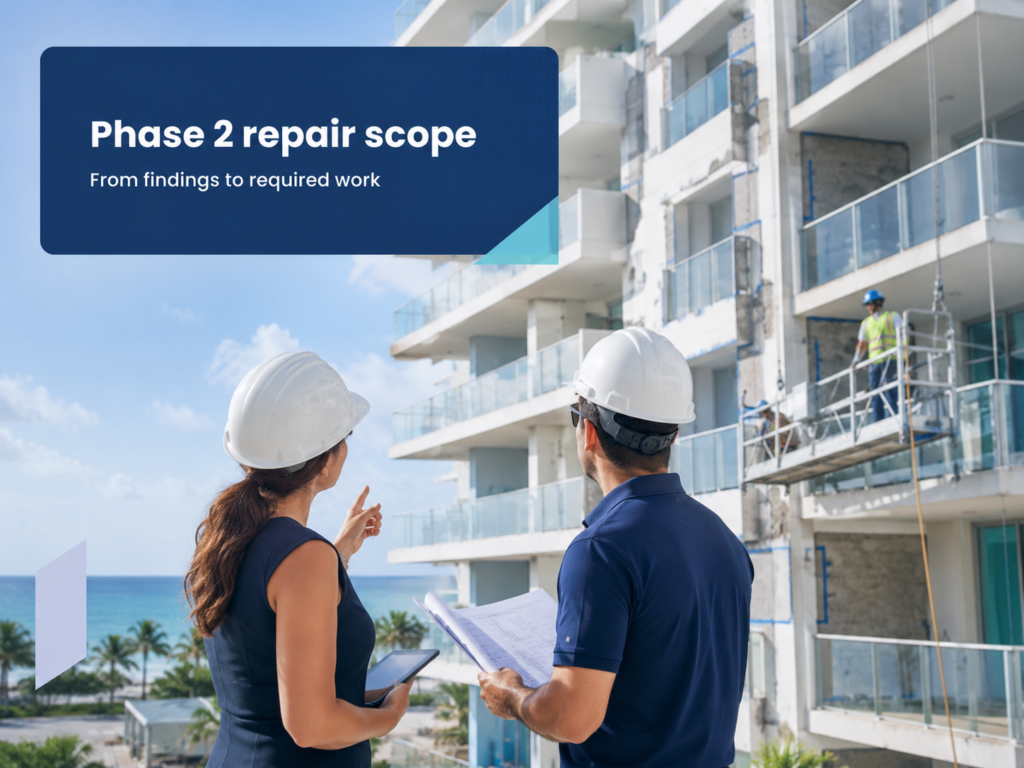
Under Florida Statute 553.899, local governments must require associations to schedule or commence repairs for substantial structural deterioration within a specified period. Repairs must begin within 365 days after receipt of the phase 2 report unless the local government sets an earlier deadline.
The association must also distribute the inspector-prepared summary to unit owners within 45 days after receiving the applicable report. Additional posting and website publication requirements may apply.
These deadlines make early financial planning important. Waiting until bids are final to discuss funding can leave the board with little time to communicate with owners, obtain approvals and prepare a complete financing request.
What milestone inspection financing may need to cover
The cost shown in an engineer’s first report may represent only part of the association’s eventual financial need. A practical funding plan should account for the full path from investigation through completed construction.
Depending on the property, milestone inspection financing may be used for costs such as:
- Additional engineering and testing required during phase 2
- Construction drawings and technical specifications
- Concrete restoration and structural repairs
- Balcony, walkway or parking structure repairs
- Waterproofing connected to structural deterioration
- Permit, inspection and professional service costs
- Contractor mobilization and temporary protection
- Required reinspection or project closeout work
- Reasonable construction contingencies
- Related repairs needed to complete the structural scope correctly
Not every cost will qualify under every financing program. The association should confirm permitted uses before signing construction contracts or assuming that all related improvements can be included.
Boards should also distinguish between three different numbers:
- The engineer’s preliminary estimate: An early planning figure based on the observed condition.
- The contractor’s bid: A price based on a defined scope, assumptions and exclusions.
- The project funding requirement: The amount the association needs after considering professional fees, permits, contingencies, existing reserves and any work outside the contractor’s base bid.
Using only the lowest contractor bid can understate the actual financing need. A low bid may exclude access equipment, hidden deterioration, permit corrections or work that becomes visible after concrete is opened.
A hypothetical phase 2 repair scenario
Consider a hypothetical 72-unit coastal condominium. Its phase 1 inspection identifies cracking and corrosion around several balcony edges, which leads to a phase 2 inspection.
Testing finds deterioration in balcony slabs, exterior columns and portions of the parking structure. The engineer develops a repair scope and the association receives a contractor bid of $3.4 million.
That figure doesn’t include all project costs. The board also expects engineering administration, permits, temporary access measures and a construction contingency. After subtracting available project reserves, the association determines that it needs to raise approximately $3.7 million.
At that point, the board isn’t choosing between repairing and doing nothing. Its decision is how to fund the required scope in a way the association can carry and owners can understand.
How associations can fund milestone inspection repairs
The right funding structure depends on the project size, available reserves, owner finances, governing documents and the association’s ability to borrow. Many projects use more than one source.
| Funding option | How it works | Main issue to evaluate |
| Existing reserves | The association pays eligible costs from money already set aside | Using reserves may reduce funds available for other scheduled work |
| Lump-sum special assessment | Owners pay their allocated shares over a short collection period | Large individual payments may create hardship, delinquencies or collection delays |
| Installment assessment | The association collects the assessment over several months | The collection schedule may not match contractor payment requirements |
| Traditional bank loan | The association borrows and repays the loan through its operating budget or assessments | Approval, loan size and term depend on the bank’s underwriting limits |
| Specialized association financing | A financing provider evaluates the association and project as a community association transaction | Terms, documentation, costs and repayment obligations require careful review |
| Combined structure | The association uses reserves, owner payments and borrowed funds together | The board must clearly document how each source will be applied |
Using existing reserves
Reserves can reduce the amount owners need to contribute or the association needs to borrow. Before using them, the board should identify which accounts are available and whether the funds are restricted to particular components.
The association should also consider what remains after the withdrawal. Spending most available reserves on one urgent project may leave the property unable to address another roof, plumbing, electrical or building-envelope need.
A Structural Integrity Reserve Study (SIRS) may affect that analysis. The Florida Department of Business and Professional Regulation describes a SIRS as a budget planning tool that reviews designated building components, current reserve funding and the amounts needed for future major work.
Florida’s official condominium inspection guidance states that a SIRS must consider regular assessments, special assessments, lines of credit and loans used to meet maintenance and reserve obligations. When financing is arranged after the study, an updated SIRS may be required to reflect the funding method and its effect on the reserve schedule.
Because milestone inspections and reserve studies serve different purposes, one shouldn’t be treated as a substitute for the other. The milestone inspection evaluates structural condition and safety. The SIRS addresses long-term reserve planning for specified components.
Levying a lump-sum special assessment
A special assessment can be a direct way to collect project funds. Each owner pays an allocated share based on the association’s governing documents and approved assessment structure.
The difficulty is timing. Contractors may require deposits and progress payments before the association can collect the full amount. Some owners may also struggle to pay a large assessment on short notice.
For example, a $3.6 million project allocated equally across 72 units would represent $50,000 per unit before considering differences in ownership shares, reserves or other funding. The actual allocation must follow the condominium documents and applicable law.
A board evaluating this route should consider more than whether owners will approve the assessment. It should also evaluate:
- When each installment becomes due
- How much cash the contractor requires at each project stage
- What happens if some owners pay late
- Whether the association has a collection policy that can support the schedule
- How unpaid assessments affect project cash flow
- Whether owners can pay early while others use a longer payment structure
Borrowing through a bank
A traditional bank loan may allow the association to begin work while spreading repayment over time. The bank will typically review the association’s financial condition, governance documents, owner delinquency levels, insurance and project information.
Approval isn’t based only on the value of the building. The association itself is generally the borrower, so the lender needs to understand the association’s ability to collect assessments and make payments.
A bank may be suitable when the association has strong financial records, manageable delinquency, adequate insurance and a project that fits the institution’s lending limits. However, the board shouldn’t assume that its existing operating bank will approve the full repair amount or proposed term.
Using specialized association financing
Specialized association financing is designed around condominium associations, cooperatives and homeowners associations rather than individual unit owners. The association obtains financing and establishes a repayment plan through its budget or assessment structure.
TuCielo provides association financing for Florida communities that need to fund major repairs or capital improvements. Projects may include concrete restoration, structural work, roofing, waterproofing, plumbing and other common-area improvements.
This type of financing may be relevant when the project is larger than the association’s reserves, a lump-sum assessment would place pressure on owners or a traditional bank won’t fund the complete scope. Approval and terms still depend on a review of the association, project and supporting documents.
Combining owner payments with financing
A combined structure can reduce the amount borrowed while giving owners more than one payment path.
For example, the board might allow owners to pay their full assessment before a stated deadline. The association could then finance the remaining amount for owners who need installments. Available reserves might also be applied to lower the total project balance.
This approach requires careful legal and accounting work. The association must define how early payments, financed balances, interest, collection responsibilities and unit transfers will be handled.
The board should avoid announcing a payment structure before association counsel, the accountant and the financing provider have reviewed how it will operate.
How to prepare a financing request after the inspection
A lender can review a milestone inspection project more efficiently when the association presents a consistent record. Missing reports, conflicting project totals or incomplete financial statements can delay the review.
Boards can use the following process.
1. Confirm the required repair scope
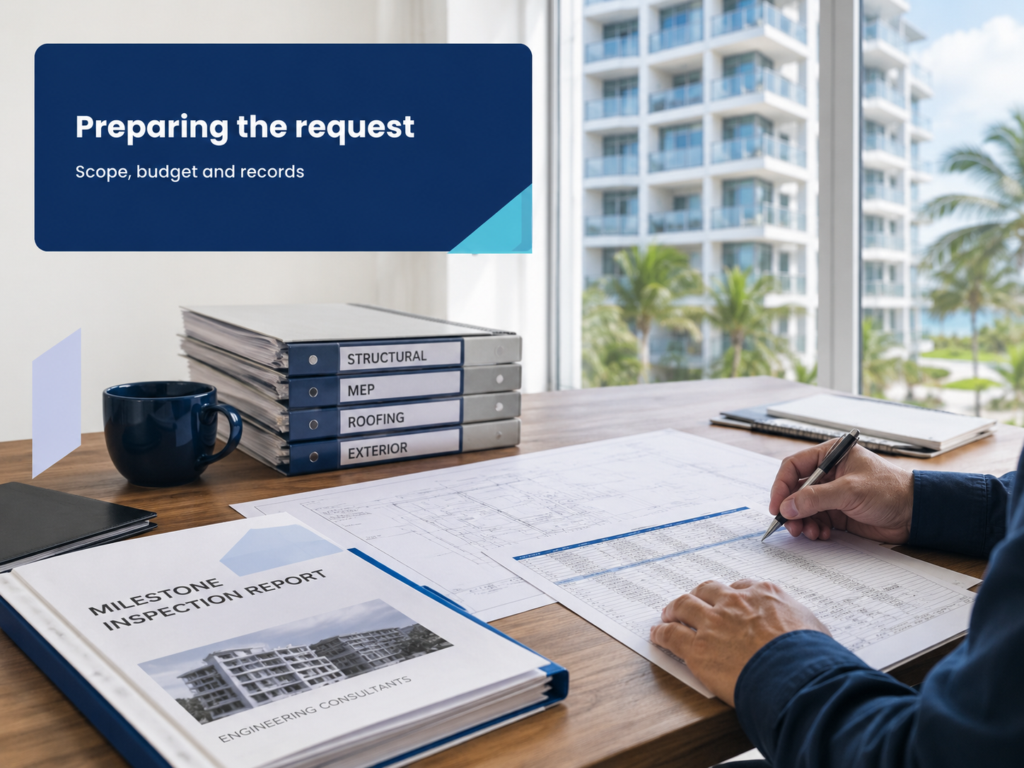
Start with the phase 2 milestone report, engineer’s recommendations and any direction from the local building official. Identify which repairs address substantial structural deterioration and which items are preventive or elective.
The board should ask the engineer whether the scope is complete enough for reliable contractor pricing. When important testing or design work remains unfinished, any financing amount may still be preliminary.
2. Develop a complete project budget
The project budget should show more than one construction number. List professional fees, permits, contractor costs, contingencies and other expected expenses separately.
It should also identify existing resources, such as restricted reserves, unrestricted cash or owner payments already collected. The remaining amount becomes the proposed financing need.
The contingency should be based on the engineer’s and contractor’s assessment of project uncertainty. Boards shouldn’t invent a percentage merely because it is commonly used on other construction projects.
3. Reconcile the inspection, SIRS and budget
The milestone report, SIRS and annual budget may describe overlapping components but use different timing and cost assumptions.
For example, a SIRS might anticipate exterior work several years from now while a phase 2 inspection calls for part of that work sooner. The reserve professional, engineer and accountant may need to update the association’s planning documents so the assumptions align.
This step helps the board explain why the project is needed now, how reserves will be treated and how future contributions may change after financing.
4. Gather association financial records
Financing providers commonly request documents that show the association’s income, expenses, cash position and collection history. TuCielo’s association financing process identifies materials that may include recent financial statements, budgets, bank statements, delinquency reports and information about existing debt.
The board should check that financial reports cover the same period and reconcile with the association’s bank records. Unexplained differences can create additional questions during underwriting.
5. Organize governance and insurance documents
The lender may need to verify that the association exists, has authority to borrow and can impose the assessments needed for repayment.
Documents may include:
- Declaration and amendments
- Articles of incorporation
- Bylaws
- Unit owner roster
- Board and membership meeting minutes
- Management agreement
- Collection policy
- Existing loan documents
- Property and liability insurance
- Directors and officers coverage
- Crime or fidelity coverage
- Applicable flood or wind coverage
Association counsel should review the governing documents and approval procedure. Depending on those documents and the proposed transaction, board action, owner approval or both may be required.
6. Collect project contracts and payment schedules
Provide the lender with the engineer’s report, repair specifications, contractor bids and proposed construction agreement. The contractor’s payment schedule should show when deposits and progress payments will be due.
This information allows the association and financing provider to compare available funding with actual cash needs. It may also reveal whether the project should be funded at closing, through controlled draws or through another disbursement structure.
7. Compare complete financing terms
Monthly payment is only one part of a financing proposal. Boards should compare:
- Principal amount
- Interest calculation
- Repayment period
- Fees and closing costs
- Security and assignment provisions
- Prepayment terms
- Funding and disbursement conditions
- Financial reporting requirements
- Insurance requirements
- Default provisions
- Treatment of existing association debt
The association’s attorney should review the documents before execution. Its accountant or financial adviser can help evaluate how the loan payment will affect budgets, assessments and reserve contributions.

Questions boards should answer before choosing a structure
A financing plan should connect the engineering timeline with the association’s financial capacity. The following questions can help the board test whether the plan is workable.
Is the proposed amount enough to complete the project?
Underfunding can be as disruptive as failing to secure financing. If the loan covers the base contract but not professional fees, contingencies or required related work, the board may need a second assessment later.
Ask the engineer and contractor to explain exclusions, allowances and unresolved conditions. The financing amount should be tied to a documented project budget rather than a rough verbal estimate.
Can the association support the payment?
The board should model the payment within the full operating budget. That means considering insurance, utilities, staffing, maintenance, existing debt and required reserve contributions.
A payment that appears affordable in isolation may still create budget pressure when combined with other rising property costs.
What will each unit owner be expected to pay?
Owners need more than a total project figure. They need a clear explanation of their allocated share, available payment choices, due dates and what may happen during a sale or transfer.
The board should avoid presenting estimated per-unit amounts as final until the allocation method, financing costs and owner participation assumptions are settled.
What happens if collections fall below projections?
A loan payment is still due even when one or more owners fail to pay assessments on time. The association should evaluate delinquency trends, collection procedures and the amount of operating cushion available.
The financing provider may also review delinquencies as part of underwriting. Boards should prepare an accurate report rather than excluding disputed or recently overdue accounts without explanation.
Does the project schedule match the funding schedule?
A contractor may require a deposit, monthly draws and payment for stored materials. Financing that becomes available too late or in the wrong amounts can interrupt construction.
The board should map each expected payment against reserves, owner collections and financing proceeds before approving the final contract.
How will the board communicate the decision?
Owners should receive a plain-language explanation of the inspection result, proposed scope, estimated cost, funding alternatives and reason for the selected approach.
Boards should clearly separate confirmed facts from estimates. They should also explain which professionals prepared the reports and where owners can review the underlying documents.
Common mistakes that make repair financing harder
Milestone inspection repairs are complicated enough without avoidable financial and administrative problems.
Waiting for the final deadline before exploring funding
The statutory deadline to commence repairs doesn’t mean an association can wait until the final month to arrange financing. Engineering, bids, legal review, owner communication and lender underwriting all take time.
Starting earlier gives the board more room to compare options and correct missing documentation.
Treating the phase 2 estimate as a fixed contract price
A phase 2 report may identify needed repairs without providing construction documents or a final price. Conditions can also change after testing or demolition begins.
Boards should ask what the estimate includes and what must happen before contractors can provide comparable bids.
Requesting financing with inconsistent numbers
A lender may receive one amount in the engineering report, another in board minutes and a third in the application. Even when each number had a valid purpose, the differences need an explanation.
A single project budget should reconcile the amounts and show how the requested financing was calculated.
Focusing only on the lowest payment
A longer term may reduce the scheduled payment but increase the period during which the association carries the obligation. Fees, prepayment conditions and reporting requirements also matter.
Boards should compare the whole transaction and document why the selected structure suits the association’s circumstances.
Assuming low reserves automatically prevent approval
Limited reserves can affect underwriting but don’t always end the discussion. The lender may examine the project, association budget, owner delinquencies, collection authority, insurance and other factors together.
TuCielo explains in its association financing FAQs that it reviews associations with limited reserves or deferred maintenance based on the overall financial and project picture. That statement isn’t a promise of approval. Each association still requires an individual review.
Announcing terms before they are confirmed
Preliminary discussions may change after document review, underwriting or legal analysis. Boards can create confusion by presenting an estimated rate, term or unit payment as final too early.
Communications should label estimates clearly and state what remains subject to approval.

Build a funding plan before the repair deadline takes control
A phase 2 milestone report gives the association a technical direction. The board still needs to turn that direction into a complete scope, realistic budget and workable owner payment plan.
Start by reconciling the engineering findings, contractor pricing, reserves and construction schedule. Then compare the effect of a lump-sum assessment, borrowed funds or a combined structure on both the association and its owners.
Florida condominium and cooperative boards that need to fund structural inspection repairs can speak with TuCielo about available association financing paths and the documentation needed to begin an eligibility review.
FAQs
Can an association finance phase 2 milestone repairs?
An association may be able to obtain financing for structural repairs identified through a phase 2 milestone inspection. Approval depends on the association’s financial condition, governing documents, project scope, insurance and the financing provider’s requirements.
How quickly must phase 2 milestone repairs begin?
Florida law requires local governments to set a timeframe for scheduling or commencing repairs involving substantial structural deterioration. The deadline can’t be later than 365 days after receipt of the phase 2 report, though a local ordinance may require earlier action.
Does the milestone inspection itself include the repair work?
No. The milestone inspection evaluates structural conditions and produces findings or recommendations. Engineering design, permitting, contractor work and post-repair verification are separate parts of the project.
Can reserves be used before the association borrows?
Potentially, but the board must determine which reserves are available and how using them affects other obligations. The association should review its governing documents, SIRS, budget and applicable legal requirements with its professionals.
Is a special assessment required when an association gets a loan?
A loan doesn’t necessarily eliminate assessments. The association still needs a source of revenue to make loan payments, which may come from regular assessments, a dedicated special assessment or another lawful budget structure.
Will every owner have to use the same payment option?
That depends on how the association structures the assessment and financing. Some plans may allow owners to pay early while the association finances the remaining balance, but legal, accounting and administrative details must be established before offering that choice.
What documents should a board prepare first?
Begin with the milestone inspection reports, engineer’s scope, contractor bids, project budget, current financial statements, budget, delinquency report, reserve information, governing documents, insurance records and details of existing debt. A complete and consistent package can make the review more efficient.