

Florida milestone inspection requirements affect older condominium and cooperative buildings across the state. For boards and property managers, compliance involves more than scheduling an engineer. It means confirming when the building is due, responding to local notices, communicating with owners, addressing inspection findings and planning how required work will be paid for.
This guide explains the rules that apply in 2026, including which buildings are covered, the 30-year and possible 25-year inspection schedules, phase one and phase two requirements, reporting deadlines and what happens when structural deterioration is found.
Because milestone inspections involve building safety, legal obligations and potentially significant association expenses, this article provides general educational information rather than legal, engineering or financial advice. Boards should confirm requirements with their local building department and qualified Florida professionals before making property-specific decisions.
Which buildings must meet Florida milestone inspection requirements?
Florida’s statewide milestone inspection program is established by Section 553.899 of the Florida Statutes. The current statutory framework generally applies to buildings that are three or more habitable stories high and are subject, in whole or in part, to residential condominium or cooperative ownership.
The requirement is tied to the building itself. A condominium property with several structures shouldn’t assume that every building follows the same schedule without confirming the height, age and ownership characteristics of each structure.
The statute excludes single-family, two-family, three-family and four-family dwellings with three or fewer habitable stories above ground. Boards should also be careful about judging building height informally. What residents call a “three-story building” may not necessarily resolve how its habitable stories are classified under the Florida Building Code.
The normal milestone is 30 years
For a covered building, the general rule requires an initial milestone inspection by December 31 of the year in which the building reaches 30 years of age. The age is based on the date the building’s certificate of occupancy was issued.
After the initial inspection, another milestone inspection is generally required every 10 years. If the certificate of occupancy date isn’t available, the statute allows the date of occupancy shown in records maintained by the local building official to be used.
For example, imagine a qualifying condominium building whose certificate of occupancy was issued in 1996. Under the general 30-year rule, it reaches its milestone year in 2026. The board should confirm the applicable deadline with its local enforcement agency rather than assuming the anniversary date itself controls.
Some buildings may face a 25-year schedule
The familiar distinction between coastal and inland buildings has changed from the original version of Florida’s milestone inspection law.
Current law allows a local enforcement agency to determine that local circumstances require an earlier inspection. Environmental conditions, including proximity to salt water, may be considered. When the local agency makes that determination, the initial inspection can be required by December 31 of the year the building reaches 25 years of age, followed by inspections every 10 years.
This makes the local building department an important source of information. Two buildings of similar age in different Florida jurisdictions may not necessarily follow identical inspection schedules.
Older buildings had earlier transition deadlines
Florida created special deadlines for buildings that were already at or near the milestone age when the statewide program took effect.
Buildings that reached 30 years of age before July 1, 2022 generally had an initial milestone inspection deadline of December 31, 2024. Buildings that reached 30 years of age on or after July 1, 2022 but before December 31, 2024 generally had a December 31, 2025 deadline.
A board taking over an older property in 2026 shouldn’t assume that an overdue inspection simply becomes part of the next normal 10-year cycle. If prior compliance is uncertain, the board should locate the inspection report, verify acceptance with the local enforcement agency and address any outstanding requirements promptly.
How the milestone inspection process works
A condo milestone inspection in Florida isn’t one single inspection with a simple pass or fail result. The statutory process can involve two phases depending on what the inspecting professional finds.
A Florida-licensed architect or engineer must oversee the inspection. The purpose is to assess the life safety and adequacy of the building’s structural components and evaluate its general structural condition as it relates to safety. The inspection isn’t intended to determine whether an older building fully complies with the current Florida Building Code or fire safety code.
Phase one is a visual examination
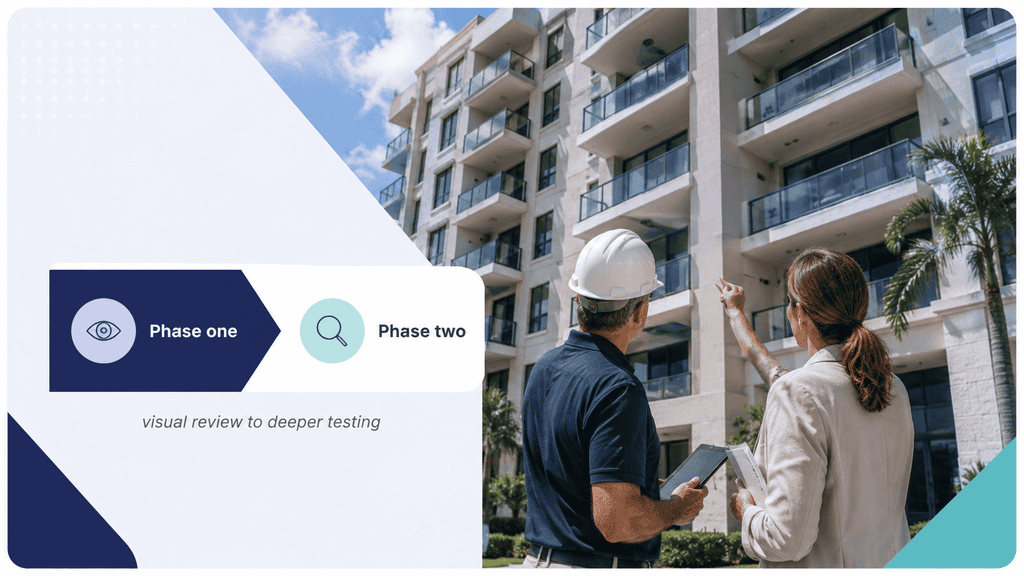
Phase one starts with a visual examination of habitable and nonhabitable portions of the building, including major structural components.
The architect or engineer provides a qualitative assessment of the building’s structural condition. If no signs of substantial structural deterioration are identified, phase two isn’t required.
“Substantial structural deterioration” has a specific statutory meaning. It refers to substantial structural distress or weakness that negatively affects the building’s overall structural condition and integrity.
That distinction matters because an older building can show visible deterioration without automatically triggering a conclusion that it has substantial structural deterioration. Surface cracking, leakage, peeling finishes, distortion or similar conditions aren’t automatically classified that way unless the inspecting professional determines that they indicate a more significant structural problem.
Phase one generally has a 180-day deadline after notice
Once the local enforcement agency determines that a building needs an inspection, it sends written notice to the association and any other applicable building owner.
The association must notify unit owners of the required inspection within 14 days after receiving that notice and provide the inspection deadline. Phase one must then generally be completed within 180 days after the building owner receives the local agency’s written notice.
For purposes of the statute, phase one is completed when the architect or engineer submits the inspection report to the local enforcement agency.
A local enforcement agency may extend an initial inspection deadline for good cause. One example specifically recognized in the statute is when the owner has already contracted with an architect or engineer but the inspection can’t reasonably be finished before the deadline. An extension isn’t something a board should assume will be granted automatically.
Phase two investigates structural deterioration in more detail
Phase two becomes mandatory if phase one identifies substantial structural deterioration.
Unlike the primarily visual first phase, phase two may include destructive or nondestructive testing selected by the architect or engineer. The investigation may be limited to particular affected areas or expanded as necessary to determine whether the structure is sound and safe for its intended use.
The professional can also use phase two to develop recommendations for further assessment and repair of distressed or damaged portions of the building.
If phase two is required, the architect or engineer must submit a progress report to the local enforcement agency within 180 days after submitting the phase one report. That progress report must include a timeline for completing phase two.
| Stage | What happens | Important timing |
| Local notice | The enforcement agency tells the association that an inspection is required | Association generally notifies owners within 14 days |
| Phase one | Architect or engineer visually evaluates major structural components | Generally completed within 180 days after written notice |
| Phase two, if required | Additional testing investigates substantial structural deterioration | Progress report due within 180 days after the phase one report |
| Final reporting | Professional submits the sealed report and summary | Submitted to the association and local building official |
| Owner distribution | Association provides the inspector’s summary to owners | Within 45 days after receiving the applicable report |
| Structural repairs | Work identified from phase two must be scheduled or started within the local deadline | Repairs must commence no later than 365 days after the phase two report |
Boards should use this as a planning framework, not as a substitute for the deadline stated in the local government’s notice or ordinance.
What happens after the inspection report arrives?
Finishing the physical inspection doesn’t finish the association’s responsibilities.
After completing phase one or phase two, the architect or engineer must submit a sealed inspection report along with a separate summary of material findings and recommendations. The report goes to the association, other applicable building owners and the building official with jurisdiction.
The report must address matters such as the type of inspection performed, identified structural deterioration, recommended repairs, observed unsafe or dangerous conditions, preventive work and items requiring additional inspection.
Boards have owner communication duties
Within 45 days after receiving the applicable inspection report, the association must distribute the inspector-prepared summary to each unit owner regardless of whether the findings are favorable or identify repairs.
The association must also post the summary conspicuously at the property. If the association is required to maintain a website, it must publish the full report and the inspector-prepared summary there.
These requirements make the milestone inspection a governance issue as well as an engineering issue.
Board communications should distinguish among several different findings. A report may identify ordinary maintenance, preventive work, areas needing further investigation or substantial structural deterioration. Telling owners simply that the building “passed” or “failed” may leave out information they need to understand the next steps.
The Florida Department of Business and Professional Regulation provides additional milestone inspection guidance for condominium and cooperative associations, including information about inspection phases, reports and repair responsibilities.
Phase two findings can trigger a repair deadline
When a phase two report identifies substantial structural deterioration, the matter moves from inspection to corrective work.
Florida law requires counties and municipalities to establish an ordinance specifying when affected owners must schedule or commence repairs. Regardless of the local timeframe, repairs for substantial structural deterioration must be commenced within 365 days after receipt of the phase two report.
A local government may require work to begin sooner.
If the building owner doesn’t provide proof that repairs have been scheduled or commenced within the required period, the local enforcement agency must review the building and determine whether it is unsafe for human occupancy.
That is why boards shouldn’t wait until the repair deadline is approaching before addressing budgets, contractor bids and financing.
A more useful sequence is to start financial planning as the scope becomes clear. TuCielo’s guide to financing repairs after a Florida milestone inspection explains how boards can connect inspection findings with project costs and available funding paths.
How milestone inspections interact with SIRS and association finances
Milestone inspections and Structural Integrity Reserve Studies, commonly called SIRS, often appear in the same board agenda. They address related building issues but serve different functions.
The milestone inspection is primarily a structural safety inspection. A SIRS is a reserve planning study that evaluates specified building components and determines how the association should fund future repair, replacement and deferred maintenance needs.
Completing one doesn’t automatically satisfy every requirement of the other.
Some associations can coordinate the two processes
Florida condominium law contains provisions allowing coordination between milestone inspections and SIRS requirements in certain circumstances.
For associations required to complete a milestone inspection on or before December 31, 2026, the statute permits the SIRS to be completed simultaneously with that inspection, subject to the applicable requirements. Florida law also allows a qualifying recent milestone inspection to be used in place of the visual inspection portion of a SIRS in certain circumstances.
Boards should still verify exactly what their engineer or reserve study professional is being engaged to perform. Hiring someone for a milestone inspection doesn’t automatically mean the association has commissioned a complete SIRS.
For a closer look at the funding side, TuCielo’s guide to SIRS funding options for Florida associations covers regular assessments, special assessments, credit lines and association loans.

Repair money and reserve money aren’t the same problem
An association can encounter two financial needs at the same time.
One is a current construction requirement. For example, phase two may lead to a concrete restoration project that needs to begin within the statutory repair window.
The other is a reserve obligation. A SIRS may require the association to increase funding for roofing, structural components, waterproofing or other covered systems over future years.
Boards should separate those amounts before deciding how to raise money.
Consider a hypothetical 120-unit Florida condominium. Its phase two report identifies concrete and balcony repairs that need prompt attention. At the same time, its SIRS calls for higher annual contributions for roof replacement and waterproofing expected several years later.
Treating all of those numbers as a single “milestone inspection cost” could produce a confusing funding proposal.
A better board analysis separates:
- The cost of the immediate repair scope.
- Current reserves legally available for that work.
- Required reserve contributions for future components.
- Engineering, permitting and project administration costs.
- A reasonable project contingency developed with the appropriate professionals.
- The amount and timing of any remaining funding gap.
Boards considering a major construction program can also review how condo capital improvement financing may fit alongside reserves and assessments.
Florida law allows several reserve funding methods
For condominium associations subject to applicable SIRS requirements, Section 718.112 permits reserves for covered components to be funded through regular assessments, special assessments, lines of credit or loans.
A special assessment, line of credit or loan used under these provisions requires approval by a majority of the total voting interests of the association. The statute also expressly permits qualifying associations to secure a credit line or loan for capital expenses required by a milestone inspection or SIRS.
Those statutory options don’t mean every association should borrow. The governing documents, owner impact, project urgency, existing debt, financing cost and repayment structure all matter.
A practical milestone inspection checklist for Florida boards
A milestone inspection 2026 plan should start before an engineer arrives. Boards that organize the compliance, engineering and funding work together are in a better position to respond when the report identifies a significant project.
Use the following workflow as a starting point:
- Verify the building’s age and classification. Locate the certificate of occupancy and confirm which buildings on the property are at least three habitable stories high.
- Confirm the schedule with the local enforcement agency. Determine whether the standard 30-year schedule applies or whether local conditions have resulted in a 25-year requirement.
- Check prior inspection records. If the property previously underwent a structural inspection, determine whether it was accepted as a milestone inspection and when the next 10-year cycle begins.
- Track the written notice carefully. Record when the local enforcement agency’s notice was received because statutory deadlines run from specific events.
- Engage a properly licensed professional. Confirm the architect or engineer is authorized to practice in Florida and understand exactly which inspection services are included.
- Prepare owners before the report arrives. Explain the inspection process, possible phase two work and how the board will communicate findings rather than waiting until a major repair recommendation appears.
- Start financial planning early. Review reserve balances, insurance considerations, SIRS recommendations, preliminary project costs and funding options before repair deadlines become urgent.
The board should also establish a simple document file containing the local notice, engineering agreement, inspection reports, owner notices, meeting records, bids, permits and financing documents. Milestone inspection reports form part of the association’s important official records and may also become relevant to future purchasers. DBPR’s condominium guidance details current recordkeeping and website requirements.
Common mistakes that can create problems for boards
One common mistake is using the building’s construction year without verifying the certificate of occupancy. The statute generally measures the building’s age from the certificate of occupancy date.
Another is assuming that every Florida building automatically follows either a 25-year “coastal” rule or a 30-year “inland” rule. Current law gives the local enforcement agency authority to require the earlier schedule based on local circumstances.
Boards can also lose valuable planning time by treating phase one as the end of the process before the report arrives. If substantial structural deterioration is identified, phase two can lead to further testing, engineering recommendations and an active repair schedule.
A fourth mistake is waiting for final contractor pricing before discussing funding. If a project could require millions of dollars that aren’t already available in reserves, the association may need time for owner approval, legal review and financing evaluation.
Finally, milestone inspections shouldn’t be treated as interchangeable with a SIRS. A board needs to understand what each report evaluates and which requirements have actually been completed.
Prepare for the inspection and the financial decision that may follow
Florida milestone inspections give boards important information about an aging building’s structural condition. The practical challenge is acting on that information within the required timeframe.
Before the association receives a phase two repair recommendation, boards can gather current financial statements, reserve information, engineering reports, governing documents and preliminary project costs. That preparation makes it easier to compare reserves, assessments and financing if the inspection leads to major structural work.
When existing funds won’t cover the required project on the needed schedule, boards can review TuCielo’s association financing options for Florida condominium and cooperative projects. Financing terms and association authority should be reviewed alongside the engineering scope, governing documents and advice from qualified legal and financial professionals.
FAQs
What is a milestone inspection in Florida?
A milestone inspection is a structural inspection of a qualifying condominium or cooperative building performed under Section 553.899 of the Florida Statutes. It evaluates major structural components and the building’s general structural condition as it relates to safety.
It isn’t intended to certify that an older building complies with every provision of the current Florida Building Code.
At what age does a Florida condo need a milestone inspection?
Covered buildings generally require their first milestone inspection by December 31 of the year they reach 30 years of age, followed by inspections every 10 years.
A local enforcement agency may require the first inspection at 25 years when local circumstances, including environmental conditions such as salt water exposure, support an earlier schedule.
Do all three-story Florida condos require milestone inspections?
The statewide requirement generally applies to buildings that are three or more habitable stories high and are subject, in whole or in part, to qualifying residential condominium or cooperative ownership.
Certain single-family through four-family dwellings with three or fewer habitable stories are excluded. Boards should confirm building classification and applicability with the local enforcement agency rather than relying on an informal floor count.
What happens if a condo passes phase one?
If the architect or engineer finds no signs of substantial structural deterioration during phase one, phase two isn’t required.
The professional still prepares a report and may identify maintenance or preventive repairs for conditions that don’t qualify as substantial structural deterioration.
How long does a board have to complete phase one?
Phase one must generally be completed within 180 days after the building owner receives written notice from the local enforcement agency.
The local agency may extend an initial deadline when statutory conditions for an extension are met, but boards shouldn’t assume an extension will be available.
How quickly must repairs begin after a phase two report?
Local governments must establish a timeframe for scheduling or commencing repairs for substantial structural deterioration.
Regardless of the local rule, those repairs must commence within 365 days after receipt of the phase two report. A city or county may impose an earlier deadline.
Can a Florida condo association borrow money for milestone inspection repairs?
Florida condominium law expressly allows qualifying associations to use a line of credit or loan to fund capital expenses required by a milestone inspection or SIRS. Certain approval, funding and disclosure requirements apply.
Whether borrowing makes sense depends on the association’s governing documents, financial position, project timing, owner impact and available alternatives.