

Florida condominium boards entered 2026 with a different set of rules for structural inspections, reserve funding and association governance than they faced a year earlier. HB 913 Florida condo changes were signed into law in June 2025 and generally took effect July 1, 2025.
For condo board members, property managers and owners, the practical question is what those changes mean now. HB 913 didn’t eliminate Florida’s structural safety requirements. It adjusted how associations can fund required work, changed parts of the Structural Integrity Reserve Study process and added new reporting, meeting and recordkeeping requirements.
This article explains the parts of the law that matter most when an association is planning repairs, reserves and project funding. It provides general information only. Associations should have Florida legal counsel, their engineer, accountant and other appropriate professionals review requirements for their specific property.
What HB 913 changed for Florida condo associations
HB 913 became Chapter 2025-175, Laws of Florida after Governor Ron DeSantis approved it on June 23, 2025. Most provisions took effect July 1, 2025. The law amended several areas affecting condominium and cooperative associations rather than replacing Florida’s existing condo safety framework.
Some of the most consequential changes affect four connected areas:
- Which buildings fall under milestone inspection and Structural Integrity Reserve Study requirements.
- How associations may fund reserve obligations and required repairs.
- How reserve schedules can respond to current building conditions and completed projects.
- What associations must report, record and disclose.
That distinction matters. An association shouldn’t treat HB 913 as permission to delay structural obligations generally. Instead, boards now have additional tools for coordinating inspections, repairs and funding while continuing to comply with Chapter 718 of the Florida Statutes.

Milestone inspections now focus on habitable stories
One technical change can have a significant effect on whether a property falls within the inspection framework.
HB 913 revised milestone inspection requirements so they apply to condominium and cooperative buildings that are three or more habitable stories in height. Earlier law referred more broadly to buildings of three or more stories.
The same concept was incorporated into Structural Integrity Reserve Study requirements. The final bill analysis states that condominium properties three habitable stories or more are subject to SIRS requirements. It also clarifies an exemption for four-family dwellings with three or fewer habitable stories.
Boards shouldn’t make their own assumptions about whether a parking level, mechanical area or another portion of the structure counts toward the statutory requirement. Building configuration and statutory definitions should be reviewed with the appropriate professionals.
Local governments must address repairs following phase two inspections
The law also strengthens the connection between inspections and the work that follows them.
HB 913 requires county commissions to adopt ordinances requiring affected associations and other owners to begin repairs within 365 days after receiving a phase two milestone inspection report.
For a board, that makes the funding question more immediate. Discovering a structural issue is only one part of the process. The association may also need engineering plans, contractor pricing, member approvals where required and enough money to begin the work within the applicable timeframe.
This is one reason boards benefit from discussing funding before the project reaches the contracting stage.
How HB 913 changed SIRS and reserve funding
The reserve provisions are among the most significant parts of HB 913 Florida condo associations need to understand.
Florida’s Structural Integrity Reserve Study requirements remain in place, but HB 913 gives associations more flexibility in determining how certain reserve obligations will be funded. It also makes the funding method part of the reserve planning process itself.
The reserve item threshold increased
For reserve accounts covering capital expenditures and deferred maintenance, HB 913 increased the threshold for certain items from $10,000 to $25,000. The $25,000 amount is subject to annual inflation adjustments by the Division of Florida Condominiums, Timeshares, and Mobile Homes.
The legislation requires the Division to post the inflation-adjusted threshold by February 1, 2026 and annually thereafter.
This threshold doesn’t mean associations can ignore structural components costing less than that amount. SIRS contains specifically covered components and other statutory requirements. Boards should rely on the current statute and their qualified reserve professional rather than using a dollar threshold alone to decide what belongs in a study.
Associations can pool reserves for SIRS items
HB 913 expressly allows associations to pool reserve accounts for two or more required SIRS components.
Under pooled funding, the proposed annual budget must provide enough funding so available reserves meet or exceed projected expenses for all components in the pool based on the association’s most recent SIRS. The board can also change between pooled and straight-line accounting without obtaining a member vote for that accounting-method change.
Pooling can give an association more flexibility in matching available funds to the timing of expected expenses. It doesn’t remove the obligation to maintain adequate funding under the applicable reserve schedule.
Boards considering a change should ask their reserve specialist and accountant to show how the balance behaves over the full projection period, particularly when several expensive components are expected to require work close together.

The SIRS must include a reserve funding schedule
HB 913 requires a SIRS to include, at minimum, a recommended schedule using a baseline funding plan that keeps the reserve cash balance above zero during each budget year. A study may also recommend other funding schedules if they are sufficient to meet the association’s maintenance obligations.
That makes the funding plan more than a theoretical calculation of component life and replacement cost. Boards need to understand how their planned contributions, assessments or borrowing fit the schedule.
The SIRS also must separately identify recommended reserves for items that aren’t legally required reserve items. That distinction can help boards understand which amounts relate to statutory obligations and which reflect additional recommendations from the professional performing the study.
The initial SIRS deadline was extended
For qualifying condominium associations that existed on or before July 1, 2022 and were controlled by unit owners rather than the developer, HB 913 extended the SIRS completion deadline from December 31, 2024 to December 31, 2025.
By 2026, that date has passed. An association that was subject to the requirement but didn’t complete its study by the applicable deadline should address the issue with qualified Florida counsel and its reserve professional rather than treating the extension as continuing relief.
The law also requires an association officer or director to sign an affidavit acknowledging receipt of a completed SIRS.
HB 913 allows loans and credit to fund certain reserve obligations
One of the clearest practical changes in HB 913 is that Florida law now expressly recognizes several ways of funding SIRS reserve obligations.
The legislation states that reserves for SIRS items may be funded through regular assessments, special assessments, lines of credit or loans. A special assessment, line of credit or loan under these provisions requires approval by a majority of the association’s total voting interests.
That creates more choices for associations facing a large funding gap.
| Funding method | How it can affect the association |
| Regular assessments | Builds funding through the association’s recurring assessment structure but may require significant increases when reserves are behind. |
| Special assessment | Raises a defined amount from owners, potentially over a shorter period depending on the assessment structure. |
| Line of credit | Provides access to borrowed funds subject to the terms, availability and approvals of the facility. |
| Association loan | Provides borrowed project or reserve funding that the association repays according to the financing agreement. |
These choices aren’t financially interchangeable. A board should compare total borrowing costs, owner payment impact, existing reserves, project timing, delinquency risk and the association’s governing documents before deciding how to proceed.

What happens when an association uses a loan?
HB 913 sets additional requirements when a loan or line of credit funds capital expenditures required by a milestone inspection or SIRS.
The financing must be sufficient to address the cumulative amount of applicable previously waived or unfunded reserve funding and the most recent SIRS. Funds also must be immediately available for the board to use for required repair, maintenance or replacement expenses without another member approval once the financing has been properly secured.
The special assessment, line of credit or loan and related information must also be reflected in the association’s annual financial statement.
Another important point is coordination with the SIRS itself. The study must consider whether an association plans to meet its obligations through regular assessments, special assessments, credit or loans. If financing is selected after the study is completed, the SIRS must be updated to reflect the chosen funding method and its effect on the reserve schedule.
For boards evaluating borrowed funding, TuCielo’s association financing overview explains how financing can be structured for major Florida condominium and HOA capital projects. TuCielo states that its association financing can be used for projects including structural repairs, concrete restoration, roofing, elevators, plumbing and other common-area improvements.
A hypothetical example
Consider a hypothetical 80-unit Florida condominium that completes a milestone inspection and learns that substantial concrete restoration is required.
Its current reserves don’t cover both the immediate repair scope and the funding level recommended in its updated SIRS. The board might consider increasing regular assessments, adopting a special assessment or seeking association financing.
Under HB 913, the board would need to look beyond the question of which option produces the lowest immediate payment. It also needs to determine whether the selected funding method satisfies the statutory framework, whether the required member approval has been obtained and whether the SIRS accurately reflects the final funding plan.
If the association chooses financing, it should review the project scope, contractor estimates, financial statements, budget, delinquency information, SIRS and insurance documents before approaching a lender. Those are among the documents TuCielo identifies in its association financing process.
Temporary reserve flexibility doesn’t eliminate repair obligations
HB 913 also created limited circumstances in which an association can pause or reduce reserve contributions.
These provisions deserve careful reading because they aren’t broad permission to stop funding reserves.
Reserve contributions can be paused after a natural emergency in limited circumstances
If a local building official determines that a condominium building is uninhabitable because of a natural emergency, the board may pause reserve contributions without first obtaining approval from a majority of the members.
That provision recognizes a practical problem. After a major event such as a hurricane, an association may need to direct available cash toward restoring a property before normal reserve funding can resume.
It doesn’t erase the association’s long-term reserve or maintenance responsibilities.
Certain associations can temporarily redirect reserve funding toward repairs
For a budget adopted on or before December 31, 2028, another temporary option may apply.
If an association completed a milestone inspection within the preceding two calendar years, a majority of the total voting interests may approve pausing or reducing reserve contributions for no more than two consecutive annual budgets so the association can fund repairs recommended by the milestone inspection.
An association using this option must obtain a SIRS before reserve contributions resume so its reserve needs and funding plan can be reassessed. The provision also contains exclusions for certain developer-controlled and recently turned-over associations.
The practical lesson is that boards should document exactly which statutory provision they intend to use. “HB 913 gives us more flexibility” isn’t enough to justify a budget decision on its own.

Other Florida condo law changes boards should know in 2026
Reserve funding received much of the attention around HB 913, but the legislation made several governance and disclosure changes that remain relevant under Florida condo law in 2026.
Annual financial reporting rules changed
The law extended the period for completing an association’s annual financial report from 120 days to 180 days after the end of the fiscal year. It also requires an officer or director to sign an affidavit confirming compliance with delivery requirements.
Reducing the required type of financial reporting now requires approval by a majority of all voting interests.
Boards should make sure their year-end calendar, accountant engagement and owner communications reflect the current requirements.
More records must be retained and posted
HB 913 expanded official record requirements. Among other items, condominium associations must retain bank statements and ledgers, recordings of meetings conducted by videoconference and affidavits required under Chapter 718. Approved board meeting minutes for the preceding 12 months also must be maintained on the association website where the website requirement applies.
The association website must be updated within 30 days after applicable information changes.
For property managers handling several communities, these requirements make consistent document management more important. TuCielo’s property manager resources address the funding side of large association projects when managers are helping boards prepare for major assessments or repair programs.
Video meetings have clearer statutory rules
The legislation permits condominium board meetings, budget meetings and member meetings to be conducted through videoconferencing subject to specific requirements. Notices must include access information and a physical meeting location. Videoconference meetings also must be recorded and preserved as official records.
There are additional rules concerning physical attendance, quorum and meeting location depending on the type of meeting. Boards should check the current statute and applicable DBPR rules before moving a meeting entirely online.
Associations have new DBPR reporting responsibilities
HB 913 required condominium and cooperative associations to create and maintain an online account with the Division by October 1, 2025. The Division may request specified association information through that system.
Permitted requests can include association contact information, building age and story count, unit totals, assessment information and information about the association’s SIRS. The law also provides for certain contact details to be updated following changes.
The Division’s jurisdiction was expanded to include matters such as procedural completion of milestone inspections, completion of repairs required by milestone inspections and SIRS reporting requirements.
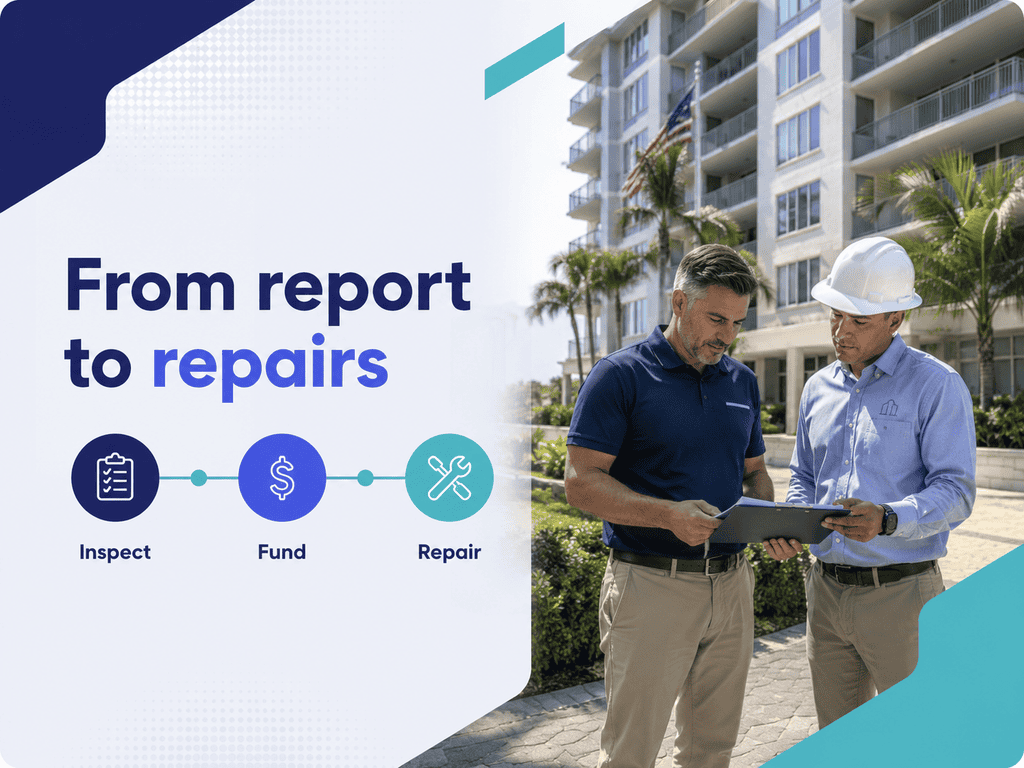
A practical HB 913 checklist for boards
HB 913 explained in statutory language can feel disconnected from the decisions a board must make at its next meeting. A practical review can be simpler.
- Confirm whether the property falls under milestone inspection and SIRS requirements. Verify the number of habitable stories, building age and any applicable exemptions with qualified professionals.
- Check the current inspection status. Determine whether the association has completed the required milestone inspection and SIRS and whether any updates are now necessary.
- Match required repairs to actual funding. Compare reserve balances, expected assessment revenue and the timing and cost of work identified in engineering or inspection reports.
- Review the SIRS funding schedule. Make sure the planned budget, special assessment, line of credit or loan aligns with the current reserve study.
- Identify owner approvals before relying on a funding method. HB 913 requires a majority of total voting interests for certain special assessments, lines of credit and loans used under its SIRS funding provisions.
- Update financial and official records. Record financing, meeting recordings, affidavits, financial documents and other materials required under the current statute.
- Have the plan reviewed before committing. Florida condominium law, governing documents, lending terms and individual project circumstances can interact in ways a general checklist can’t resolve.
Boards considering borrowed funding can also review TuCielo’s resources for Florida condo board members to understand the project and financial information typically discussed before an association financing application.
Build the funding plan around the work that has to be done
HB 913 gives Florida condo associations more flexibility in coordinating reserve funding with actual structural work. That flexibility still requires careful planning. Boards need a current SIRS, a realistic project budget, the required approvals and a funding method that can support both near-term repairs and longer-term reserve obligations.
For an association facing a large repair or reserve funding gap, TuCielo can review the project scope, existing financial position and available association financing path. The next step is to gather the association’s current budget, financial statements, delinquency report, SIRS or engineering report and contractor estimates so the funding discussion starts with the actual numbers.
FAQs
When did HB 913 take effect in Florida?
Governor Ron DeSantis approved HB 913 on June 23, 2025. The law generally took effect July 1, 2025, although individual provisions may contain different dates or implementation requirements.
Did HB 913 eliminate Florida’s SIRS requirements?
No. HB 913 revised Structural Integrity Reserve Study rules, including which buildings are covered, reserve funding schedules, funding methods and the deadline for certain associations. Qualifying condominium properties that are three or more habitable stories remain subject to the SIRS framework.
Can a Florida condo association use a loan to fund SIRS reserves?
HB 913 expressly permits SIRS reserve funding through regular assessments, special assessments, lines of credit or loans. When a special assessment, line of credit or loan is used under that provision, approval by a majority of the association’s total voting interests is required.
Can a condo association stop making reserve contributions under HB 913?
Only in specific circumstances. The law permits limited pauses or reductions following certain natural emergencies or, through budgets adopted by the end of 2028, when specified conditions involving a recent milestone inspection, repair funding and owner approval are met.
What is the reserve threshold under HB 913?
HB 913 increased the threshold for certain reserve and SIRS items from $10,000 to $25,000. The law also requires that amount to be adjusted annually for inflation, so associations should check the current amount rather than relying permanently on the original $25,000 figure.
Does HB 913 apply to every condominium building in Florida?
Not every provision applies to every building or association. Building height, association status, developer control, property configuration and other statutory criteria can affect which requirements apply, so boards should review their property with qualified Florida professionals.
What should a board do if it has required repairs but not enough reserves?
Start by quantifying the gap using the current SIRS, inspection or engineering report, reserve balance, project bids and expected assessment revenue. If regular reserves can’t cover the required work, HB 913 recognizes special assessments, lines of credit and loans as possible funding methods subject to applicable statutory requirements and approvals.