

Condo capital improvement financing can help an association complete major repairs or upgrades when its available reserves don’t cover the full project cost. Instead of postponing necessary work or asking every owner for a large payment at once, the association may use reserves, a special assessment, borrowed funds or a combination of all three.
This guide is for condominium board members, property managers and owners comparing ways to fund association capital projects. It explains what counts as a capital improvement, how association loans work, what boards should compare and what information to prepare before seeking financing.
This article provides general educational information. It isn’t legal, tax or financial advice. Boards should have their association documents, proposed assessments and financing terms reviewed by qualified Florida community association counsel and other appropriate professionals.
What condo capital improvement financing covers
A capital improvement is a major repair, replacement or upgrade involving association property or a common building component. Unlike routine maintenance, the work typically provides value or service over several years.
Common association capital projects include:
- Roof replacement and waterproofing
- Concrete restoration and structural repairs
- Elevator modernization
- Plumbing system replacement
- Electrical system upgrades
- Heating, ventilation and air conditioning work
- Impact-resistant windows and exterior doors
- Fire protection system improvements
- Exterior painting and building envelope repairs
- Parking garage and pavement work
- Seawall and marine structure repairs
- Accessibility improvements
- Major amenity renovations
A monthly elevator service contract would usually be treated as an operating expense. Replacing the elevator equipment or modernizing the control system would be more likely to qualify as a capital project.
The same distinction applies to other building components. Patching a small roof leak may fall under maintenance while replacing an aging roof is a capital expense.
Planned improvements versus required repairs
Some capital projects are planned years in advance. Others become urgent after an inspection, insurance review or sudden failure.
A board might decide to renovate a clubhouse because the community has budgeted for it. By contrast, concrete restoration identified during a structural inspection may need to begin within a defined period.
The funding decision should reflect that difference. A discretionary project can often be delayed while the association builds reserves. Safety-related work or active building damage may leave the board with less time to collect funds.
Urgency doesn’t remove the need to follow the association’s governing documents or Florida law. It does make early coordination between the board, manager, engineer, attorney and financing provider more important.
Why associations face capital project funding gaps
A well-managed condominium association contributes to reserves so money will be available when major components need repair or replacement. Even with a reserve plan, the actual cost and timing of a project may not match earlier assumptions.
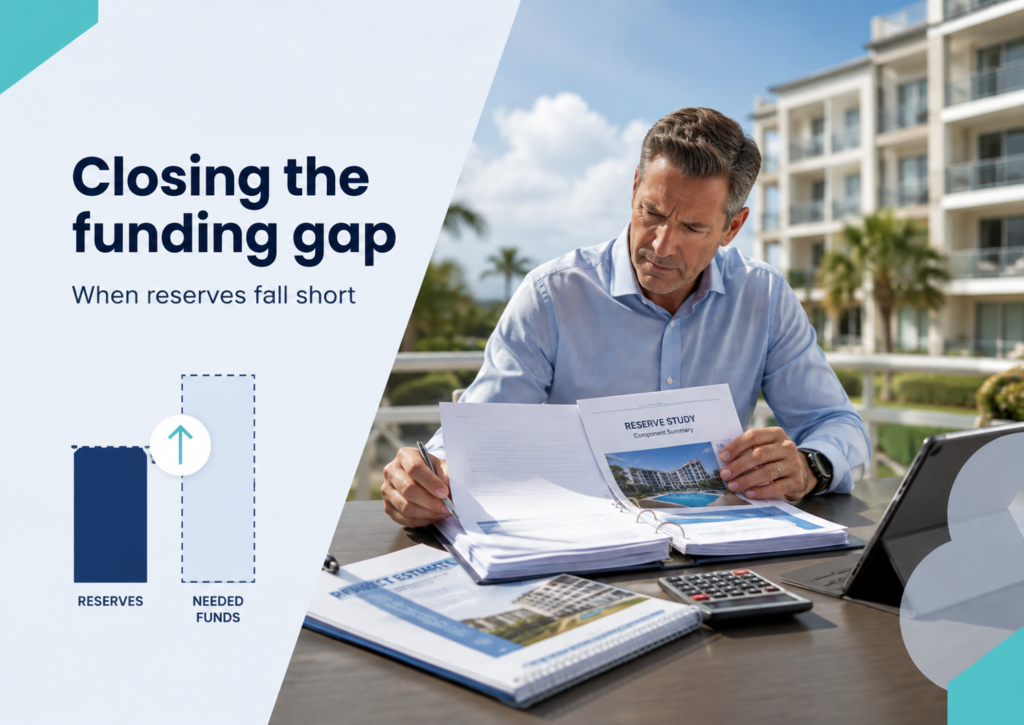
A funding gap can develop when:
- Construction costs exceed an older reserve estimate.
- A component fails earlier than expected.
- Several building systems require work at the same time.
- Earlier reserve contributions were reduced where legally permitted.
- An inspection identifies damage outside the planned scope.
- Insurance requirements accelerate the project timeline.
- Contractors uncover hidden deterioration after work begins.
- Available reserves are assigned to different components.
- The association must preserve cash for another near-term project.
Florida’s condominium rules have increased the attention placed on structural inspections and reserve funding. The Florida Department of Business and Professional Regulation’s condominium inspection resources explain how milestone inspections and structural integrity reserve studies apply to certain condominium buildings.
A structural integrity reserve study, commonly called a SIRS, reviews specified building components and recommends a reserve funding schedule. The study is a planning tool, but it doesn’t guarantee that a community already has enough cash for all work identified.
The final construction scope may also differ from the study estimate. Engineering, permitting, contractor pricing and hidden conditions can change the amount an association needs to raise.
Ways to fund condo capital improvements
Most associations use one or more of four funding methods: reserve funds, a special assessment, association financing or a combined structure.
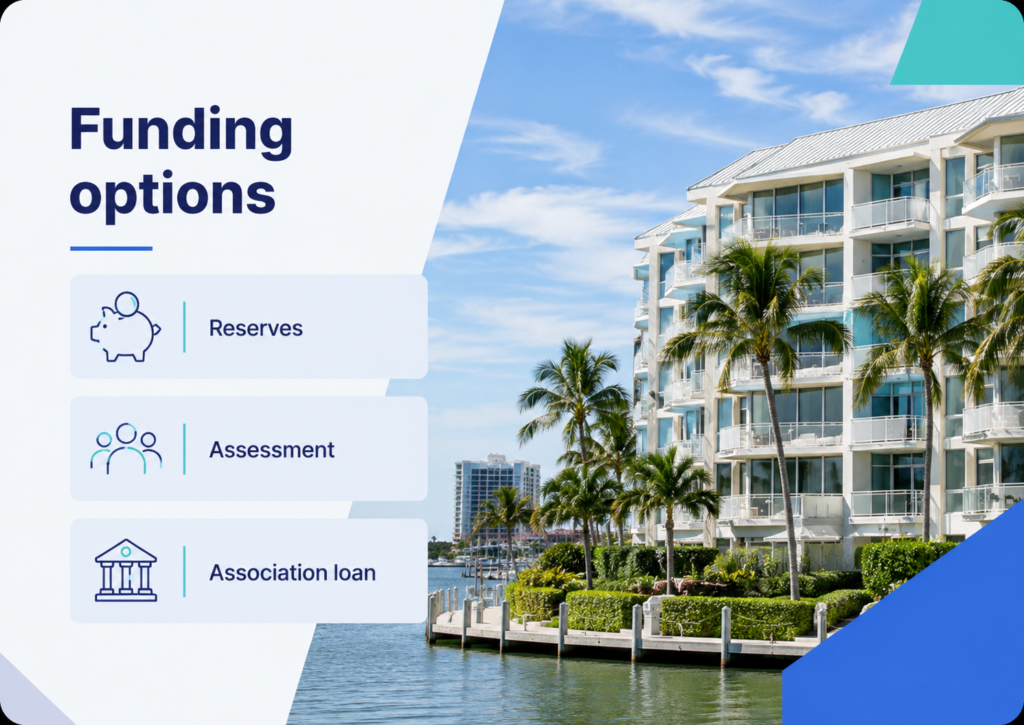
| Funding method | How it works | Main advantage | Main tradeoff |
| Reserve funds | The association uses money accumulated for the relevant repair or replacement. | No loan interest or financing fees. | Funds may be insufficient, restricted or needed for another project. |
| Lump-sum special assessment | Owners pay their allocated shares within a set collection period. | The association may avoid borrowing costs. | Some owners may struggle with a large payment due over a short period. |
| Association loan | The association borrows the project funds and repays the debt over time. | The cost can be spread across several years. | Interest and fees increase the total amount paid. |
| Combined funding | The association uses reserves and owner payments, then finances the remaining balance. | The board can reduce the loan amount without using all available cash. | The structure requires more planning and clear owner communication. |
The lowest upfront payment isn’t always the best option. Boards should compare the total project cost, payment schedule, owner impact and effect on future budgets.
Using reserve funds
Reserve funds may be the most direct option when the association has enough money assigned to the project component.
Before committing reserve money, the board should confirm:
- The project falls within the intended use of the reserve account.
- The amount shown in the budget is currently available.
- The expenditure won’t leave another required project unfunded.
- The proposed use matches the latest reserve study.
- The association has followed any applicable approval requirements.
Florida law limits how certain reserve funds can be used. The reserve funding provisions in Section 718.112 of the Florida Statutes address reserve calculations, structural integrity reserve items and available funding methods.
A board shouldn’t assume it can move money from one reserve category to another. Counsel and the association’s accountant should review the proposed use when the answer isn’t clear.
Even when sufficient reserves exist, using all available cash may create another problem. The association still needs operating liquidity and may face insurance deductibles, emergency work or additional repairs.
Levying a special assessment
A special assessment requires owners to pay an additional amount beyond their regular assessments. The amount allocated to each unit generally depends on the association’s declaration and applicable law.
Consider a hypothetical 100-unit condominium facing a $3 million concrete restoration project. If the expense were divided equally, the average amount would be $30,000 per unit. The declaration may require a different allocation, so the board can’t assume each owner will pay the same amount.
A lump-sum assessment can reduce financing costs, but it transfers the immediate funding burden to owners. Some may have enough savings or access to personal credit. Others may have difficulty paying within the required period.
Collection problems can affect the association’s ability to sign a construction contract or meet a contractor’s payment schedule. The board should evaluate expected collection timing rather than treating the approved assessment amount as cash already received.
Before considering a nonemergency assessment, boards should review the state’s minimum condominium meeting notice requirements. The official guidance explains that the notice must identify that an assessment will be considered and provide its estimated cost and purpose.
The association’s governing documents may impose additional requirements. Counsel should confirm the notice, meeting, voting and collection process before the board adopts the assessment.
Taking out an association loan
With a capital improvement loan, the condominium association becomes the borrower. The lender provides funds for the project and the association repays the debt according to the loan agreement.
Repayment usually comes from association revenue collected through regular or special assessments. The financing spreads the owner payment over time, but it doesn’t eliminate the underlying project cost.
Florida law permits certain reserve obligations to be funded through regular assessments, special assessments, lines of credit or loans. The specific approval requirements depend on the purpose of the financing and the statutory provision involved.
The association’s declaration, bylaws and articles may also affect its borrowing authority. Existing loan documents could contain restrictions on additional debt or pledging assessment revenue.
A board should get legal guidance before promising owners that a loan can be approved without a membership vote.
Combining several funding sources
Many associations don’t need to choose only one method. They may apply reserve funds to part of the project, allow some owners to pay upfront and finance the remaining amount.
For example, a hypothetical association with a $2.5 million roof and waterproofing project might:
- Use $600,000 from an eligible reserve account
- Collect $400,000 through owner prepayments
- Finance the remaining $1.5 million
- Repay the loan through monthly assessment revenue
This approach lowers the amount borrowed while giving owners more flexibility. It can also preserve some cash for other association needs.
The details matter. The board must determine how prepayments affect each owner’s future obligation, whether the lender permits partial owner payoffs and how the association will account for each payment category.
How condo capital improvement financing works
The financing process begins before the association submits an application. A board with a clear scope, complete budget and organized financial records is in a better position to evaluate terms and avoid delays.
1. Define the project scope
The board needs a reliable written description of the proposed work. Depending on the project, the scope may come from an engineer, architect, reserve professional or qualified contractor.
It should identify:
- The building components involved
- The reason the work is necessary
- The expected construction schedule
- The estimated cost
- Design and engineering fees
- Permit and inspection costs
- Contractor payment milestones
- Contingency amounts
- Potential phases or optional work
A contractor’s preliminary estimate may not represent the complete project budget. The association may also need to pay for engineering, testing, legal review, temporary protection, insurance requirements and lender costs.
Borrowing before the scope is mature can result in a funding shortfall. The board may then need a second assessment or additional financing after construction begins.
2. Confirm borrowing authority
Association counsel should review the financing structure before the board presents it as final.
The legal review should address questions such as:
- Does the board have authority to borrow for this project?
- Is a unit owner vote required?
- What percentage of voting interests must approve?
- Can the association pledge assessment revenue?
- Does an existing lender have approval rights?
- What notice must owners receive?
- What resolution should the board adopt?
- What information must be disclosed to owners?
- How should owner prepayments be handled?
For some loans used to fund structural reserve obligations, Florida law requires approval by a majority of the association’s total voting interests. Other transactions may follow different rules.
The board should rely on advice based on its documents and proposed transaction rather than a general description of association financing.
3. Build a complete financing request
The requested amount should reflect the full amount the association expects to spend, less the funds it plans to contribute.
A useful calculation is:
Construction and project costs
plus
Professional fees, financing costs and contingency
minus
Available project funds
equals
Estimated financing need
The board should also decide how much cash the association needs to keep available. Using every dollar of reserve or operating cash to reduce the loan amount may leave the community unable to respond to another expense.
4. Prepare the association’s documents
An association loan is underwritten using the association’s financial position, project information and governing records.
A lender may request:
- Current and previous annual budgets
- Financial statements
- Bank and reserve account statements
- Assessment collection reports
- Delinquency aging reports
- Unit and owner rosters
- Existing debt schedules
- Governing documents and amendments
- Board or owner meeting minutes
- Insurance policies or coverage summaries
- Reserve studies and inspection reports
- Engineering reports
- Contractor bids and signed agreements
- A project budget
- A proposed construction draw schedule
- The management agreement
- The association’s collection policy
TuCielo’s association financing FAQs outline the project, financial, governance and insurance records commonly reviewed during its process.
The property manager should reconcile the records before submission. Different delinquency totals, outdated budgets or conflicting project amounts can create questions during underwriting.
5. Compare financing proposals
The interest rate matters, but it shouldn’t be the only point the board compares.
Review each proposal for:
- Fixed or variable interest
- Loan and amortization term
- Origination or closing fees
- Legal and documentation costs
- Required debt service accounts
- Prepayment terms
- Conditions that must be met before closing
- Construction draw requirements
- Financial reporting obligations
- Insurance conditions
- Default provisions
- Restrictions on additional debt
- Treatment of owner prepayments
- Total estimated repayment
A longer repayment period can lower the monthly assessment. It will usually increase the total interest paid.
A shorter term may reduce total financing costs while creating a payment that owners can’t comfortably manage. The board should model several terms and show both the monthly payment and total estimated cost.
TuCielo includes an association financing estimator on its financing page. Boards can use it to explore how the project amount, number of units, credit profile and repayment term may affect estimated payments. The results are illustrations and aren’t a commitment or formal loan offer.
6. Present the proposal to owners
Owners need enough information to understand the project and the payment structure. A brief statement that the association plans to borrow money is unlikely to answer their main concerns.
A clear owner presentation should explain:
- What needs to be repaired or improved
- Why the work is required
- How the project scope was prepared
- The estimated total cost
- How much will come from reserves
- How much the association proposes to borrow
- How payments will be allocated
- Whether owners can pay their shares upfront
- The expected monthly amount
- The proposed repayment period
- The major fees and financing costs
- What happens if the project cost changes
- Where owners can inspect supporting records
Boards should label preliminary figures as estimates. Final payments may change after underwriting, owner elections, construction bidding or closing.
7. Close the loan and manage project funds
Once the association completes the approval and closing process, the lender releases funds under the loan agreement.
Some loans provide the full amount at closing. Others use a draw process tied to invoices, project milestones or inspections.
The association should maintain a complete project file containing:
- Contracts
- Contractor invoices
- Payment applications
- Change orders
- Inspection reports
- Lien releases
- Draw requests
- Board approvals
- Lender correspondence
Financing provides access to money. It doesn’t replace the board’s responsibility to monitor the project and protect association funds.
8. Track repayment after construction begins
The annual budget should show the required loan payment and the assessment revenue used to cover it.
The board and manager should monitor:
- Monthly assessment collections
- Delinquent accounts
- Loan payment dates
- Remaining principal
- Project spending
- Unused loan proceeds
- Reserve balances
- Insurance compliance
- Lender reporting deadlines
- Financial covenants
The association should also keep loan documents and related financial records available as required by Florida law. The official records provisions in Section 718.111 of the Florida Statutes describe several categories of financial, contract and association records that must be maintained.
How to decide whether financing is the right choice
Financing may make sense when the work can’t be delayed and a lump-sum assessment would place too much pressure on owners. It may be less attractive when the association already has sufficient reserves or can collect the funds without disrupting the project.
Boards should evaluate the following factors.
Project urgency
Start by determining what happens if the association waits.
Ask:
- Is active damage occurring?
- Has an engineer identified a structural or safety concern?
- Is there a statutory or local inspection deadline?
- Could delay increase the repair scope?
- Could the condition affect insurance coverage?
- Will postponement make contractor scheduling more difficult?
A project tied to building safety or active water intrusion may require a different approach from an optional amenity renovation.
Available reserves
Confirm how much money is both available and appropriate for the project.
The reserve account balance alone may be misleading. Part of the money may be assigned to another component or needed for a project scheduled soon.
The board should compare the proposed reserve withdrawal with the association’s latest study, budget and anticipated capital work.
Owner payment capacity
Spreading the cost over time can reduce the immediate burden. The monthly amount still needs to be realistic.
Model several possible structures:
- A full lump-sum assessment
- A shorter loan with higher monthly payments
- A longer loan with lower monthly payments
- Partial reserve use plus a loan
- Owner prepayments plus financing for the balance
The analysis should show how each option affects current owners and the association’s future budget.
Total financing cost
A lower monthly amount can look attractive while hiding a much higher total repayment.
Boards should compare:
- Principal borrowed
- Total interest
- Closing and legal fees
- Required reserve or debt service accounts
- Prepayment costs
- Total projected payments over the full term
Owners should be able to see the difference between the amount needed for construction and the total amount the association may repay.
Useful life of the improvement
The financing term should make sense in relation to the improvement’s expected service life.
A long-lived structural repair may support a longer repayment period than a smaller project expected to require replacement again in several years.
The board should also consider whether other major projects will arise while the loan remains outstanding. Overlapping loan payments and assessments can strain the budget even when each project appears manageable on its own.

A capital improvement financing checklist
Use this process before the board commits to a loan or special assessment.
- Confirm the project need. Obtain a written scope from the appropriate engineer, architect, reserve professional or contractor.
- Prepare the complete budget. Include construction, professional fees, permits, inspections, financing expenses and contingency.
- Identify available funds. Confirm which reserves can be used and how much cash the association should retain.
- Review the governing documents. Ask counsel to verify borrowing authority, voting requirements and assessment procedures.
- Model several funding options. Compare a lump-sum assessment, association financing and a blended structure.
- Prepare the lender records. Organize budgets, financial statements, delinquency reports, insurance documents and project contracts.
- Compare total costs. Review the rate, fees, term, prepayment rules, draw requirements and projected repayment.
- Explain the proposal to owners. Show the project need, funding sources, owner payment options and estimated costs.
- Complete the required approvals. Follow the applicable meeting, notice, voting and resolution procedures.
- Track the project and loan. Monitor spending, draws, assessments, payments and reporting obligations.
Common financing mistakes to avoid
Starting with an incomplete estimate
A preliminary construction number may exclude engineering, permits, hidden damage and financing expenses. The board should build the complete budget before setting the assessment or loan amount.
Comparing only interest rates
A lower rate doesn’t always mean a lower overall cost. Loan term, fees, prepayment conditions and required accounts can change the result.
Using all available cash
Applying reserves can reduce the amount borrowed. Draining the association’s accounts can leave it unprepared for another repair or operating shortfall.
Assuming the loan replaces owner assessments
The association must repay the lender from association revenue. Financing changes the timing of owner payments, but owners still fund the project through assessments.
Waiting too long to communicate
Owners may resist a proposal they first see in a meeting notice. Earlier communication gives them time to understand the project, review reports and compare funding choices.
Treating legal review as a closing task
Counsel should review the proposed structure before the board makes promises or schedules a final vote. Authority and notice problems are easier to correct during planning.
Build a funding plan before the project becomes urgent
A workable capital improvement plan connects the project scope, total budget, legal approval process and owner payment structure. The board should understand each part before choosing a lender or setting an assessment.
TuCielo provides association financing for eligible Florida condominium associations, homeowners associations and cooperatives funding major repairs, improvements and certain reserve needs. Boards can review how TuCielo compares with traditional bank financing and use the information to prepare questions for a financing discussion.
Before proceeding, compare the complete cost and have the proposed structure reviewed by the association’s attorney, accountant and other appropriate advisers.
FAQs
Can a condo association borrow money for capital improvements?
A condominium association may be able to borrow when its governing documents and applicable law permit it. The required board action, membership vote and notice process depend on the project and financing purpose.
Does every capital improvement require a special assessment?
No. An association may use eligible reserves, current funds, a loan or a combination of sources. A special assessment may still be used to collect project funds or repay borrowed money.
Can reserves and association financing be used together?
Yes, a blended structure may be possible. The board should confirm that the reserve funds can be used for the project and that the financing structure follows the association’s documents.
What documents are needed for an association loan?
Lenders commonly request budgets, financial statements, bank records, delinquency reports, governing documents, insurance information, reserve studies and project contracts. Requirements vary by provider and transaction.
Is the association or each owner the borrower?
The association is generally the borrower under an association loan. Owners contribute to repayment through association assessments rather than signing separate individual loan agreements.
Is a longer loan term better for owners?
A longer term can reduce the monthly payment, but it generally increases the total interest paid. The board should compare affordability, total repayment and the useful life of the improvement.
How long does condo capital improvement financing take?
Timing depends on the project, required approvals, underwriting and the completeness of the association’s records. Missing financial statements, unresolved insurance questions or an incomplete project scope can delay the process.