

A bank declined HOA loan request can put a Florida association in a difficult position, especially when the money is needed for structural repairs, roofing, elevators, waterproofing or another project that can’t simply be postponed.
A denial doesn’t necessarily mean the project can’t be financed. It means the board needs to understand why the bank said no, determine whether the underlying issue can be corrected and compare funding structures that evaluate associations differently.
This guide explains what Florida HOA and condominium boards should do after a bank denial, what lenders may be concerned about and what information to prepare before pursuing another financing option.
Why a bank declined HOA loan request may not be the end of the process
Traditional banks make lending decisions according to their own credit policies, concentration limits, risk tolerances and underwriting requirements. A loan that falls outside one institution’s criteria may still fit another lender’s approach.
For an association, that distinction matters. The borrower isn’t an individual homeowner taking out a personal loan. The association is seeking financing for a shared property obligation and its ability to repay depends on factors such as assessments, collections, reserves, existing debt and the overall financial position of the community.
A bank may also be comfortable with the association but unwilling to finance the full amount required.
Imagine a hypothetical 120-unit condominium that needs several major projects completed at roughly the same time. Concrete restoration, roof work and elevator modernization push the total project cost well beyond what the association currently holds in reserves.
The bank may be willing to lend part of the amount but stop below the project’s full cost. From the board’s perspective, that’s still a funding gap. The association must either find another source for the remaining amount, reduce the project scope where that is legally and practically possible or consider a different financing structure.
That situation is particularly important in Florida because certain condominium buildings are subject to milestone inspection and Structural Integrity Reserve Study (SIRS) requirements. The Florida Department of Business and Professional Regulation’s condominium inspection guidance explains that residential condominium and cooperative buildings of three or more habitable stories generally become subject to milestone inspections at specified building ages.
For a board facing necessary work, simply abandoning the project after one lender declines it may not be a realistic option.

Find out why the bank declined the HOA loan
The first useful step is to separate the lender’s decision from the project itself.
Ask the bank which factors prevented approval. The lender may not provide its complete internal underwriting model, but the board should try to identify whether the problem involved the amount requested, association finances, delinquencies, reserves, existing debt or documentation.
Common areas worth investigating include the following.
The requested loan was larger than the bank would approve
A large project can exceed the amount a bank is willing to lend to a single association or within a particular lending category.
This isn’t necessarily a judgment that the repairs aren’t needed. It can simply mean the transaction doesn’t fit the bank’s balance sheet or internal exposure limits.
TuCielo’s comparison of association financing and traditional bank lending identifies loan size as one point where funding approaches can differ. TuCielo states that its association financing is designed for projects that may exceed traditional bank limits.
Boards should therefore ask a precise question: Was the association declined altogether or was the requested amount outside the bank’s lending parameters?
Those are different problems.
The association has limited reserves
Low reserves can raise concerns because lenders want to understand how the association handles both expected expenses and unexpected costs.
For some Florida condominium associations, reserve funding is also connected to statutory requirements. Florida Statute 718.112 establishes requirements related to structural integrity reserve studies for certain condominium buildings and identifies responsibilities surrounding the completion and distribution of those studies.
A reserve shortfall can therefore present two challenges at once. The association may need money for current work while also addressing future funding obligations.
Boards shouldn’t conceal or minimize the problem when approaching another lender. Prepare the reserve study, budget and a clear explanation of what caused the shortfall and how the proposed financing fits into the association’s financial plan.
Delinquencies are affecting the association’s cash flow
A lender evaluating an association will generally want to understand how reliably owners pay assessments.
If a meaningful portion of assessments is delinquent, the lender may question whether the association can consistently make its proposed loan payments while continuing normal operations.
Florida law gives condominium associations mechanisms for collecting assessments, including lien rights in qualifying circumstances. Florida Statute 718.116 addresses unit-owner liability for assessments and association lien rights related to unpaid assessments.
The practical issue for financing is broader than whether the association has collection rights. A prospective lender may want to see the actual delinquency report, aging of past-due accounts and the association’s collection policy.
Existing debt leaves little room for another bank loan
An association may already have borrowed for an earlier roof, clubhouse, structural or infrastructure project. If new work becomes necessary before that debt is repaid, the bank may be unwilling to increase the existing balance.
In that situation, the board should obtain the current payoff balance and review the existing loan documents before seeking additional financing.
One option may be refinancing the existing obligation together with the new project amount. Whether that makes sense depends on the new financing terms, transaction costs, remaining life of the old debt and the association’s governing documents.
TuCielo states that its association financing can be used for capital improvements and required reserves and that repayment periods may extend up to 25 years, subject to underwriting and final loan terms.

The application package was incomplete or difficult to underwrite
Sometimes the issue isn’t a single financial ratio. The lender simply can’t get comfortable with the information provided.
Missing meeting minutes, outdated financial statements, unexplained delinquency figures, incomplete project contracts or inconsistent budgets can slow an application or make the association appear harder to evaluate than it really is.
This is one of the more fixable problems after a denial.
Before moving to another lender, clean up the package.
What to do after your HOA loan is declined
A board shouldn’t immediately submit the same application to five more lenders. If the original problem follows the association, repeated applications won’t solve it.
Use the denial to improve the association’s financing position first.
1. Ask for the reason behind the decision
Document what the bank tells you.
Try to determine whether the issue involved:
- The total amount requested
- Delinquency levels
- Reserve balances
- Existing association debt
- Debt service capacity
- Project scope or contractor documentation
- Financial reporting
- Insurance
- Governing documents
- Another lender-specific underwriting requirement
Avoid assuming that “declined” means the association has poor credit. The problem may be narrower.
2. Compare the requested amount with the actual project need
Review contractor bids, engineering recommendations and contingency amounts.
Determine whether the association requested exactly what the project requires or whether the financing request included work that can legitimately be separated into later phases.
Boards should be cautious here. Deferring required maintenance merely to fit a smaller loan can create additional risk and may conflict with the association’s responsibilities.
For Florida condominium associations, common expenses can include costs associated with operating, maintaining, repairing, replacing or protecting common elements and association property under Florida Statute 718.115.
If engineering work identifies repairs as necessary, the financing decision should be made with that obligation in mind.
3. Review the association’s financial condition before reapplying
A new lender is likely to review many of the same underlying records.
Before making another application, the board and property manager should understand:
- Current operating cash
- Reserve balances
- Annual budget
- Assessment collections
- Delinquencies and aging
- Existing debt payments
- Insurance coverage
- Planned capital expenditures
- Proposed special assessment structure
- Expected loan payment
The goal isn’t to make weak areas disappear. It is to understand them well enough to explain the association’s position accurately.
4. Check the governing documents and approval requirements
An association’s authority to borrow shouldn’t be assumed.
For Florida HOAs, the association’s powers and duties come from Chapter 720 and the governing documents, subject to applicable statutory limits. Florida Statute 720.316 also addresses borrowing authority in certain emergency circumstances.
Condominium associations operate under Florida’s Condominium Act, Chapter 718 along with their declaration, articles and bylaws.
Before entering financing, the board should have association counsel confirm the required approval process, including whether the documents require a board vote, membership approval or another procedure.
This article provides general educational information, not legal or financial advice. Association-specific borrowing authority and obligations should be reviewed with qualified Florida counsel and appropriate financial professionals.
5. Prepare a lender-ready document package
A complete package makes it easier for the next lender to understand the association without repeated requests for missing information.
TuCielo identifies several categories of documents commonly requested during underwriting in its association financing FAQs, including recent financials, budgets, delinquency reports, bank statements, reserve or engineering studies, governing documents, meeting minutes, insurance information and project documentation.
A practical preparation checklist looks like this:
- Gather current financial statements, approved budgets and recent bank statements.
- Produce an up-to-date delinquency or aging report.
- Collect the declaration, bylaws, articles and relevant amendments.
- Organize recent board meeting minutes and existing loan documents.
- Provide current insurance certificates and relevant coverage information.
- Assemble engineering reports, reserve studies, bids, signed contracts and project budgets.
- Clearly explain any unusual financial issue instead of leaving the lender to infer what happened.
TuCielo’s guide to how association financing works can also help boards understand what documentation may be needed before underwriting begins.
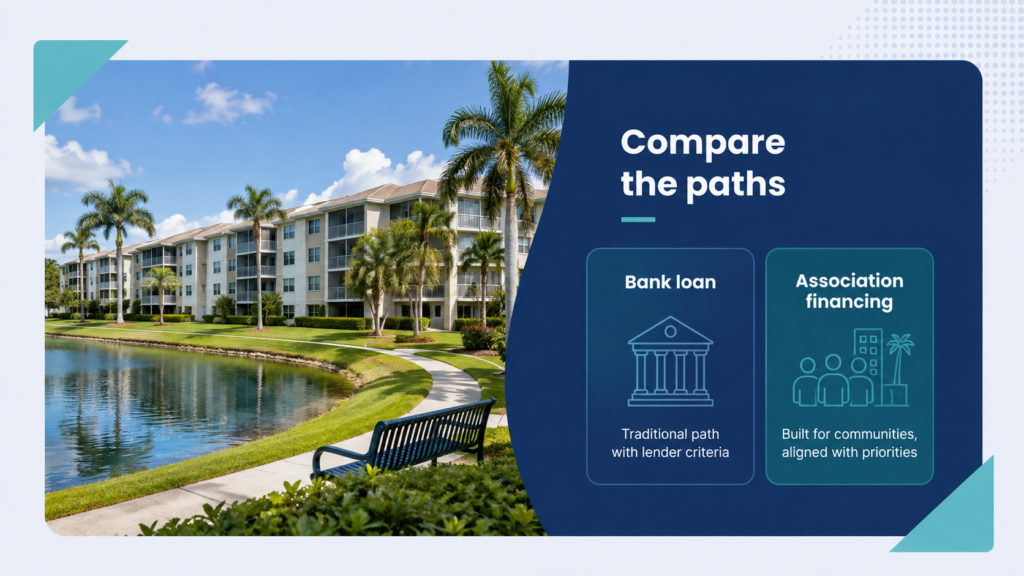
Compare the realistic funding paths after a bank denial
The best response to a declined loan depends on why the loan failed and how quickly the project must move.
Boards may have several possible paths.
| Funding path | When it may be considered | What the board should examine |
| Reapply with the same bank | The denial involved missing information or another correctable issue | What must change before reconsideration and whether the full project amount can be approved |
| Approach another bank | The association remains a conventional bank candidate | Loan amount, term, rate structure, covenants, collateral requirements and approval conditions |
| Specialized association financing | The project or association falls outside conventional bank criteria | Underwriting requirements, total financed amount, term, fees, repayment structure and prepayment provisions |
| Lump-sum special assessment | Owners can reasonably fund the project directly | Per-unit amount, collection risk, payment deadline and owner impact |
| Combination strategy | Some reserves or owner funding are available but aren’t enough for the whole project | How each source fits together and what portion still requires financing |
No single option is automatically better.
A special assessment avoids taking on association debt but can create a substantial immediate obligation for owners. Financing spreads repayment over time but introduces interest, fees and a longer-term obligation for the association.
The board should compare total cost and owner impact rather than focusing only on the monthly payment.
For example, suppose a hypothetical condominium has enough reserves to cover one-third of a major restoration project. The board might compare using those reserves and financing the remainder against preserving some reserve liquidity and financing a larger amount.
That comparison should consider the association’s future projects, statutory reserve requirements where applicable, financing costs and the consequences of reducing cash available for other obligations.
What a specialized association lender may review differently
Getting declined by a bank doesn’t remove the underlying credit questions. Another lender still needs a reasonable basis for believing the association can repay its obligation.
The difference may be in how the transaction is evaluated.
A lender focused specifically on community associations may have more experience assessing special assessments, owner collections, deferred maintenance, reserve studies and multi-phase capital projects.
TuCielo states on its association financing website that its underwriting considers associations with limited reserves or deferred maintenance that may not fit a traditional bank’s criteria. It also states that refinancing an existing association loan while adding financing for additional project scope may be available, subject to underwriting.
That doesn’t mean approval is automatic. Rates, terms and qualification depend on the specific association and transaction.
Boards should ask prospective financing providers detailed questions such as:
- Is the lender willing to finance the full project amount?
- How does it evaluate delinquency levels?
- Can required reserve funding be included?
- Can an existing association loan be refinanced?
- Is the rate fixed or variable?
- What fees and reserves are required at closing?
- What is the proposed amortization period?
- Are partial or full prepayments allowed?
- What financial covenants continue after closing?
- What happens if project costs change before completion?
- How are construction draws or contractor payments handled?
- Which assessments will support repayment?
The answers belong in the board’s comparison, not just the headline interest rate.

What the board should explain to unit owners
A bank denial often creates anxiety because owners may assume the project is now unfunded or that a very large assessment is coming immediately.
Clear communication can prevent speculation.
Explain what happened without overstating the problem. If the bank declined because the amount exceeded its parameters, say that. If the board is still evaluating alternatives, don’t present one as approved until it actually is.
Owners will typically want to know four things: how much the project costs, why the work is necessary, how the association proposes to pay for it and what their individual obligation may be.
Financing also needs to be explained accurately.
According to TuCielo’s association financing FAQs, the association is the borrower under its financing structure and the association loan itself doesn’t create individual loan obligations or place lender liens on individual units. Owners remain responsible for association assessments imposed under the association’s governing documents and applicable law.
That distinction matters. Florida Statute 718.116 provides that condominium owners are responsible for assessments that become due while they own their units, with association lien rights applying to unpaid assessments under the circumstances described in the statute.
Boards should therefore avoid telling owners simply that the financing “doesn’t affect them.” Owners may still have assessment obligations used by the association to service its debt.
Don’t let the denial delay necessary Florida building work
A financing setback and a project delay aren’t always the same thing.
If the association is facing structural work, milestone inspection findings, reserve obligations or insurance-driven repairs, the board should keep the project planning process moving while financing alternatives are evaluated.
The Florida Department of Business and Professional Regulation’s milestone inspection guidance explains the inspection requirements that may apply to three-story or taller condominium and cooperative buildings, including inspection timing and subsequent inspection cycles.
A loan denial doesn’t change an association’s underlying statutory, contractual or maintenance responsibilities.
Boards should keep coordinating with engineers, association counsel, property management, contractors and insurance professionals as appropriate rather than treating financing as a substitute for those decisions.

Explore another financing path with complete information
When a traditional bank says no, the board’s next move should be deliberate.
Find out what caused the denial. Confirm the full cost and urgency of the work. Review the association’s financial records and governing documents. Then compare another bank, a special assessment and specialized association financing using the same project assumptions.
Florida associations whose projects exceed traditional bank parameters can review TuCielo’s resources for HOA and condominium board members and prepare their project and association information for an eligibility review.
The objective isn’t simply to find a lender willing to say yes. It is to find a financing structure the association understands, can support and can explain clearly to its owners.
FAQs
Why would a bank decline an HOA loan?
A bank may decline because of the requested loan size, reserve levels, owner delinquencies, existing debt, cash flow, documentation or lender-specific underwriting limits. The board should ask which issue drove the decision before pursuing another financing application.
Can an HOA get financing after a bank declines its loan?
Potentially. A denial from one bank doesn’t determine whether every lender will decline the association. Specialized association lenders may use different underwriting criteria, but approval and final terms still depend on the association’s finances, project and documentation.
Can an HOA with low reserves still qualify for financing?
Some lenders may consider associations with limited reserves, although underwriting standards vary. TuCielo states in its association financing FAQs that it evaluates Florida associations with limited or no reserves by reviewing the association’s broader financial position and project scope.
Can an association refinance an existing HOA loan to pay for new repairs?
It may be possible depending on the lender and the existing loan documents. TuCielo states on its association financing website that its financing may refinance an existing balance and add financing for additional project scope in one transaction, subject to underwriting and final terms.
Should the board impose a special assessment instead of taking a loan?
That depends on the project’s cost, available reserves, owner finances, borrowing terms and the association’s governing requirements. Boards should compare the total cost of financing with the amount and timing of a lump-sum assessment rather than assuming either option is automatically preferable.
What documents should an HOA prepare before applying again?
Boards should expect to prepare current financial statements, budgets, delinquency reports, bank statements, governing documents, meeting minutes, insurance records, reserve or engineering studies and project bids or contracts. Exact requirements depend on the lender and transaction. TuCielo provides additional documentation guidance in its association financing FAQs.
Does an HOA loan create a loan on every owner’s property?
The structure depends on the financing agreement. According to TuCielo’s association financing FAQs, the association is the borrower under its financing structure and the loan itself doesn’t place a lender lien on individual units. Owners may still owe association assessments used to repay association obligations and unpaid assessments can carry separate consequences under Florida law.