

Florida condo reserve requirements in 2026 affect how many associations budget for structural repairs, collect assessments and plan long-term building work. Associations subject to the Structural Integrity Reserve Study requirements generally must now fund covered reserve items according to their most recent study.
This article explains the rules for Florida condominium boards, property managers and unit owners. It covers which buildings are affected, what must be reserved, how the reserve waiver ban works and which funding methods associations may consider.
This is general educational information. Condominium documents and individual circumstances differ, so associations should consult qualified Florida legal, accounting and engineering professionals before adopting a budget or funding plan.
What changed for Florida condo reserves in 2026?
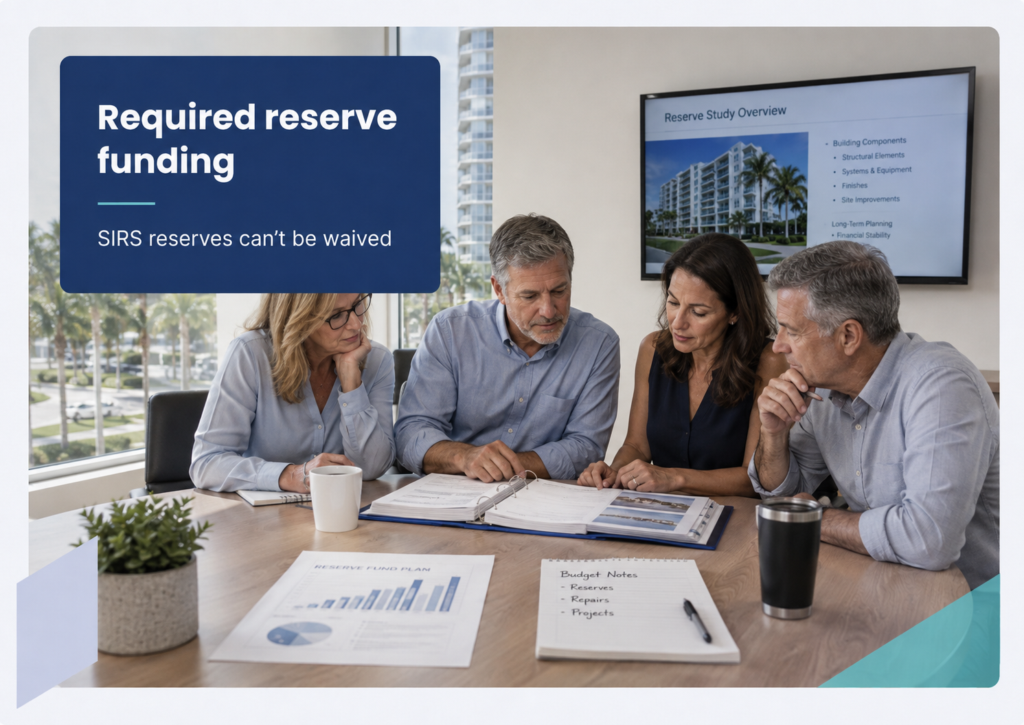
The central change is that affected condominium associations can no longer rely on repeated owner votes to waive or reduce reserves for major structural components covered by a Structural Integrity Reserve Study, commonly called a SIRS.
For budgets adopted on or after December 31, 2024, associations required to obtain a SIRS generally may not vote to provide less than the amount required for the applicable structural reserve items. The required amounts must be based on the findings and recommendations in the association’s most recent study.
Florida’s Department of Business and Professional Regulation (DBPR) states that associations with budgets adopted before December 31, 2024 could temporarily waive or reduce SIRS reserves with the required vote. Those associations were expected to begin funding the reserves according to the study on January 1, 2026.
This means 2026 is the first full budget year in which many established Florida condominiums are operating under mandatory SIRS-based funding.
The rule does not require every association to have all future repair money in cash today
Mandatory funding doesn’t necessarily mean the reserve account must already contain the full replacement cost of every component.
The association’s reserve contribution is calculated using factors such as:
- The estimated cost of repairing or replacing the component
- The component’s estimated remaining useful life
- Existing money allocated to that reserve item
- Deferred maintenance expenses identified in the study
- The funding method used by the association
The study creates a funding schedule. The annual budget then needs to provide for the required contribution under that schedule unless a statutory exception applies.
An association with a roof expected to last another eight years, for example, isn’t necessarily required to collect the entire future roof replacement cost in one year. It generally needs to follow the funding recommendation prepared for that component.
The rules address both reserve funding and repair funding
Boards should distinguish between two related obligations.
Reserve funding prepares for anticipated future expenses. Repair funding pays for work that must begin now or within a defined period.
A SIRS may identify a component that needs future funding. A milestone inspection may identify deterioration requiring more immediate investigation or repair. In some cases, an association may need to fund both its ongoing reserve schedule and an active construction project.
That distinction matters because a balanced reserve account doesn’t correct an unsafe condition. Likewise, completing a repair doesn’t remove the need to plan for the next repair cycle.
Which Florida condominium buildings need a SIRS?
A residential condominium association must generally complete a SIRS for each condominium building that is at least three habitable stories high, as determined under the Florida Building Code.
DBPR identifies several exclusions. The requirements don’t apply to:
- Buildings that are less than three stories high
- Single-family, two-family, three-family or four-family dwellings with no more than three habitable stories above ground
- Building portions that haven’t been submitted to condominium ownership
- Components maintained by someone other than the condominium association
Associations existing on or before July 1, 2022 generally had to complete their initial SIRS by December 31, 2025. A residential condominium must then complete another SIRS at least every 10 years after the condominium’s creation, subject to the applicable statutory timing rules.
Boards shouldn’t decide whether a building qualifies based only on the number of floors that residents commonly use. Habitable-story classification, building configuration and responsibility for specific components may require professional and legal review.
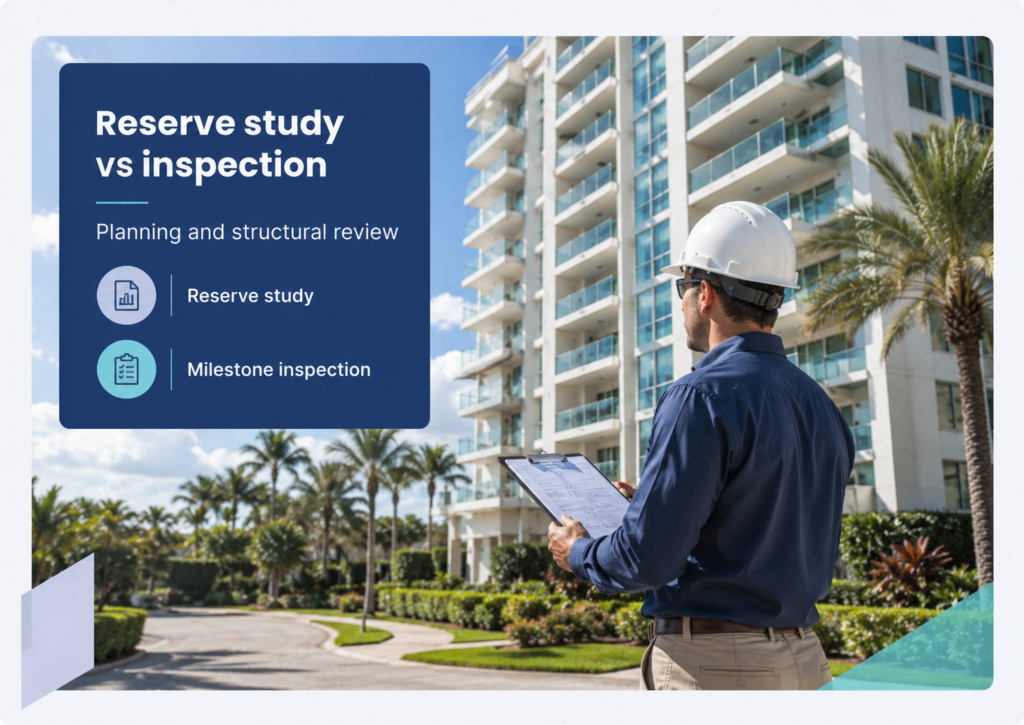
A SIRS and a milestone inspection serve different purposes
These two requirements are often discussed together, but they aren’t interchangeable.
A milestone inspection evaluates the structural condition of an older residential condominium or cooperative building. Under Florida law, covered buildings generally undergo an initial milestone inspection when they reach 30 years of age and every 10 years afterward. The inspection may proceed to a more detailed second phase when signs of substantial structural deterioration are found.
A SIRS is a reserve-planning study. It reviews specified building components, estimates their remaining useful lives and identifies how much the association should reserve for repair, replacement or deferred maintenance.
An association may coordinate the visual inspection portion of a SIRS with a milestone inspection when permitted. However, completing a milestone inspection doesn’t automatically satisfy every SIRS requirement.
DBPR explains that an association with a milestone inspection due by December 31, 2026 may complete the SIRS at the same time. In that limited situation, the SIRS may not be completed later than December 31, 2026.

What must Florida condominium associations reserve for?
Florida’s SIRS framework applies to building components that directly affect structural integrity and fall within the association’s maintenance responsibility.
DBPR describes the covered categories as:
- Roof
- Structural systems
- Fireproofing and fire protection systems
- Plumbing
- Electrical systems
- Waterproofing and exterior painting
- Windows and exterior doors
- Other components above the statutory cost threshold that affect structural integrity
The eighth category isn’t a catch-all for every association expense. The component must meet the applicable cost threshold and be found to affect structural integrity during the visual portion of the study. The threshold may be adjusted periodically, so boards should check the current DBPR figure rather than relying on an older study or article.
The association only reserves for components it is responsible for under the declaration of condominium. Responsibility for windows, doors, balconies, plumbing lines or limited common elements may differ among properties.
Traditional statutory reserve items still matter
Florida condominium budgets have long included reserve accounts for capital expenditures and deferred maintenance. The statute specifically identifies roof replacement, building painting and pavement resurfacing. It also covers other items exceeding the applicable replacement-cost or deferred-maintenance threshold.
For associations subject to a SIRS, the reserve requirements for the covered structural items must be based on the most recent study. The association may also need reserve accounts for non-SIRS components required under the broader budget provisions.
Boards should therefore avoid treating the SIRS as the complete association capital plan. It focuses on structural integrity. Elevators, amenities, security systems, landscaping infrastructure and other major assets may still require separate budgeting depending on the property.
Components with long or uncertain useful lives receive different treatment
Some structural components may have an estimated remaining useful life longer than 25 years. Others may not have a useful life that can be estimated reliably.
Florida law states that an association isn’t required to reserve the full replacement cost for such an item solely on that basis. However, it must reserve any deferred maintenance expense recommended by the SIRS.
For example, a structural foundation may not have a predictable replacement date. The professional preparing the study may still identify waterproofing, remediation, monitoring or maintenance work that should be funded.
This is one reason boards shouldn’t reduce a SIRS to a list of replacement dates. The study may contain maintenance recommendations that carry present budget consequences even when full replacement isn’t expected.
How the Florida reserve waiver ban works
The phrase “reserve waiver ban” refers mainly to the restriction on waiving or underfunding SIRS reserves.
Before the recent changes, many owner-controlled associations could vote each year to waive or reduce reserve contributions. This kept regular assessments lower but often left associations without enough money when major repairs became unavoidable.
Under the current framework, an association required to obtain a SIRS generally can’t waive or reduce the required funding for the structural components listed in the law. It also can’t move those protected reserve funds to unrelated purposes.
The Florida condominium budget statute states that reserves for applicable SIRS items must follow the association’s most recent study. It also identifies regular assessments, special assessments, lines of credit and loans as permitted funding methods.
The ban doesn’t apply identically to every reserve category
An association may still have some ability to waive or reduce non-SIRS reserves, depending on the type of reserve, the association’s governing documents and the voting requirements in Florida law.
DBPR states that a majority of the association’s total voting interests is required to waive eligible reserves or use them for another purpose. SIRS reserves, however, generally can’t be waived or redirected by an association subject to the SIRS requirements.
Boards should clearly identify which budget lines are:
- Protected SIRS reserves
- Other statutory reserves
- Discretionary capital accounts
- Operating expenses
- Current repair costs
- Debt-service expenses
Labeling every capital expense as a reserve expense can create confusion. Treating every reserve as waivable can create a more serious compliance problem.
Limited exceptions may apply
The statute and DBPR guidance recognize narrow exceptions.
Owners may vote to waive SIRS reserve maintenance when the association has voted to terminate the condominium under Florida law.
A multicondominium association may also be able to use an alternative funding method if the Division approves it.
In addition, if a local building official determines that an entire condominium building is uninhabitable because of a natural emergency, the board may pause or reduce reserve contributions until the building is found habitable again.
These aren’t general hardship exceptions. An association can’t suspend mandatory reserve funding simply because the increase is unpopular, owners are on fixed incomes or the board expects a future property sale.
How associations can fund required reserves and repairs
Florida law now gives affected associations several ways to meet SIRS-related funding needs. These include regular assessments, special assessments, a line of credit or an association loan.

The best structure depends on whether the association is addressing an annual contribution, an accumulated reserve deficit, an immediate repair or a combination of all three.
| Funding method | How it generally works | Main issue to review |
| Regular assessments | Reserve contributions are included in recurring owner payments. | Whether the annual increase is enough to follow the SIRS schedule |
| Special assessment | Owners pay an additional amount, either at once or through an association payment schedule. | Owner affordability, collection timing and project deadlines |
| Line of credit | The association receives access to approved funds and draws as needed. | Availability period, variable costs, fees and repayment requirements |
| Association loan | The association borrows project or reserve funding and repays it over an agreed term. | Total borrowing cost, approval requirements and effect on future budgets |
| Combined approach | The association uses reserves, assessments and financing together. | Whether each source is available when contractor payments are due |
The statute requires approval by a majority of the association’s total voting interests for a special assessment, line of credit or loan used to fund the specified SIRS reserve items. Associations must also follow their declarations, bylaws and meeting-notice requirements.
Boards should have association counsel confirm the required vote and documentation before relying on any financing plan.
Funding a reserve account is different from financing a project
An association may have a funding shortfall even when construction hasn’t started. It may also have an urgent project cost that exceeds the current reserve balance.
Consider a hypothetical 100-unit Florida condominium. Its SIRS identifies:
- Concrete restoration that should begin soon
- A roof with five years of remaining useful life
- Exterior waterproofing needed within three years
- An electrical component requiring annual reserve contributions
The board may need cash for concrete work now while continuing to fund the roof, waterproofing and electrical reserves. A single special assessment based only on the current construction contract might not address the complete SIRS schedule.
The board could compare a combined plan using existing reserves, recurring contributions and project financing. The purpose isn’t to make the obligation disappear. It is to match the timing of available funds with the timing of repairs and future reserve needs.
Associations facing a large immediate shortfall can review how TuCielo association financing may be used for eligible repairs, capital work or required reserves. Availability, rates, terms and approval remain subject to underwriting and association-specific review.
Financing doesn’t replace the board’s budgeting work
Borrowing can provide funds sooner, but it creates a repayment obligation within future association budgets.
Before voting, the board should compare:
- The total amount available at closing
- Whether funds are available for reserves, construction or both
- Fixed or variable interest terms
- Closing costs and required accounts
- Draw procedures
- Contractor payment timing
- Prepayment terms
- Existing association debt
- Monthly or annual debt service
- The effect on regular and special assessments
The board should also determine whether the financing amount covers previously waived or unfunded SIRS contributions when the statute requires it.
A lender may ask for recent financial statements, budgets, delinquency reports, bank statements, reserve studies, engineering reports, governing documents, insurance records, project bids and existing debt details. TuCielo provides a more complete overview of the association financing process.
A practical 2026 reserve planning process
Boards should treat reserve compliance as an annual workflow rather than a one-time study.
1. Confirm whether each building is covered
Document the number of habitable stories, condominium ownership structure and association maintenance responsibilities.
Don’t assume every building in a multicondominium property has the same requirements. One building may be covered while another is excluded.
2. Verify that the latest SIRS is complete and reported
Check the study date, professional credentials, covered components and funding schedules.
Associations must report SIRS completion through DBPR. The agency maintains a reporting system and database for submitted studies. Associations should confirm that the information on file is accurate and keep the full report in their official records.
3. Reconcile the study with current conditions
Ask whether repairs, storm damage, contracts or updated inspections have changed any assumptions.
A roof replacement completed after the study may extend the useful life of that component. Newly discovered deterioration may shorten another component’s schedule. The association may need professional guidance on whether the study should be updated.
4. Separate annual funding from immediate project costs
Build one schedule showing:
- Current reserve balances
- Annual contributions
- Previously unfunded amounts
- Near-term repair contracts
- Expected payment dates
- Insurance proceeds, if any
- Special assessment collections
- Proposed financing proceeds
- Future debt payments
This makes it easier to see whether the association has a temporary cash-flow gap or a long-term budget deficit.
5. Compare owner impact under several structures
A large one-time assessment may collect money quickly but create collection problems for owners who can’t pay the full amount.
A loan may spread the cost but increase the total amount paid over time. Higher regular assessments may build reserves steadily but may not produce enough cash for immediate structural repairs.
Boards should present the tradeoffs in specific dollar terms rather than asking owners to vote on a general concept.
TuCielo’s association financing estimator can provide an initial illustration of potential association and per-unit payments. Estimates aren’t loan commitments, and actual terms depend on underwriting.
6. Obtain legal, accounting and engineering review
The engineer or reserve specialist explains the physical components and funding recommendations.
The accountant helps reconcile reserve schedules, financial statements and budget treatment. Association counsel advises on statutory requirements, governing documents, notices, voting and use of funds.
Each professional answers a different part of the decision.
7. Document the board’s decision
Meeting notices, presentations and minutes should explain:
- The reserve requirement
- The SIRS findings
- The funding gap
- Alternatives considered
- Expected owner payments
- The proposed vote
- Key financing or assessment terms
- The planned use of proceeds
Clear records help owners understand why assessments changed and show how the board reached its decision.
Common mistakes boards should avoid
One mistake is treating the December 2025 SIRS deadline as the end of the process. Completing the report doesn’t fund the recommendations. The association must incorporate the findings into its budget and future planning.
Another is assuming owners can vote down mandatory reserves because a proposed budget is too expensive. Owner voting rights remain important, but they don’t override the restrictions placed on required SIRS funding.
Boards also create risk when they use protected reserve money for unrelated operating expenses. A temporary cash shortage doesn’t automatically permit the association to redirect structural reserves.
Waiting until a contractor is ready to mobilize can also limit the association’s options. Financing, special assessments and document review take time. Boards should begin comparing funding structures while the project scope and bids are being developed.
Finally, associations shouldn’t present financing as free money or as a way to avoid assessments. The association remains responsible for repayment. The practical question is whether owners will fund the obligation through a large upfront collection, recurring contributions, debt-supported payments or a combination.

Build a funding plan before the next budget vote
Florida’s 2026 reserve requirements leave affected condo associations with less room to postpone structural funding. Boards need to connect the SIRS recommendations with actual reserve balances, repair schedules, owner payment capacity and available funding sources.
When current reserves and planned assessments won’t provide the needed money on time, boards can compare TuCielo’s funding options for Florida associations and prepare the financial, engineering and governance documents needed for review. Any final plan should be evaluated with the association’s attorney, accountant and qualified building professionals before adoption.
FAQs
Are Florida condo reserves mandatory in 2026?
Certain reserves are mandatory. Condominium associations subject to the SIRS requirements generally must fund the covered structural components according to their most recent study and may not waive or reduce those required contributions.
Other reserve categories may follow different waiver rules. The association should have its budget and governing documents reviewed professionally.
What is the Florida condo reserve waiver ban?
The reserve waiver ban prevents covered associations from voting to waive or underfund reserves for SIRS components. It also generally prevents those protected funds from being used for unrelated purposes.
The restriction applies to associations and items covered by the statute. It isn’t a blanket rule that every reserve account in every Florida condominium can never be changed.
Do two-story Florida condominiums need a SIRS?
Buildings with fewer than three stories are generally excluded from the SIRS requirements. Other exclusions apply to certain small residential structures, building portions outside condominium ownership and components maintained by another party.
Boards should confirm the building classification rather than relying on informal descriptions.
When did affected associations have to start SIRS funding?
DBPR states that associations with qualifying budgets adopted before December 31, 2024 had to begin funding their SIRS reserves according to the study on January 1, 2026.
Associations with budgets adopted on or after December 31, 2024 generally couldn’t waive the required SIRS reserves and needed to begin funding according to the study.
Can a Florida condominium use a loan to meet reserve requirements?
Florida law permits regular assessments, special assessments, lines of credit and loans to fund specified SIRS reserve items. The applicable voting, funding and disclosure requirements must be followed.
The association should confirm that the financing amount, availability and permitted uses satisfy the statutory requirements and its specific funding plan.
Does a SIRS require full funding immediately?
Not necessarily. A SIRS generally recommends contributions based on component costs, existing balances and remaining useful lives.
However, an association with past underfunding or immediate repair needs may face a large near-term amount. The study, current budget and repair schedule must be reviewed together.
Can mandatory reserves be paused after a hurricane?
A board may pause or reduce reserve contributions when a local building official determines that the entire condominium building is uninhabitable because of a natural emergency. The pause may continue until the building is determined to be habitable.
Storm damage by itself doesn’t automatically activate this exception.