

A structural integrity reserve study Florida condominium boards receive is more than a building inspection. It is a financial planning study that connects the condition and expected life of major building components with the reserves needed to repair or replace them.
For Florida condominium associations, that distinction matters. State law now requires qualifying associations to complete a Structural Integrity Reserve Study, commonly called a SIRS, at least every 10 years. The study can affect annual budgets, reserve contributions, special assessments and decisions about how major repairs will be funded.
This guide explains what a SIRS is, which Florida condominiums are subject to the requirement, what the study must cover and what boards should do after receiving one. It is written for condominium board members, property managers and unit owners who need a practical explanation of the current requirements rather than a summary of the legislation alone.
Because Florida condominium law continues to evolve, associations should confirm their specific obligations with qualified legal, engineering and accounting professionals before making budget or funding decisions.
What is a SIRS in Florida?
A Structural Integrity Reserve Study is a reserve study focused on the major components of a condominium property that affect the structural integrity and safety of the building.
Florida law defines a structural integrity reserve study as a study of the reserve funds required for future major repairs and replacement of condominium property. For qualifying buildings, the study is based on a visual inspection and must estimate both the condition of covered components and the money the association should accumulate for future work. The statutory requirements appear in Section 718.112 of the Florida Statutes.
That makes SIRS different from simply asking, “Does this building need repairs today?”
The study also asks questions such as:
- How much useful life is reasonably expected to remain for each covered component?
- What is the estimated cost of replacement or deferred maintenance?
- When will the association likely need the money?
- How much should the association contribute to reserves each year?
- Will the proposed reserve funding schedule keep the reserve cash balance above zero?
- How do regular assessments, special assessments, a line of credit or a loan affect that funding schedule?
In practical terms, a SIRS connects the physical building with the association’s financial plan.

What components does a SIRS cover?
For a condominium subject to Florida’s SIRS requirement, the statute lists several minimum components:
- Roof
- Structure, including load-bearing walls and other primary structural members and systems
- Fireproofing and fire protection systems
- Plumbing
- Electrical systems
- Waterproofing and exterior painting
- Windows and exterior doors
- Certain additional items whose replacement or deferred maintenance cost exceeds the statutory threshold and whose failure could negatively affect the components above
For 2026, the Florida Department of Business and Professional Regulation lists the inflation-adjusted threshold at $25,675, up from $25,000 in 2025. Boards should check the DBPR reserve threshold page when preparing future budgets because the threshold is adjusted annually.
The person completing the study may also determine that additional work or deferred maintenance should be accounted for based on the property’s condition.
Who can perform a SIRS?
Florida law requires the SIRS, including its visual inspection portion, to be performed or verified by one of the professionals permitted by statute. These include:
- A Florida-licensed engineer
- A Florida-licensed architect
- A person certified as a reserve specialist
- A professional reserve analyst certified through an organization recognized under the statute
The study must identify the components being inspected, estimate their remaining useful lives and estimate their replacement costs or deferred maintenance expenses. It must also recommend a reserve funding schedule.
When selecting a provider, a board should look beyond the price of the study. Ask who will perform the visual inspection, what credentials that person holds, what cost assumptions will be used and how future updates will be handled.
Who must complete a SIRS in Florida?
The central SIRS Florida rule applies to residential condominium associations with buildings that are three habitable stories or higher, as determined by the Florida Building Code.
DBPR states that a residential condominium association must complete a SIRS for every qualifying building within the condominium. The requirement generally doesn’t apply simply because an association exists. The height, form of ownership and maintenance responsibility for the particular building or component matter.
Florida law excludes:
- Buildings less than three stories in height
- Certain single-family, two-family, three-family and four-family dwellings with three or fewer habitable stories above ground
- Portions or components that haven’t been submitted to the condominium form of ownership
- Components maintained by a party other than the association
For a mixed property or an association with several buildings of different heights, the board shouldn’t assume one answer applies to every structure. The governing documents, building configuration and statutory definition should be reviewed together.

What are the current SIRS deadlines?
For unit-owner-controlled associations that existed on or before July 1, 2022, the general deadline to complete the required SIRS was December 31, 2025.
There is an important timing rule for certain associations that also have a milestone inspection due. If an association is required to complete a milestone inspection on or before December 31, 2026, Florida law allows the SIRS to be completed simultaneously with that inspection. In that situation, the SIRS can’t be completed later than December 31, 2026.
After the initial study, qualifying residential condominiums must generally have a SIRS completed at least every 10 years after the condominium’s creation.
DBPR considers the condominium’s date of existence to be based on the date its certificate of occupancy was issued by the local building department or enforcement agency.
Can a milestone inspection replace a SIRS?
Not automatically.
A milestone inspection primarily evaluates the structural condition of an aging condominium building. A SIRS is a budget-planning study that uses a visual inspection to assess specified components and establish a funding plan for future maintenance and replacement.
There can be overlap. If a milestone inspection or similar local inspection was completed within the previous five years and satisfies the applicable SIRS requirements, Florida law allows that inspection to be used in place of the visual inspection portion of the SIRS. The association still needs to satisfy the financial and reserve-study requirements.
Boards should therefore treat the two processes as related but distinct rather than assuming one report automatically satisfies both.
What are the SIRS requirements condo boards need to plan for?
Completing the study is only the beginning. The more consequential part for many boards is incorporating its findings into the association’s budget and long-term capital plan.
The study must provide a funding schedule
Florida law requires a SIRS to include a recommended reserve funding schedule. At minimum, that schedule must use a baseline funding approach designed so the association’s reserve cash balance remains above zero while meeting anticipated maintenance obligations.
The study considers the estimated remaining useful life of each applicable component and its estimated replacement or deferred maintenance cost. This means the required contribution isn’t necessarily equal to the entire future repair bill today.
DBPR gives a simple example: if a roof will cost $100,000 to replace in 10 years, the association isn’t necessarily required to have all $100,000 in reserve immediately. Instead, the funding plan is intended to accumulate sufficient money over time so the association can meet the anticipated cost without the reserve balance falling below zero.
That distinction is useful when explaining SIRS to owners. A large future replacement cost doesn’t automatically translate into an identical immediate assessment.
Required SIRS reserves generally can’t simply be waived
Historically, condominium associations often had more flexibility to vote to waive or reduce reserve contributions.
That flexibility is now much narrower for the required SIRS components.
For budgets adopted on or after December 31, 2024, unit-owner-controlled associations subject to SIRS generally can’t vote to provide no reserves or less than the required amount for the mandatory SIRS items. Those reserve funds also generally can’t be redirected to unrelated purposes. Certain statutory exceptions exist, so associations should review their particular circumstances with counsel.
In other words, a board can’t treat a required SIRS reserve line as an optional budget item simply because owners would prefer lower assessments.

Loans and special assessments can form part of the funding plan
One of the significant points in current Florida law is that reserve planning isn’t limited to regular monthly assessments.
The statute expressly says a SIRS must consider funding methods used by the association, including:
- Regular assessments
- Special assessments
- Lines of credit
- Loans
Florida law also permits a qualifying unit-owner-controlled association to secure a line of credit or loan to fund capital expenses required by a milestone inspection or SIRS, subject to the statutory requirements.
If a SIRS was completed before the association approved a special assessment or obtained a loan or line of credit, the study must be updated to reflect the selected funding method and its effect on the reserve funding schedule.
That requirement matters when boards compare a large immediate assessment with financing. Financing the project doesn’t make the SIRS disappear. The financing becomes part of the association’s broader reserve and capital funding plan.
For boards considering that path, TuCielo’s association financing overview explains how financing may be used for major Florida condominium capital projects, including structural repairs, roofing, waterproofing, plumbing and other common-area work.
A hypothetical example
Consider a hypothetical 80-unit Florida condominium whose SIRS identifies major concrete restoration, waterproofing work and a roof replacement over the coming years.
The board might initially focus on the total projected cost. A better first step is to separate three questions:
- What work needs to happen soon?
- What work can be funded gradually through reserves?
- How will the association fund an immediate project if current reserves aren’t sufficient?
Suppose the roof still has years of useful life remaining, but the building needs structural repair work much sooner. The association might continue building roof reserves according to the SIRS schedule while considering a special assessment or association loan for the immediate construction project.
If the board changes the funding method from what was assumed in the current SIRS, it should determine whether an updated study is required before adopting the affected budget.
The legal requirement and the funding decision therefore need to be coordinated. They shouldn’t be treated as separate projects handled by different committees with different assumptions.
What should a board do after receiving its SIRS?
A completed report can be long and technical. Boards can make the process more manageable by moving through it in a fixed sequence.
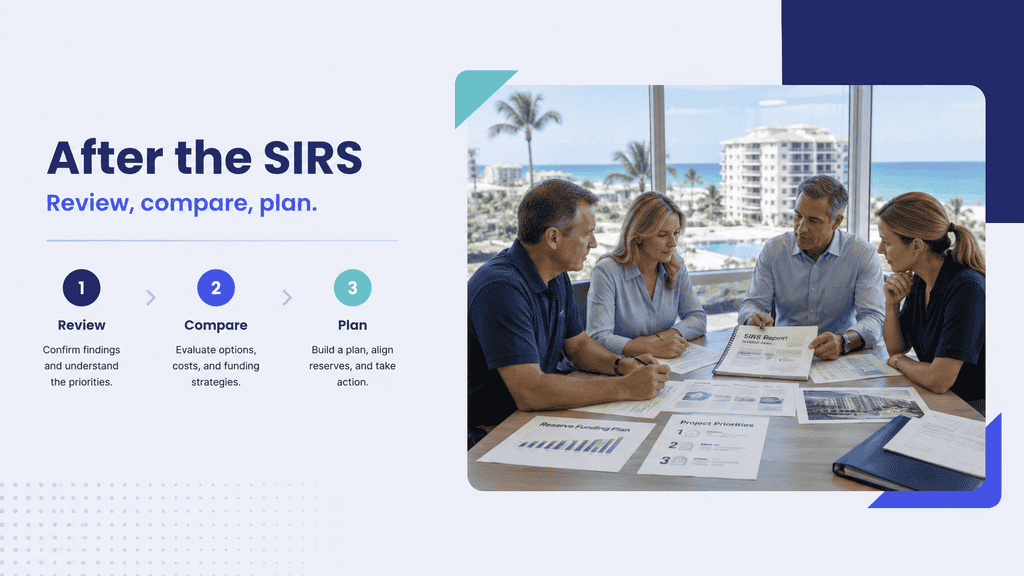
1. Confirm the study satisfies the statutory requirements
Start with the basics.
Confirm that the report covers the correct buildings, was performed or verified by a properly qualified professional and addresses the components required for the association.
Don’t assume a prior reserve study automatically qualifies as a SIRS merely because it discusses roofs, elevators or structural repairs.
2. Identify what requires near-term action
Separate components with immediate or near-term work from components whose useful lives extend well into the future.
Look for:
- Deferred maintenance recommendations
- Remaining useful life estimates
- Repairs already identified in a milestone inspection
- Components approaching the end of useful life
- Safety-related work
- Major project costs that could materially affect the next budget
This makes the report useful as a capital planning document rather than something filed away for compliance.
3. Compare the recommended funding plan with current reserves
For each major component, compare:
- Current reserve balance
- Recommended annual contribution
- Estimated remaining useful life
- Projected repair or replacement cost
- Existing special assessments
- Existing association debt
- Expected regular assessment revenue
This is where a board begins to see whether a funding gap exists.
4. Build realistic project budgets
A SIRS estimate isn’t necessarily the same as a contractor’s final price.
When a major project is approaching, boards should obtain current scopes, engineering recommendations and contractor proposals. Construction costs, permitting, project management and unforeseen conditions may affect the actual amount required.
For associations exploring outside funding, TuCielo outlines the documents typically needed during the association financing process, including recent financial statements, the current budget, delinquency information, contractor bids and the SIRS or applicable engineering report.
5. Compare funding methods
Once the board knows the approximate project cost and timing, compare how each funding path affects both the association and owners.
| Funding method | What the board should review |
| Existing reserves | Whether enough money is available without leaving other required components underfunded |
| Higher regular assessments | Annual increase required and how quickly the needed balance can accumulate |
| Special assessment | Amount per unit, payment schedule and likely collection timing |
| Line of credit | Availability, interest structure, repayment terms and draw conditions |
| Association loan | Total financed amount, interest rate, term, fees, repayment obligation and effect on association cash flow |
| Combined approach | How reserves, owner contributions and financing work together within the SIRS funding schedule |
The best structure depends on the association’s actual finances, governing documents, project timing and owners’ ability to absorb assessments. Boards should review borrowing authority and assessment procedures with association counsel before committing to a structure.
TuCielo also has information specifically for condominium and HOA board members who are comparing a large lump-sum assessment with longer-term association financing.
6. Update the SIRS when the funding plan changes
This step can be easy to miss.
If the association’s approved special assessment, loan or line of credit wasn’t reflected when the study was prepared, Florida law requires the SIRS to be updated to show the selected funding method and its effect on the reserve schedule.
The statute also requires an updated SIRS before the association adopts a budget in which reserve funding from regular assessments, special assessments, lines of credit or loans doesn’t align with the funding plan in the most recent version of the study.
Boards should therefore keep the reserve professional involved when major funding decisions change.
7. Complete the required owner and state reporting
Florida law imposes follow-up obligations after the association receives the study.
Within 45 days, the association generally must distribute the SIRS to unit owners or notify them that the completed study is available for inspection and copying. The association must also provide the Division of Condominiums, Timeshares and Mobile Homes with the required completion statement. DBPR provides an online process for SIRS reporting.
Treat these steps as part of the SIRS project rather than administrative cleanup to handle later.
How SIRS changes capital planning for Florida condominiums
The practical effect of SIRS is that long-term building conditions and annual budgeting now have to speak the same language.
A board may know that a roof is aging or concrete restoration is coming. A SIRS gives that information a financial timeline. It estimates when money will be needed and establishes a reserve funding schedule intended to keep the association able to meet its maintenance obligations.
That can expose uncomfortable gaps. Some associations may discover that previous contributions haven’t kept pace with expected work. Others may already have significant reserves but face a large project sooner than expected.
Neither situation should automatically lead to one funding answer.
Boards should first determine:
- What does the SIRS require the association to fund?
- What repairs actually need to happen now?
- What money is already available?
- What additional contribution can reasonably be collected through regular assessments?
- Does the remaining gap require a special assessment, borrowing or a combination?
- How will the selected method affect the SIRS funding schedule and future budgets?
That process also helps boards communicate with owners. Instead of presenting one alarming project total, the association can explain what the building needs, when the work is expected and how different funding choices affect owner payments.
For property managers overseeing several communities, the same discipline can help separate properties with routine reserve needs from those approaching substantial structural work. TuCielo’s property manager financing resources provide another perspective for managers helping boards evaluate major repair funding.
Common SIRS mistakes boards should avoid
A strong SIRS process involves more than hiring a reserve specialist and meeting a deadline.
Treating SIRS as a one-time compliance report. The study is meant to inform future budgets. If the funding method, project timing or remaining useful life changes materially, the reserve plan may need to change too.
Confusing a SIRS with a milestone inspection. The reports can share inspection information, but they answer different questions. One evaluates structural condition while the other also establishes a financial reserve plan.
Waiting until the annual budget meeting to discuss a funding gap. If the study points to substantial near-term work, boards need time to obtain scopes, bids, legal guidance and financing information before presenting a workable budget.
Assuming financing eliminates reserve obligations. Florida law recognizes loans and lines of credit as potential funding methods, but they become part of the reserve funding plan. The association still has to align its budget with the applicable SIRS requirements.
Relying on the study’s construction estimate as a guaranteed project price. Reserve estimates help with planning. Actual construction costs should be supported by current professional scopes and contractor bids.
Failing to explain the timing to owners. Owners may see a large future replacement number and assume the full amount is immediately due. Explaining useful life, current reserves, annual contributions and project timing can make the financial plan easier to understand.

Turn the SIRS into a workable funding plan
A SIRS gives a Florida condominium association something more useful than a list of future repairs. It creates a timeline connecting building needs with the money required to address them.
The next job is making that plan workable.
Boards should confirm which projects are urgent, compare the report with current reserves, obtain updated project costs and evaluate how regular assessments, special assessments or borrowing would affect both the association and its owners. Any financing decision should be reviewed alongside the latest SIRS, governing documents and professional legal and financial advice.
If your association has identified major repairs or a reserve funding gap, you can check your association’s eligibility with TuCielo and provide basic information about the project and current funding situation to explore available association financing options.
FAQs
What is a SIRS?
A Structural Integrity Reserve Study is a reserve study required for certain Florida condominium buildings. It evaluates specified building components, estimates their remaining useful lives and costs, then recommends how the association should fund future repair and replacement obligations.
Which Florida condos need a SIRS?
Residential condominium associations generally must complete a SIRS for each building that is three habitable stories or higher, subject to the exceptions in Florida law. Building configuration, ownership structure and maintenance responsibility can affect whether the requirement applies.
How often is a SIRS required in Florida?
A qualifying residential condominium must generally have a SIRS completed at least every 10 years after the condominium’s creation. Existing unit-owner-controlled associations subject to the initial requirement generally had a December 31, 2025 deadline, with a limited extension through December 31, 2026 when coordinated with certain milestone inspections.
What is the difference between SIRS and a milestone inspection?
A milestone inspection is primarily a structural inspection focused on the condition of the building. A SIRS is a reserve planning study based on a visual inspection that also estimates future costs and recommends a funding schedule. Under certain circumstances, recent milestone inspection work may satisfy the visual inspection portion of a SIRS.
Can a Florida condo association waive SIRS reserves?
Generally, associations subject to SIRS can’t waive required reserve funding for the mandatory SIRS components in budgets governed by the current statutory rules. Limited exceptions and special circumstances exist, so a board should have association counsel review any proposal to reduce, pause or redirect reserve contributions.
Can a condominium association borrow money to meet SIRS-related costs?
Florida law permits qualifying unit-owner-controlled associations to use a line of credit or loan to fund certain capital expenses required by a SIRS or milestone inspection. The borrowing structure and its effect on reserves must be reflected appropriately in the association’s funding plan.
Does a SIRS tell the board exactly how much to assess each owner?
Not by itself. The SIRS recommends a reserve funding schedule for the association, while the amount charged to individual owners depends on the association’s budget, allocation method, governing documents and chosen funding structure. Boards should review assessment decisions with their attorney, accountant and other appropriate professionals.